MOFU keywords bridge awareness and purchase. Learn how to find and use them to educate prospects, build trust, and guide them toward conversion.
Yes, there is someone at the heart of every marketing department that is determined to come up with more acronyms, because that always makes everything better. We’ve already got top of funnel content, TOFU (and everyone likes tofu, so what could go wrong there), so why not MOFU?
But what exactly is MOFU, or “middle of the funnel?” And, more importantly, how are you supposed to integrate it into your organic content marketing strategy on top of everything else?
We’ve got you covered. This is your ultimate MOFU guide. Read on to learn exactly how to spot the right keywords, create content that pushes users toward conversions, and measures MOFU content’s impact on pipeline and revenue.
What is a MOFU keyword?
MOFU, or middle of the funnel, keywords are the search terms someone uses when they’re in the evaluation stage of the buyer’s journey—basically when someone is actively comparing options and deciding what solution works best for them.

MOFU is the middle child of the marketing funnel, that model that maps how people move from learning about your brand to becoming a customer. MOFU is caught between TOFU (top of funnel) and BOFU (bottom of funnel).
Note: The marketing funnel represents all the stages a customer goes through from initial product awareness to a loyal customer purchase.
This is the point when someone is aware of your product or service, and they’re actively deciding which company can best help them.
Let’s zoom out. Say you’re a B2C coffee subscription company. Now compare MOFU to TOFU and BOFU.
TOFU, or top of funnel, keywords happen when someone is still in the awareness stage. This person is thinking, “I have a problem, and I’m looking for help.” In the case of your coffee company, they might be trying to figure out why their morning routine feels so off, but they haven’t decided if premium coffee delivered directly to their door is the solution yet.
The TOFU stage is a very broad area of the funnel. It includes five different search intents (informational, navigational, transactional, commercial, and local). As a coffee company, your goal here is just to be a blip on someone’s radar. You don’t need to be top-of-mind (yet). At this point, your keyword research is probably surfacing some phrases like “morning routine ideas” or “how to not feel so tired in the morning.”
Zoom all the way in from TOFU—skipping past MOFU—and you’ll find BOFU.
At the BOFU stage, users (aka potential customers) are ready to make a decision. They just need one last push before they give you their credit card details.
In comparison to long-tail MOFU terms, you’re more likely to see branded terms and high-intent commercial searches. Even at this stage, users are still looking for proof, and will often use “[your brand] reviews” or “[your brand] discount code” to confirm they’ve made the right choice.
Things look pretty similar from a B2B angle, too. Say you’re still in the coffee business, but now you’re a SaaS company who provides inventory management software for local coffee roasters. Now, your keywords at every stage of the funnel might look like:
- TOFU stage: “coffee business inventory guide,” or “how to do coffee inventory”
- MOFU stage: “inventory management software for coffee store,” or “best coffee store inventory management tool”
- BOFU stage: “[your brand] pricing” or “free trial for coffee inventory software”
Notice how B2B searches tend to be more specific about the inventory and solution type? That’s how B2B differs from B2C—the language is more focused on finding an immediate, and case-specific, solution. B2C, in comparison, is much more benefit-driven, and can be more founded in emotion.
The SEO toolkit you know, plus the AI visibility data you need.

Now take a step back. Let’s return to MOFU.
At this point, your searchers have decided their sleepy morning solution is superior coffee, but they’re still debating over:
- Light roast or dark roast
- Ground beans or whole beans
- Subscription service or no subscription service
- Which coffee subscription offers the best options
In other words: at this stage in the content journey, users are still evaluating what they need and which brand can help.
Keywords you’d expect to see here through tools like Google Keyword Planner or Semrush would look like:
- Coffee subscription pros and cons
- Best whole bean coffee subscription
- Whole beans vs. ground beans
Notice how all these searches are still in the research phase? And, more importantly, how these aren’t keywords so much as they are key phrases. MOFU keywords tend to be a bit more long-tail, containing three or more words and focus on consideration intent, compared to BOFU terms, which are more purchase-focused and brand- or product-specific.
Here’s a breakdown of how you’ll see these differences across the funnel for both B2B and B2C:
| Area of Funnel | B2C (Coffee Subscription) | B2B (Coffee Inventory Software) |
| TOFU | Morning routine ideas How to wake up in the morning Coffee brewing guide | Coffee inventory tracking Small roastery management trips How to get started with inventory |
| MOFU | Coffee delivery vs. store bought Coffee subscription pros and cons Best coffee subscriptions | Coffee inventory software comparison Best inventory management for coffee business 2025’s top ERP for small coffee business |
| BOFU | [Brand] reviews [Brand] vs. [competitor] Coffee subscription discount | [Software] demo Coffee roaster software free trial [Software] pricing vs [competitor] |
Why do MOFU keywords matter in SEO?
MOFU keywords are so important for SEO because they help you to actively target users who are looking for the solutions you offer. You’re working with terms that are usually searched more often than those at the bottom of the funnel but are also a lot more targeted than searches at the top.
For many industries, you’re also likely to find the MOFU space a lot less crowded than BOFU, where everyone is fighting for a conversion. Instead, you can almost cut in line, moving your brand to the forefront of users’ minds as they continue their search.
There are five main reasons why MOFU keywords should sit high on your SEO to-do list.

Read on to make sure you’re using each of these benefits when explaining why your content should be punching in at the middle of the funnel.
Drive higher-quality leads than TOFU
People at the awareness stage of the funnel are only just beginning to understand what the problem is that they’re dealing with whereas people at the middle of the funnel are ready to find a solution. That’s why MOFU leads are often just a lot more productive than TOFU.
Let’s go back to our B2B example. Say you’ve captured a lead from someone searching for “coffee business challenges”—a TOFU search term—and someone searching for “inventory management software for coffee roasters”—a MOFU search term. That MOFU term? It’s a lot more likely to actually convert because your MOFU searchers know they need a software, they’re just deciding which one.
How exactly do we know this? MOFU keywords have what marketers call “qualified intent.” That means the person searching isn’t just looking up a problem—they’re looking for a solution. They’re much closer to making that final purchase decision, earning you much higher conversion rates and a stronger return on your investment.
Influence buying decisions before competitors lock them in
Remember how we said that MOFU content lets you cut in line before competitors who are only focusing on BOFU keywords? We weren’t joking. If your competitors are only showing up for branded BOFU searches, you’ve got a huge opportunity on your hands because you can get on your customer’s radar earlier in the purchasing journey than anyone else.
Take our B2C coffee example. If you’re looking at all of the other subscription services in your space, and you see that those businesses are ranking well for branded local searches like “[brand] near me” or “[brand] reviews,” you’ve got a massive opportunity on your hands.
Your audience needs content before they’ve decided on a brand. That means you should generate content and guides like:
- How to choose the right coffee subscription
- Coffee subscription vs. buying beans in-store
- Ground beans vs. whole
That gets you more eyes on your site, and, more importantly, means when those users are ready to make a purchase, your brand is the first they think of.
Bridge the gap between traffic generation and revenue
In your usual marketing world, TOFU content is what drives the traffic, capturing huge waves of search volume that probably aren’t interested in converting. BOFU, on the other hand, is someone ready to make a purchase. These users make up for their small search volume with much higher conversion rates compared to top of funnel searches.
MOFU is the happy marriage between the two. You can still get that much more notable search volume, and you get to keep that higher conversion rate, too.
Let’s go back to your B2C coffee subscription company. Say you’ve decided to write a TOFU blog post targeting “morning routine ideas.”
You take a look at this keyword phrase in your SEO tool, like Semrush, and you find that it has a monthly search volume of 1,300, and a keyword difficulty of 32. Basically, it’s a highly searched term that will be moderately difficult to rank for.

Next, you compare that with a different idea you have. You also want to write an article about the “best coffee subscriptions” so you can list yourself as number one.

Since this keyword is in the middle of the funnel, it does have a slightly lower search volume—but it also likely comes with a higher conversion rate.
In comparison, take a look at “caribou coffee discount code.”

Notice how the search volume here has now dropped off a cliff? Yes, you’ll get much higher conversion rates with this BOFU term, but at the cost of over a thousand monthly visitors.
That’s why MOFU is often the best of both worlds.
Lower CPCs than BOFU in many paid search campaigns
Another big bonus of MOFU keywords is that they’re often a lot cheaper in paid search campaigns. You’re not fighting with a mass of competitors to get a conversion here over users that aren’t as ready to make a decision, which means you don’t have to pay top dollar for visibility.
In the case of things like pay-per-click (PPC) advertising, where every ad clicked means another dollar in Google Ads’ pocket, a MOFU campaign will be a lot cheaper than a BOFU one. That means you can make your budget stretch even further.
Take another look at Semrush to see the proof in the pudding (or in the bidding). If you look at the CPC (cost per click) for a MOFU term like “best coffee subscriptions,” you’ll see that you’ll have to pay $4.84 for every person who clicks on your ad listing:

That’s pretty high for CPCs, especially since the average cost per click for keywords in the restaurants and food industry usually sits at around $2.05. But if you take a look at “best coffee subscription discount,” you’ll see the CPC is even more expensive than that:

That’s because all of your competitors want to bid on the much higher conversion term “best coffee subscription discount.” By directing your dollars toward “best coffee subscription” instead, you’re getting in front of people who will eventually convert, just at a much more reasonable price.
Help build authority and topical coverage
MOFU is key to getting your brand top of mind for your audience, but it’s also crucial for something called topical authority. That’s SEO speak for “Google thinks you really know what you’re talking about in your industry.” And MOFU content can help with that a lot.
When you create MOFU content, you’re covering all of the evaluation-stage questions your target audience has. That isn’t just a signal to your audience that you know what you’re doing. It tells Google that you’re an expert in your field—which means your brand is much more likely to appear with more frequency for difficult terms.
Plus, MOFU content has the added bonus of being a backlink magnet, attracting links from outside sources that show further proof how authoritative your content—and brand—is.
Think about it from a coffee business perspective. A company with only product pages and reviews feels like they only care about your money. But a business with extensive guides on how to choose the right beans, the best burr grinder, and your favorite roasting method? They clearly know their stuff, and they want you to, too.
The types of MOFU keywords
Unlike TOFU keywords that might dance around the topic, MOFU keywords speak to a subject directly. Think of queries with “best” or “versus.” The people performing searches like these are the people who know what they want and are actively comparing options.
The key question here?
How exactly do you identify MOFU keywords that accurately reflect research and consideration-stage intent, not just generic informational queries?
The secret is language. True MOFU keywords contain “consideration modifiers,” or words that show someone is actively evaluating all their options.
Let’s break down the most common types:

Comparison keywords
These are those “versus” keywords that your PR team told you to worry about.
Examples:
- HubSpot vs. Salesforce for small business
- iPhone vs. Samsung camera quality
- Squarespace vs. WordPress for photographers
- French press vs. pour over coffee
Why do these keywords work so well? You’re targeting someone who has already narrowed down the entire internet to two specific solutions. They’re not browsing—they’re deciding.
Pro tip: The best comparison content doesn’t just list features. It explains who each option is best for, what the pros and cons are for each, and provides a clear recommendation based on a variety of different use cases.
Best-of ranked lists
These are your “ultimate guide” keywords. Your goal here is to be the go-to that everyone wants to bookmark and share.
Examples:
- Best email marketing tools for nonprofits
- Top hiking backpacks for travel
- Best coffee subscription for espresso lovers
- Top CRM software for local business
Why do these keywords get you the traffic (and conversion) you need? The word “best.” “Best” means you’re working with someone ready to evaluate their options. They’re not asking “what is a coffee subscription?” They’re ready to pick what subscription works best for them.
Pro tip: Real best-of content should always include pricing, pros and cons, use cases, and in-depth product descriptions (and pictures). Generic lists that just describe features won’t cut it.
Feature-driven searches
These MOFU searches show someone who knows exactly what functionality they need.
Examples:
- CRM with WhatsApp integration
- Vacuum cleaner with HEPA filter
- Coffee grinder with timer function
- Monthly whole bean coffee deliveries
Why should you add these keywords to your list? Feature-specific searches are another sign of high intent. This is someone who has done their research, and they know what they want.
Pro tip: Don’t just create content that lists product or service features. Explain why these features matter, and which will appeal to what use cases.
Industry-specific solutions
These types of MOFU keywords combine the problem, or industry, with the solution type.
Examples:
- Accounting software for freelancers
- Marketing automation for SaaS
- Coffee roaster inventory management
- Scheduling software for local businesses
Why are these keywords just as useful as the rest? Well, these are industry-specific searches. It means you can be as targeted as you want with your content, still have some reach with your search volume, and maintain a higher conversion rate than your TOFU content.
Pro tip: These keywords are especially useful for B2B companies because they often have much lower competition but high conversion potential. Don’t be fooled by smaller search volumes. They’re still very lucrative.
Pain-solution searches
These search terms directly address problems people need to solve. Right. Now.
Examples:
- How to reduce churn in SaaS
- How to remove pet hair from carpet
- How to automate invoice reminders
- How to keep coffee beans fresh for longer
Why do these still count as MOFU queries when they look so informational? Don’t be deceived here. These keywords stand apart because people are looking for a solution to a problem, not a long-winded explanation.
Pro tip: The best pain-solution content must provide multiple solutions. Include everything from DIY to professional. This makes it easier for you to slip your solution in naturally.
MOFU optimization best practices
So far we’ve covered why MOFU keywords are so important for organic search, and you know how to identify them in the wild, now comes the hard part: how to create converters in an already saturated space.
Yes, MOFU content will give you more fighting room than BOFU, but you’re still going up against comparison sites, review platforms, and AI-generated summaries.
How can you create net-new content that can rank and compete with already ranking pages?
The answer lies in making something that’s more helpful, comprehensive, and trustworthy than what’s already out there. Remember: you don’t need to run faster than the bear (Google), you just need to run faster than the other people being chased by it (the other ranking pages).
Here’s how to do that:
Match the intent
Yes, this sounds obvious, and yes, it’s a common mistake. Imagine you’ve spent hours creating content for users searching for “best coffee subscription for light roast,” only to write a blog about how to brew the perfect light roast at home.
No matter how much effort you put into that copy, your user is going to leave unhappy, because they got a TOFU blog, not a MOFU blog. That’s why matching buyer intent to your SEO strategy should always be at the top of your mind.
Say someone searches for “best coffee grinders under $100.” This person doesn’t want to read a thousand word essay on the history of coffee grinders or how coffee beans are grown. They want a specific list of grinders, with prices, pros, cons, and clear recommendations.
How exactly should you create MOFU content that actually satisfies a user’s search intent?
Here’s how to do that for comparison content in four simple steps:
- Always provide clear, honest comparisons. No one wants to feel like they’re being sold something. Make sure you’re honest when you talk about your competitors. For example, if you’re comparing coffee subscriptions, don’t just hype your light roast box—explain, in honest detail, how your competitor’s dark roast compares.
- Address pros, cons, and clear differentiators for each product. Your content needs to stand heads and shoulders above the rest. That means you should be knowledgeable about and have tried out each of the products and services you’re describing. For your coffee subscription business, that means noting which subscription offers free shipping, has flexible grind options, and raving reviews.
- Include pricing and availability information. Don’t make readers click around to find basic information like pricing. List how much each coffee subscription costs, if it ships weekly or monthly, and if there are minimum order requirements.
- Give recommendations for different use cases. You might be trying to sell your product, but your reader is just looking for the best option for them. Consider how to find the best solution for different kinds of people, and recommend accordingly. You might suggest a light roast subscription for someone who loves morning espresso, or a dark roast for someone looking for a bold afternoon pick-me-up.
And here’s how to do that for best-of lists:
- Test or research the products you recommend. In the case of our coffee shop that means trying out subscriptions for yourself. Always include lots of photos of the beans, packaging, and brew results.
- Include a mix of options. Think about the user’s situation. They might be looking for premium, budget, best overall, best for a certain situation, products or services. For a coffee aficionado, that means offering budget-friendly picks for casual drinkers, a sampler box for the indecisive, or a single-origin subscription for someone looking for a specific flavor.
- Update your content regularly. If you published a “Summer’s Best Coffee Subscription Guide” guide, that means you’ll need to refresh it for each year going forward to reflect new offerings, pricing changes, or seasonal blends.
- Explain your selection criteria up front. Make it clear why you picked what subscriptions you did. Choose criteria to grade each option on, like taste, freshness, pricing, and shipping flexibility.
Notice what all of these have in common? They all boil down to one thing. Content quality. Ultimately, search engines want to rank content that people want to read. Think about exactly what someone needs when they perform their MOFU search, exceed those expectations, and you’ll be golden.
Use structured content formats
MOFU content needs to be scannable. You’re appealing to users who are in evaluation mode. They’re looking through multiple sources to find the information they need—as quickly as possible.
Create high-scannability content by using these types of structure formats:
- Comparison tables: Perfect for head-to-head comparisons against competitors.
- Bullet lists: Great for showing pros, cons, and features.
- Feature grids: Visual way to quickly demonstrate what products have what features.
- FAQ sections: Address common objections (e.g., “Is this coffee subscription worth the price?” or other doubts your audience might have), concerns, and questions. FAQs help users get quick answers without having to leave the page, which massively reduces friction in the decision-making process and can improve SEO by targeting long-tail keywords.
Integrate trust signals
In a world of AI-generated comparison content and affiliate-driven reviews, trust signals are king. Google even has a whole acronym for it: E-E-A-T. It stands for expertise, experience, authority, and trust. Or, basically, how can you prove that you have the experience to write that article and sell that product.
Demonstrating that expertise is how you can separate your real expertise from generic content.
Keep your trust signals strong by following these best practices:
- Provide case studies: Show real results from real users that demonstrate how your product or service made a difference. For your coffee subscription, that could look like highlighting a recent subscriber’s review on how much their morning routine has improved thanks to their recent purchase.
- Be transparent: Prove how you decided that these 12 coffee grinders are the best of this year. Show your testing process from brewing each coffee, timing grind consistency, and noting taste differences.
- Include expert credentials: Your author bios should explain any relevant experience, like being a coffee roaster, long-time coffee consumer, or even a barista.
- Always update your data: Include a “recently updated” date to show your content reflects the most recent subscription options, seasonal trends, or pricing changes.
- Give user testimonials: Let your customers speak for you to demonstrate how awesome your coffee is.
- Link to authoritative sources: Back up your facts with links to authoritative sources like .edu or .gov sites. For your coffee business, that could look like linking out to trusted sources or research studies on brewing, grinding, or coffee origins.
- Provide a unique view: Give industry-specific advice on which kind of blend works for different morning routines, offer specific use-case scenarios, and make it clear why you’re the person to offer specialty coffee subscriptions.
Strong internal linking
MOFU content is the ideal place to improve your internal linking, or add more links that point to other pages on your site. Those added links make it easier for users—and search engines—to move around your site and discover new content, which means higher conversions and rankings.
And since MOFU is the happy middle child of the marketing funnel, you’ll want to link out to both ends of the marketing funnel, pushing some users toward conversions (BOFU) and others toward more context (TOFU).
Here’s what that linking strategy might look like. Say you’ve built out your “best coffee subscriptions” page. You should build links out to:
- BOFU content: Link to your coffee subscription page, your pricing page breakdown, and your customer reviews
- TOFU content: Link to content that explains what a coffee subscription service is
- Lateral linking: Link to other pieces of MOFU content, like how to use a coffee grinder or whole beans vs ground

Include CTAs that nurture
Getting your CTAs, or calls to action, wrong is another easy mistake. Remember: MOFU visitors aren’t ready to buy…yet. That means pushing hard-sell CTAs down their throat—like “Subscribe now and pay $49.99 today!”—is almost guaranteed to make them bounce. Instead, you want “soft” CTAs that give the relationship time to grow.
Here are a few examples of strong-but-“soft” MOFU CTAs:
- Free trials or demos: Let people test your product or service before committing (e.g., “Get our 14 day free coffee inventory software trial”).
- Lead magnets: A lead magnet is a marketing tactic that gives the customer something in exchange for their contact information. Offer a valuable resource like a how-to guide or webinar to get their contact info (e.g., “Download our complete guide on how to use a coffee grinder”).
- Email newsletter signups: Encourage them to be first in line for new articles or deals (e.g., “Sign up for our newsletter now to be the first to hear about our summer coffee sale”).
- Consultation bookings: Offer free, personalized advice (e.g., “Contact me for a free 15 minute consultation call”).
How to measure MOFU keyword success
Now for the million-dollar question: how can you make sure all of this hard work pays off with actionable ROI?
The challenge with measuring MOFU content is that it’s not as straightforward as BOFU conversions or TOFU traffic. MOFU content influences decisions. That means conversions often don’t happen on the page itself.
Here’s the best way to keep tabs on things:
Track assisted conversions in GA4
Assisted conversions are your secret weapon for proving MOFU content values. These show how often MOFU pages appear in the customer’s journey before they convert, even if it wasn’t the final touchpoint.
And don’t worry. GA4 can still be intimidating to use for SEO. We’ll break down how to track MOFU conversions with both basic path analysis and advanced custom events.
Basic setup: Use path exploration for MOFU content analysis
Don’t let the title of this method intimidate you. This is pretty straightforward. Before you get started, make sure you know what MOFU pages you want to review.
- In the sidebar navigation, click on “Explore.”

- Now select “Path explorations” so you can build out a MOFU-specific path.

- The next screen shows a flow of how all sessions navigate through your site. Click on “Step +1” to update what pages you want to see.

- In the boxes below, enter the page titles of the MOFU content you wish to track. You can either enter the exact title of the page as it appears on the site or a close match. Then hit “Apply” to save your selection.

- With your pages selected, now you only have to click on the pages you wish to see triggered events for.

- Now you can view all of the events triggered by that piece of MOFU content. Use this information to analyze how often users who visit your MOFU content eventually convert.

Advanced setup: Use custom events for deeper tracking
You can use custom events to get a better idea of how users are interacting with your MOFU content. How exactly can you do this? Well, first, you’ll need to create your custom events. There are a couple of different ways to do this. We’ll walk you through how to set these up from the GA4 side of things.
- Navigate to the “Admin” section of your dashboard.

- Navigate to “Data display” and select “Events.” Don’t worry, we’ll get to “Key events” in a second.

- Say you’ve decided to track the “thank you” page users see after they sign up for the newsletter CTA on your coffee subscription MOFU guide. To do that, you’ll need to click on “Create event.”
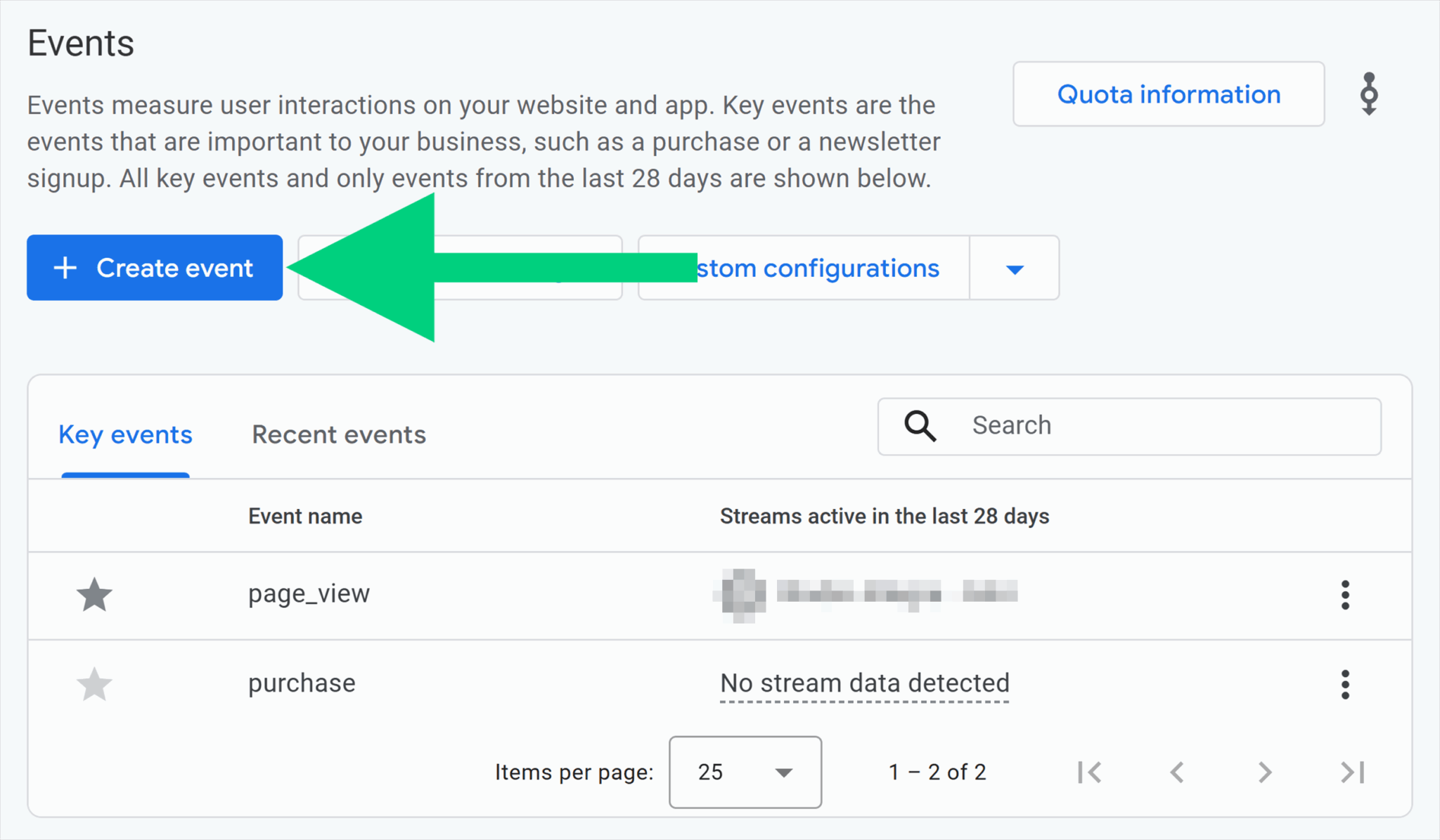
- Now you can name your custom event. Try to be as specific as possible here. In this case, since we’re creating this event for the /thank-you page, we’re using “page_view_thank_you.”

- Then fill out the parameters. We used “page_location,” or, in other words, the page’s URL. Just in case our site has multiple thank-you pages, we used “contains” here.

- Once you’ve filled in that information, click on “Create,” and now you have your new event.

Pro tip: An “event” in GA4 tracks general user actions like page views, clicks, or scrolls, while a “key event” measures crucial business goals, like a purchase or lead form submission.
- If you would like to make your “Event” a “Key event,” all you have to do is click on the star under “Key events,” and you’ve now turned that into a “Key event.”

- Now you can integrate your new key event into your MOFU tracking dashboard you made in the previous method. To do this, you’ll need to head back to “Path explorations.”
- Pull up the MOFU tracking dashboard you created in the basic setup.

- In your MOFU path exploration setup, navigate to the “+” next to “Metrics” under the “Variables” column.

- Select your newly made key event. Then click “Confirm.”

- Filter or segment your custom event to see how users move around your site after interacting with your MOFU content.

- Analyze these paths and interactions to see which piece of MOFU content is performing best.
While you’re reviewing this data, keep an eye out for:
- MOFU pages that frequently appear two to three pages before a final conversion: This tells you the types of MOFU content that perform best with your user base.
- How much time elapses between MOFU engagement and the final conversion: This shows you how long it typically takes for leads to move from interest to action, or in other words, how long your conversions should take.
- If users are visiting only one or multiple MOFU pages before converting: This tells you how well your internal linking strategy is working.
Pro tip: Set up custom events in GA for key MOFU interactions like “comparison table viewed” or “product guide downloaded” to get more granular with your tracking.
Monitor keyword movement in Semrush or Ahrefs
MOFU keyword success is about consistent visibility and gradual improvement. Though it can be fun to check your rankings manually on a daily basis, no one has time to do that long-term.
Instead, you should keep tracking your ranking improvements using a third-party tool like Semrush or Ahrefs—that way you can get alerts to celebrate when you break into the top three, or you know when you need to go back to the optimization drawing board to recover old rankings.
Here’s how to track keyword movements using Semrush:
- Log in to your account. You can either use the paid or free account to do this, though the free version will be much more limited.
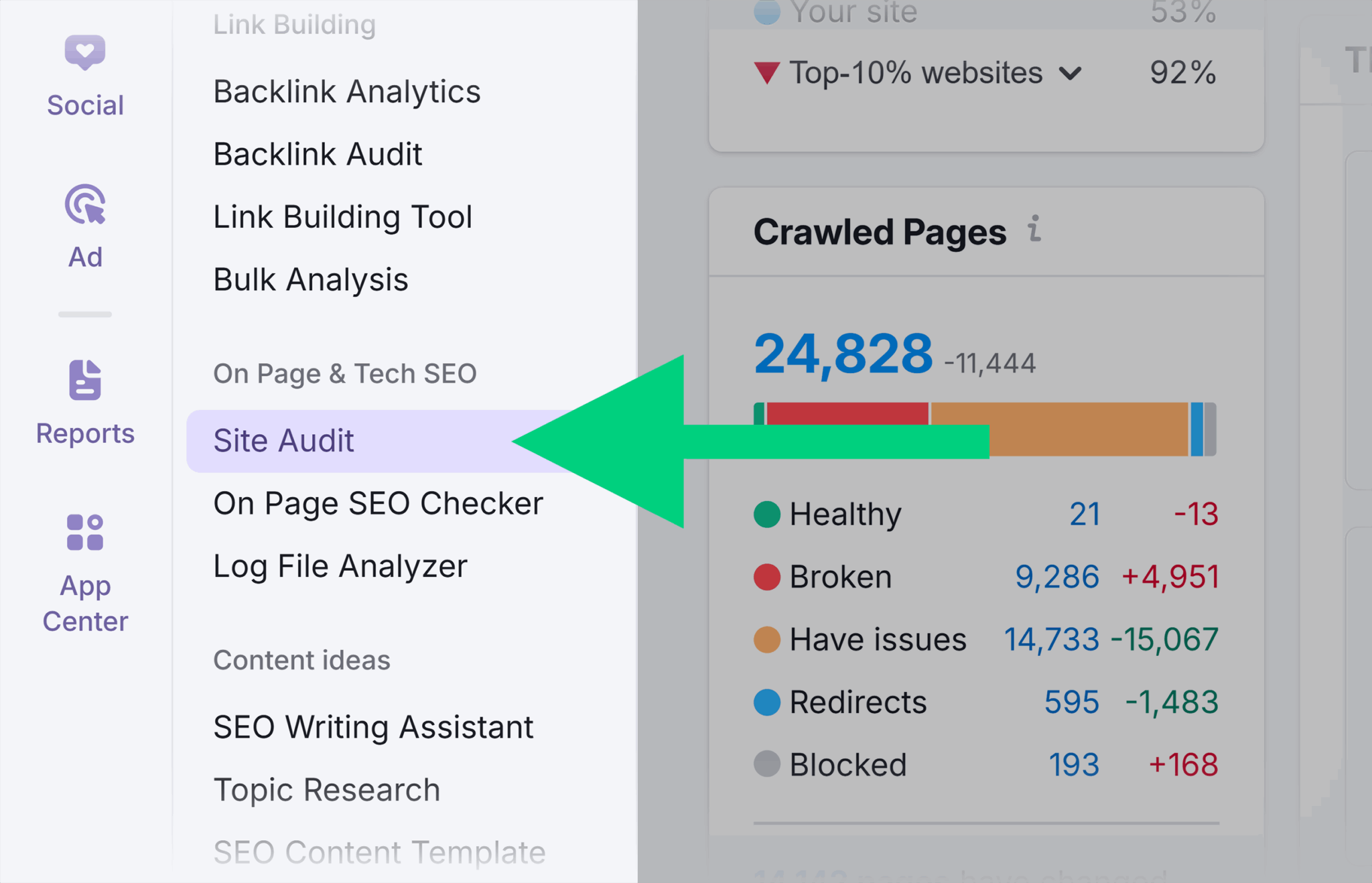
- Go to the sidebar navigation under “SEO.” Select “Site Audit.”
- Click on the blue “Create project” on the right side of the screen.
- Fill out the required information about your site’s domain. You can also specify how many pages and how often you’d like for the tool to crawl your site and review it for improvement opportunities. Once finished click “Start audit.”

- With your audit set up, you can now specify what keywords you want to track. Do this by navigating from the initial dashboard to the “Position tracking” section and click “Set up.”

- Here you can select the search engine, location, device, and, if you’re looking at keywords for a local business, business name for the local pack. Once you’ve provided that information, select “Continue To Keywords.”

- List all of the keywords you want to keep tabs on. You can also import keywords from an outside spreadsheet. Once you’ve finished adding everything, click “Start Tracking.”

Now you can get weekly ranking updates sent straight to your inbox.
And don’t just pay attention to rankings here. Keep an eye on other key metrics like:
- Visibility score: Tells you how often your page shows up in searches for keywords you care about. A high score means more people can find you.
- Featured snippet rankings: MOFU content will often trigger search engine result page features, or SERP features, like AI Overviews or the People Also Ask box.
- Competitor rankings: You can repeat this same process to keep an eye on how your competitors’ content is performing in comparison to your own.
Compare time on page and engagement rate to TOFU/BOFU
MOFU content will have different engagement patterns than other stages of the funnel.
Here’s what to expect when you compare it to your TOFU and BOFU content:
- MOFU content should have high time on page compared to TOFU content: People are actively evaluating, so they tend to read more carefully, and won’t just try to power through an article.
- MOFU content should have lower bounce rates: Unlike BOFU pages where users might see something they don’t like and leave immediately, MOFU users often linger.
- MOFU content should have increased page views per session: With the right internal linking strategy, MOFU users want to learn more, so they’ll often dig deeper into your site.
- MOFU content should have increased scroll depth: MOFU pages don’t push for immediate action like BOFU pages or encourage skimming like TOFU content, which is why MOFU users tend to scroll deeper as they weigh their options.
To make sure your MOFU content is performing well, keep an eye out for these red flags:
- Time on page for MOFU content is very similar to TOFU content: Might mean your content is too basic. Consider adding more in-depth guides or deeper insights to improve engagement.
- Very high bounce rate: Usually indicates an intent mismatch. Review your keywords and adjust content to match user search intent.
- Low scroll depth: Means your content isn’t engaging enough and you might need a stronger hook to encourage users to scroll deeper.
Watch influence on pipeline velocity (B2B) or AOV (B2C)
Pipeline velocity (how quickly leads move through your sales process) and average order volume (AOV, the typical value of a sale) is where MOFU content really proves its worth. Why? Because MOFU content is known for attracting higher quality users that convert faster and spend more.
The best way to put that theory to the test is by looking at these factors. We’ll break things up by B2C and B2B because things differ a bit here.
B2C metrics you should watch for:
- Average order volume: Do MOFU visitors spend more per transaction? If not, your content might not be effectively highlighting upsell opportunities or premium features.
- Purchase decision time: How much time passes between the first MOFU visit and the customer purchase? Longer times can indicate unclear messaging or another kind of friction that slows conversion.
- Product selection: Do MOFU visitors choose premium options more often? Low uptake often indicates your content isn’t doing the best job at showing off the value of higher-tier products.
- Cart abandonment: Do MOFU visitors complete purchases more often? High abandonment can tell you that you have confusing CTAs or missing trust signals.
B2B metrics you should watch for:
- Sales cycle length: How quickly do leads convert after consuming MOFU content versus leads that convert without consuming MOFU content? A slower than average cycle could mean your content isn’t properly addressing key objectives or user pain points.
- Deal size: Are MOFU-influenced deals larger than average? Smaller deals often indicate your content isn’t effectively demonstrating ROI or upsell opportunities.
- Sales qualification rates: Do leads created by MOFU content have better lead scores? Poor scores usually mean you’re not reaching the right people.
- Demo show rates: Are people who consume your MOFU content more likely to attend demos? Low attendance can indicate your content isn’t building enough interest or urgency.
Analyze contribution to multi-touch attribution models
Multi-touch attribution shows the full customer journey. This is especially important to review to understand MOFU impact because it shows you what pieces of content a user interacted with before they finally converted.
The key to a strong multi-touch attribution model is the right tools. Here are some of the best for attribution analysis:
- Google Analytics 4: Best for basic attribution modeling
- HubSpot: Best for B2B multi-touch attribution
- Adobe Analytics: Best for advanced attribution for enterprise organizations
- Bizible/Marketo: Best for B2B-focused attribution platforms
Once you have the right tool, you’ll want to decide which attribution model you should use (and yes, there’s more than one):
- Time decay: Gives more credit to touchpoints the closest to conversion. This model is especially useful if you want to optimize the “last touch” actions of a customer journey (e.g., the final email, retargeting ad, demo request).
- Position-driven: Gives the most credit to the first and last touchpoints. Use this model if you want to balance nurturing new leads while also tracking what seals the final conversion.
- Data-driven: Uses machine learning to assign credit based on your actual data. This model is powerful, but also requires substantial traffic to work well. If you have the numbers, it shows the value of each touchpoint in the customer journey, removing all guesswork.
As you’re setting up and reviewing the data pulled by these models, look out for data points on:
- Which MOFU content consistently appears in winning conversion paths
- The optimal number of MOFU touchpoints before conversion
- Which types of MOFU content lead to the most conversions
Use this information to inform what types of MOFU content you should continue to optimize and create for your future content calendar.
Track, optimize, and win in Google and AI search from one platform.
Putting MOFU keywords to work in your SEO strategy
Now for the final piece of the puzzle: How can you add MOFU to your already crammed-full SEO strategy?
The art of MOFU content is being helpful first, promotional second. Your goal here is to be so genuinely helpful, people think of your brand first when they’re finally ready to buy.
The best way to approach this is by:
Building topic clusters around MOFU themes. That means making comprehensive topics that cover all of the evaluation questions your audience might have. When it comes to coffee subscriptions, that means addressing everything from coffee, coffee makers, grinders, coffee subscriptions, etc.
You’ll also want to integrate your MOFU content with other content. Remember: your MOFU content should just be one step in a buyer’s journey. Use internal linking to make it easier for users to learn more about your BOFU pricing page or TOFU coffee maker explainer.
And don’t forget to prepare for a long-term investment. BOFU might get those immediate conversions and TOFU will get that traffic, but MOFU takes time to build authority. The leads you capture today from your MOFU content can take days, weeks—even months—to actually convert.
But MOFU content is just one piece of the massive SEO puzzle. Ready to dive deeper? Explore our guides on:
- Keyword research: Learn how to find the terms your audience is actually searching for so your MOFU content reaches the right people at the right time.
- Keyword difficulty: Understand how difficult it is to rank for your target terms so you can prioritize opportunities that give your content the best chance to rank.
- Technical SEO fundamentals: Before you can get your MOFU pages ranking, you need to be visible to search engines, and that all comes from the right technical set up.
- Metadata optimization: Create title tags and meta descriptions that help you better capture those clicks and conversions.


No comments:
Post a Comment