PBNs promise fast links—but at what cost? Learn how private blog networks work, why they’re risky, and what to consider before using them in SEO strategy.
Private blog networks, commonly called PBNs, can tank your search rankings.
These networks of closely connected websites use questionable tactics in an attempt to manipulate search engine results pages (SERPs). Because of that, they have long been a big target in Google’s crackdown on link spam and poor-quality content.
This guide shows how PBNs work, what makes them so risky, and what you can do if you find PBN backlinks pointing to your site.
What is a PBN?
A private blog network (PBN) is a group of websites created to pass link equity to a single site, often called the “money site.” These websites are all owned or controlled by the same person or company, and they exist primarily to manipulate search rankings.
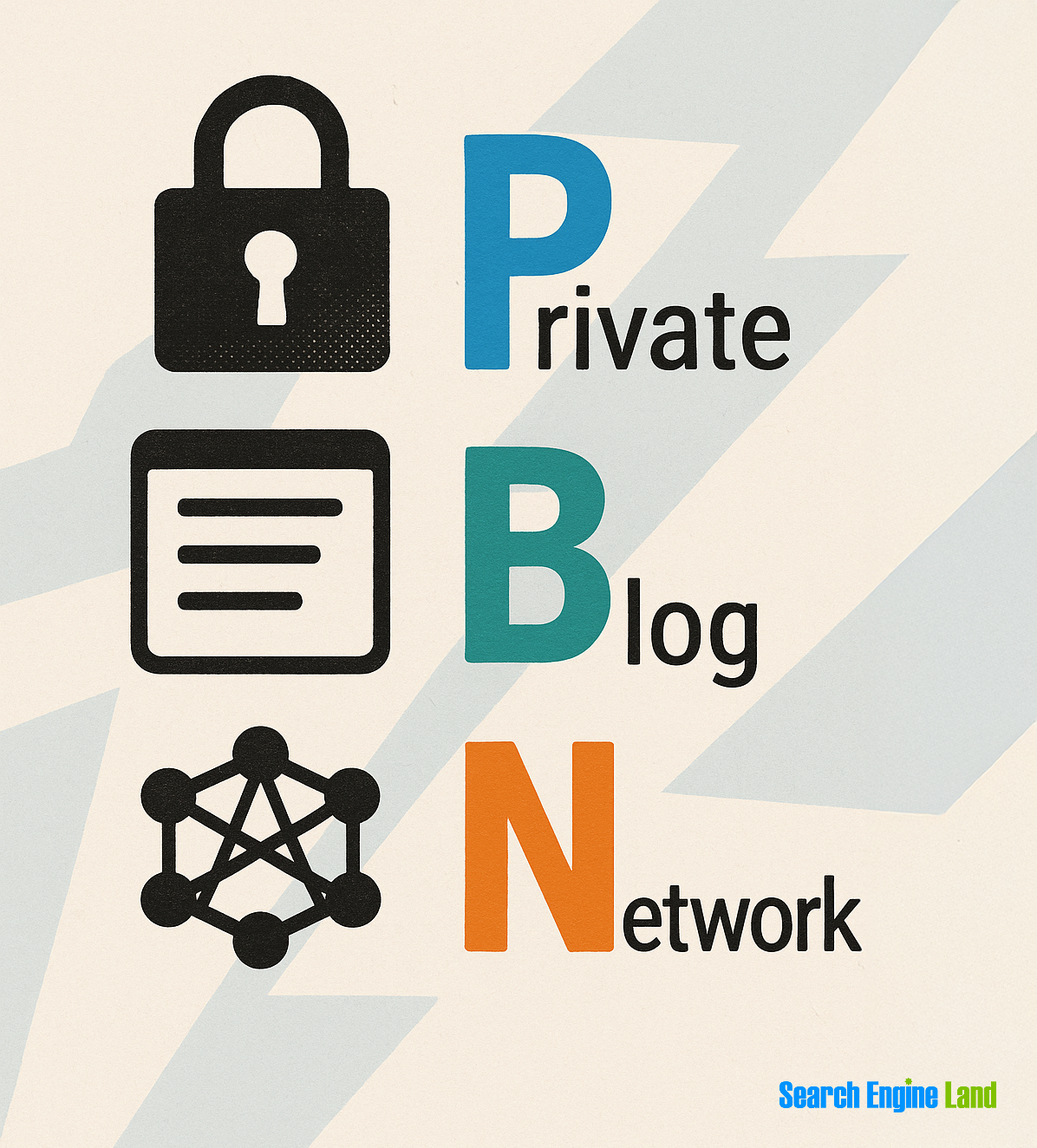
While PBNs may appear like ordinary websites on the surface, they’re structured to game the system. And while some legitimate website networks are also centrally owned, not every network is a PBN. The difference lies in their purpose and transparency.
Let’s break down what makes a PBN a PBN.
What makes a PBN a PBN?
A typical PBN shares three defining characteristics:
- Private ownership: All sites in the network are controlled by a single person or entity. Ownership details are often hidden using WHOIS privacy protection or anonymized registration services.
- Blog-based formats: Most PBNs are built on easy-to-use blogging platforms like WordPress, Blogger, or Weebly, allowing for quick publishing and easy control over backlinks.
- Interlinking structure: The sites are strategically linked to one another—and to a designated “money site”—to funnel link equity and manipulate search rankings.
Common traits of PBNs
Beyond those core attributes, most PBNs share a handful of recognizable patterns:
- Established domains: PBNs are often built on expired or auctioned domains with strong backlink profiles. Google’s spam policies note that acquired domains must contain content relevant to their original use—otherwise, they may be flagged as spam.
- Low-quality content: These sites typically publish generic, scraped, AI-generated, or duplicate content that provides little to no real value. In some cases, the content may be nonsensical or misleading.
- Hidden ownership: While the websites are accessible to the public (so Google can crawl them), identifying the actual owner is intentionally difficult.
- Suspicious link patterns: PBNs link to each other and often to unrelated high-authority websites in an attempt to appear credible. These links may violate Google’s spam policies, especially when they lack contextual relevance or use manipulative anchor text.
While these are common, not every PBN will have all of these traits. For example, some PBNs utilize free blog hosting platforms rather than purchasing expired domains, or they may have a mix of purchased domains and free hosting.
Other PBN sites may engage in additional problematic behaviors, like phishing or trying to infect users with malicious computer code, but that is less common.
Legitimate website networks are not PBNs
Not all website networks are PBNs. Networks that are open about their ownership connection—and whose primary purpose isn’t to manipulate search rankings for a single money site—are legitimate.
For example, a company like Ford maintains a central website and links out to authorized dealership sites. Those dealership sites may also link back to the Ford site.

This kind of structure is common and user-focused, helping people find relevant local information, not manipulate search results.
The difference is transparency and intent. When site connections are clear and designed to serve users, they’re not considered part of a PBN even if they share ownership.
Now that you’re familiar with what PBNs are (and aren’t), it’s time to look at how they operate.
The SEO toolkit you know, plus the AI visibility data you need.

How do PBNs work?
PBNs are designed to manipulate link equity.
Here’s how: Each site in the network earns backlinks—some naturally, some from within the network itself. Then, those sites link to a single destination: the “money site.”
This results in all the SEO value from the supporting sites (or “nodes”) getting funneled into that one target. The goal is to boost the money site’s rankings quickly, without having to earn links organically.

Why PBNs target “link equity”
Link equity (sometimes called “link juice”) is a long-standing SEO concept. It comes from PageRank, Google’s original algorithm for scoring websites based on the number and quality of backlinks.
The higher a page’s PageRank, the more valuable it appeared in search, and the better it ranked.
Note: PageRank hasn’t disappeared. While it’s no longer visible to the public and has evolved significantly since its 2006 overhaul, link equity remains a core signal in Google’s algorithm.
The problem with link equity manipulation
Once SEOs understood how powerful backlinks could be, some began using shady tactics to speed things up. Examples included:
- Posting backlinks in forums, blog comments, and other user-generated content
- Embedding links in widgets, templates, or site-wide footers
- Submitting sites to directories, blog rolls, and link lists
- Buying expired domains with strong backlink profiles, then adding thin or spammy content
- Paying directly for backlinks
Not all of these link-building techniques are inherently bad. Used thoughtfully, directories or guest comments can play a legitimate role in SEO.
But when these methods are used only to manipulate rankings—and not to help users—Google considers them link spam.
How PBNs evolved
As Google cracked down on individual tactics, SEOs got smarter about hiding their efforts. That’s when PBNs became a favored workaround.
Instead of leaving links scattered across the internet, SEOs built their own networks. Full control. No gatekeepers.
This approach made it easier to:
- Control anchor text
- Manage link velocity
- Scale backlinks across multiple domains
But it also created patterns—patterns Google would eventually learn to detect.
Further reading: What is link equity and why does it still matter in an AI landscape?
Why do people use PBNs?
Like most shortcuts, PBNs promise fast results.
They offer SEOs complete control over where links appear, how fast they’re added, and what anchor text they use. For some, that’s worth the risk, especially in competitive niches or under tight deadlines.
And while PBNs were once effective, today they’re mostly ineffective at best—and dangerous at worst.
Let’s break down the most persistent myths still driving their use.
Myth #1: PBNs provide backlink control

Control is one of the biggest reasons people build PBNs.
You get to decide:
- Where the link goes
- What anchor text it uses
- How quickly you build links, also known as link velocity
Sounds strategic, right?
But the reality is that link placement doesn’t guarantee link value.
Google evaluates context, source quality, and relevance. Even if you control everything, it still decides how much—if any—value that link passes.
If Google detects manipulation, the penalty outweighs the control.
Reality: Google controls a backlink’s value. If Google thinks a site is being manipulative, it’ll rank the site lower in the SERPs or restrict it from appearing altogether.
Myth #2: PBNs allow faster link building

It’s true: a PBN lets you spin up backlinks quickly.
That early boost might nudge a new site up the rankings temporarily.
But “fast” isn’t always good. When it comes to link-building efforts, it’s more important to demonstrate a steady link velocity.
Think about it this way:
- If you publish a page that gets a lot of links right away, and then the links stop coming, Google will think that page is no longer relevant or helpful.
- However, if you publish a page that continues earning more and more links the longer it’s live, Google will see that page as having long-term value and usefulness.
When it comes to a website’s backlink profile, it’s important to get links from a diverse array of domains. Getting backlinks from only the same domains over and over will likely signal to Google that something sketchy is going on.
Google rewards consistency over speed. A sharp spike in backlinks, followed by silence, is a red flag. A slow, steady stream of natural links? That’s what Google trusts.
Reality: Proper SEO takes months and requires steady backlink acquisition.
Dig deeper: Link building in 2025: 12 ways to win or fail
Myth #3: PBNs excel at ranking low-competition keywords

Maybe PBNs aren’t the best option for high-difficulty keywords. But what about keywords with low competition?
Keyword difficulty is a concept based on two factors:
- Search volume: How many people are searching for the keyword each month?
- Search intent: How transactional is the user intent behind the query?
A rough rule of thumb is that keywords with higher volume and more transactional intent tend to be harder to rank highly in search results.

Because of this, many websites try to rank for low-volume, low-difficulty terms related to their products and industry. These terms are often referred to as “long-tail” keywords.
There’s a tenacious belief that PBNs are great for quickly ranking these long-tail, low-competition keywords. Pulling in lots of traffic from these low-competition keywords can then help the money site rank for bigger, more competitive queries—or so the theory goes.
Reality: Low-competition keywords are easier to rank for by definition, and targeting such terms can be a good way for new and unestablished sites to start earning links and ranking. In the long run, however, it’s best to go after terms with varying levels of search volume and intent to attract visitors at different stages of the customer journey.
Myth #4: PBNs are necessary for affiliate and local SEO

Some posters in the seedier SEO forums still claim that PBNs are essential for certain types of ecommerce, including affiliate marketing and local business promotion.
Affiliate marketing, in particular, has long been a source of many spammy SEO tactics, not just PBNs. Some types of affiliate programs are worse than others, though, especially those in “Your Money, Your Life” (YMYL) spaces.
A few examples of YMYL topics that overlap with affiliate marketing are:
- Health supplements
- Cryptocurrency
- Courses on how to live, how to stay healthy, or how to manage your money
To be clear, none of those YMYL topics are inherently bad. These topics involve high-stakes decisions that require more scrutiny. And unfortunately, because they can be used to prey on people’s insecurities, fears, and frustrations, these topics tend to attract people who are willing to bend or break ethical boundaries to get clicks and transactions.
When it comes to local SEO, the considerations are a little different. In most cases, local business owners want to do the right thing, but their expertise is related to their business, not SEO.
In such cases, local businesses may be poorly informed or hire an SEO specialist who doesn’t have enough experience to understand the harm PBNs can do.
The common link between affiliate programs, local SEO, and other crowded ecommerce spaces is the belief that PBNs are the best way—perhaps even the only way—to stand out in a crowded field.
- Affiliate marketers work against not only others in the same affiliate network, but also sellers in other affiliate networks, big retailers, and even direct-to-consumer (D2C, B2B, etc.).
- Local businesses compete against other local businesses, including big-box brick-and-mortar stores, as well as online companies that deliver within their service area.
To exacerbate the issue, these types of businesses are often run by individuals with multiple priorities who feel they lack the time, energy, or resources to invest in longer-term solutions. So the promise of PBNs becomes very appealing.
Reality: SEO value tends to correspond to the quality of the time and effort put into it. Both affiliate marketers and local businesses are best served by optimizing and promoting a single site for long-term SEO value, rather than building up a network of private sites with thin content and outdated backlinking practices.
PBNs violate Google’s Webmaster Quality Guidelines
PBNs violate several of Google’s core policies, particularly those related to link spam and content quality.
Google first issued widespread manual actions against PBNs in 2014, and its detection systems have only grown more sophisticated since then. Today, PBN tactics fall squarely within Google’s definition of search manipulation.
Link spam practices common in PBNs:
- Link exchanges: By definition, most (if not all) PBNs engage in excessive link exchanges, which Google defines as a form of link spam.
- Programmatic linking: Using an automated linking software to create backlinks to your website is prohibited by Google. Many PBNs automate adding backlinks to their money site across their node websites.
- Hidden links: PBNs are known for trying to hide links to their money site from users, while making sure search engines can find those links for ranking purposes.
- Template and widget links: PBNs often use the same or slightly modified templates and design elements. These may include links in template areas or widgets that all point to a single money site in violation of Google policies.
- Expired domain abuse: As mentioned above, purchasing expired domains with healthy backlink profiles is a key tactic used by PBNs. Websites that contain content or links that don’t align with the domain name are considered untrustworthy. Many domains used by PBNs have fallen afoul of this policy.
Content spam tactics used in PBNs:
- Doorway abuse: A “doorway” page essentially exists to capture search traffic and link value, and then funnel them to another page. The doorway page itself has very little useful content. Funneling traffic and link equity in this way is the primary purpose of a PBN, and many PBNs consist of many doorway pages.
- Low-value content: Google wants to see helpful content. Content that’s scraped from other websites, generated by AI without human oversight, or completely nonsensical will be considered spam.
- Hidden text: Some PBNs use website layout and styling (CSS) to add text that will only be seen by search engines in order to rank for certain keywords.
- Keyword stuffing: Using a single keyword over and over, perhaps accompanied by close variations, is a common tactic to try to rank for that keyword. PBNs often engage in keyword stuffing, especially on pages meant to pass link equity for specific terms to their money page.
- Thin affiliate content: Similar to scraped content, thin affiliate content uses product copy, customer reviews, and other marketing text from the original manufacturer, merchant, or ecommerce site with very few changes or additional context. Affiliate-based PBNs may try to hide this tactic by stitching together content from different sources, while making only minor changes to it.
While these tactics aren’t exclusive to PBNs, most PBNs rely on several—if not all—of them. Ultimately, it’s not just the tactic that matters. It’s the intent to manipulate rankings that places PBNs squarely in violation of Google’s spam policies.
How does Google detect PBNs?
Google doesn’t have a single system that flags “PBNs” by name. But it does detect link schemes, and PBNs often trigger multiple red flags across its detection systems.
Here are some of the key signals Google uses to identify potential PBN activity:

Shared IP addresses and common hosting providers
Having the same IP address doesn’t always indicate a PBN. But it’s pretty easy to spot a bunch of domains using the same IP address. This is especially true when all the PBN sites link to each other but barely link to any sites outside the network.
Using the same hosting provider can be another indication of a PBN, again, especially when the sites only (or mostly) link to each other. This may go hand-in-hand with shared IP addresses, but it might also be spread across an IP range or subnet.
Tracking code reuse
Tracking codes used for analytics, ad platforms, affiliate networks, and similar programs and tools are traceable by design.
Google can obviously track the IDs it issues under its own programs like Google Analytics (GA4), Google Ads, Google AdSense, and others. It can also identify similar tracking codes from other analytics tools, ad networks, affiliate programs, and so forth.
When multiple sites use the same tracking codes in their links and HTML source code, it becomes fairly easy to identify those that belong to the same PBN.
Repetitive RDAP (formerly WHOIS) data
The Registration Data Access Protocol (RDAP) provides information about domain name registration. It replaced the similar WHOIS protocol in January 2025, though some domain name registrars still maintain WHOIS data.
Both RDAP and WHOIS lookups can reveal the owners behind suspected PBNs. For example, multiple domains registered by the same person or company could be a PBN indicator, especially when combined with other red flags mentioned above.
While RDAP and WHOIS lookups can be useful, they’re not always helpful, since some domain registrars offer privacy services that hide domain ownership details.
Minimal traffic and user engagement
PBN nodes are designed to attract a few users, with minimal engagement from those users who do visit. Instead, they aim to direct users and link value to the money site.
Google can track this traffic and engagement through tools like GA4 and AdSense. For sites that don’t use Google tracking codes, Google can look at things like click-through rate (CTR) on search impressions to estimate traffic.
Sites with very low visits and engagement can point to poor-quality content, poor UX, or other indications of being a PBN.
Manual review of potential spam sites
Google employees manually review websites to rate their quality. One of the things they look for is potential spam.
The Search Quality Rater Guidelines (PDF) contain information about exactly what Google employees look for, including more detailed explanations of the spam policies mentioned above.
Manual reviews of spam websites happen as a normal course of Google’s quality control efforts. However, people can also report spam directly, which can prompt a manual review.
Link spam updates and link graph modeling
Google makes thousands of algorithm updates each year. Many of these are small tweaks and tests to SERP displays.
Others are significant changes to the algorithm that can cause the rankings to change monumentally. For example, in December 2022, Google began a major link spam update to its algorithm. The update was so significant that it took almost a month to complete.
That update referenced new functionality to the part of the algorithm known as “SpamBrain.” Launched in 2018, SpamBrain is an AI-powered tool focused on reducing the amount of spam pages that make it into search results.
Some of the things SpamBrain looks at are:
- Identifying spam sites and networks
- Discovering hacked sites and pages
- Reducing nonsensical and gibberish pages
The details of SpamBrain’s functionality are not public. However, it’s long been known that Google uses a “link graph” (sometimes called a “web-link graph” or “web graph”) to model the relationships between various websites.
With a link graph, Google is able to identify closely related sites and pages. And depending on how closely affiliated those sites are, it can do things like change how those sites appear in search results or reduce the value of their outgoing links.
PBNs may have evolved in appearance, but their underlying tactics are well known to Google. With the help of AI systems like SpamBrain and years of manual refinement, PBNs have become easier—not harder—to detect and devalue.
Risks associated with private blog networks
PBNs may seem like a harmless experiment, especially if you’re chasing fast results. But the reality is, they carry significant risks that can undo months of legitimate SEO work.
Here’s what’s at stake.
Wasted investment
The ineffectiveness of using PBNs is part of the risk.
Why waste time, effort, and money on something that rarely works?
SEO budgets are typically stretched thin enough to begin with. Instead, put those resources into productive SEO activities like:
- Building out your content marketing strategy
- Adapting your content for Generative Engine Optimization (GEO)
- Improving your site’s technical SEO signals
Short-term gain, long-term instability
A brand new PBN could give your money site a little boost initially.
That is, until Google detects it. And you likely won’t be aware of when the search engine discovers your attempt to fool it.
SEOs like to talk about “quick wins.” And while it’s true that there are ways to move the needle a little bit in the short term, the fact is that such tasks are mere stepping stones to longer-term strategies.
Don’t go after tactics whose value could be wiped out overnight. Instead, prioritize your SEO efforts in ways that will stabilize your ability to rank over the long haul.
Algorithmic demotion
Regaining a fallen SERP position is difficult at any time. It’s even more difficult when Google identifies a page, site, or network as being spammy.
Google’s spam-detection algorithms are trained to quickly push poor-quality content down in the search results. Any value you got from an early PBN boost will be wiped away quickly, and the spammy sites can cause your money site to fall by association.
It’s possible to recover from this sort of algorithmic demotion, but it takes a lot of time and effort. It’s best to avoid this problem altogether and follow good SEO content practices from the beginning.
Manual actions and deindexation
If a site is determined to be part of a PBN, Google may issue a manual action, which can reduce your site’s ability to rank.
A manual action may also result in deindexation—that is, the complete removal of your site from Google’s index.
Some of the manual actions related to PBNs are:
- User-generated spam
- Spammy-free host
- Unnatural links (to or from the website)
- Thin content
- Major spam problems
- Hidden text or keyword stuffing
To have a manual action removed, the website owner needs to correct all of the problems listed in the manual action report and submit a reconsideration request via Google Search Console. Reconsideration can take weeks or months, and there’s no guarantee your site will be indexed again.
Inability to pass E-E-A-T signals
PBNs fail to signal E-E-A-T (i.e., Experience, Expertise, Authority, and Trust). This means they also don’t provide E-E-A-T value for the money site they link to.
Google attempts to measure E-E-A-T in various ways:
- User engagement metrics such as CTR, time on site, and scroll depth
- Quality ratings as reported by its Search Quality Raters, especially in relation to E-E-A-T factors
- Backlink quality from other domains that demonstrate E-E-A-T principles
Having good E-E-A-T signals is important for any website. However, Google requires an even higher level of E-E-A-T for YMYL content, which many PBNs contain. (See “PBN Myth #4” above for more on PBNs and YMYL.)
Reputational damage
If Google can find your site, so can others. And once you’re outed, it can take a lot of time and effort to restore your reputation.
This can be true even when it’s another party building and maintaining the PBNs. For example:
- SEO agencies that build PBNs may do so without their clients’ knowledge or consent. This can put the client at risk, even though they aren’t involved.
- Clients can harm legitimate agencies they hire by working with a second, unscrupulous agency on the side, or even attempting to build a PBN on their own.
In SEO, your reputation is hard-won and easy to lose. Association with shady tactics isn’t worth the risk.
What to do if you have PBN links pointing to your site
You don’t have to use PBNs to be affected by them. Sometimes, they’ll link to your content to mask their true purpose.
If you discover PBN backlinks in your profile, you have three options:

1. Do nothing
Most of the time, Google is good at ignoring low-quality backlinks. Unless the links are extreme in volume or associated with a manual action, you don’t need to intervene.
Google itself recommends this passive approach in most cases.
2. Request link removal
If you can identify the owner of the PBN (unlikely, but possible), you can ask them to remove the links.
But be prepared: PBN owners usually hide behind privacy services and fake identities. You may never reach a real person.
3. Disavow the links
Use Google Search Console’s disavow tool only if:
- You’ve received a manual action for unnatural links
- You see a pattern of toxic backlinks that clearly impact your rankings
Disavowing links won’t instantly reverse damage, but it can be a necessary step in recovering from penalties.
Follow our guide on disavowing backlinks to learn how to do it correctly.
What to do if a stakeholder insists on PBNs
Sometimes, despite knowing the risks, your boss or client still wants to try PBNs. Here’s how to push back with data, logic, and values.
Emphasize how fast Google catches spam
According to Google, its automated systems find 40 billion pages worth of spam every day.
40 billion pages. In one day. Every day.
The chances of building a PBN that passes link value to your website before Google finds it are almost zero.
In fact, the risk of receiving a manual penalty against your website because of a PBN is much higher than the likelihood that the PBN will help your website rank.
Focus on the return on investment (ROI)
Money talks. And when it’s being wasted on PBNs, people tend to listen.
Even when seeded with cheap, poorly written blog posts, scraped content, and generative AI text, PBNs still cost money to set up and run.
Some of those costs include:
- Finding and purchasing domain names
- Customizing content management systems and templates
- Loading and coding the content
- Adding the right backlinks
- Initializing monitoring tools
All the money spent on PBNs will go to waste immediately if Google penalizes the domains in the network. In that instance, the ROI will effectively be zero.
In contrast, a great piece of content will lead to more traffic and conversions as it rises to the top of the SERPs, even though it costs more to create.
Focusing your efforts on building fewer pieces of content that target the right keywords and audience will offer a much higher ROI in the long run.
Connect to values and reputation
If wasted effort and low ROI aren’t enough, appeal to brand values and reputation.
Many businesses have a set of core values, principles, or other beliefs that guide how employees—up to and including the owner(s)—are expected to operate.
Here are some example core values and how you can use them to discuss the risks of PBNs:
- Transparency: “Because they are so manipulative, PBNs are seen as a shady practice by most reputable SEO professionals. If our use of PBNs became public, it could erode the trust of customers, business partners, shareholders, and the general public.”
- Customer focus: “PBNs are inherently anti-customer, because they use spammy content and link practices to gain traffic and link equity. Our time would be better spent building useful content on our main website that’s useful for both existing and prospective customers.”
There are far too many potential core values a company could have to list them all here. Hopefully, these examples and the information you’ve learned in this guide can help you make similar arguments for the values held by your company or your clients.
SEO decisions reflect the company behind them. Make sure those decisions align with what your brand says it stands for.
How to get links the right way
PBNs are shortcuts. But in SEO, real authority comes from real value.
If you want to earn links that improve rankings, focus on strategies that scale:
- Publish original research or data
- Build useful tools or calculators
- Contribute expert insights to industry publications
- Create content that answers real questions better than anyone else


No comments:
Post a Comment