Payment of ₹ requested by HONEY VIG. Click the link to pay securely via Razorpay: Make 5000 payment Payment of ₹ requested by HONEY VIG. Click the link to pay securely via Razorpay: Make 5000 payment ⭐ If you would like to buy me a coffee, well thank you very much that is mega kind! : https://www.buymeacoffee.com/honeyvig
Hire a web Developer and Designer to upgrade and boost your online presence with cutting edge Technologies
Showing posts with label SEO. Show all posts

Friday, March 6, 2026

The Bird's Eye in the Age of Algorithms :Why Freelancers and Solopreneurs Need Clarity More Than Reach


A few days ago, I was watching yet another discussion about LinkedIn.

The comments were predictable.

"Reach is dead."

"LinkedIn wants everyone to pay."

"Engagement pods don't work anymore."

"The algorithm is against small creators."

And as I scrolled through those conversations, I was reminded of a story many of us grew up hearing.

The story of Arjuna.


What Do You See?

Guru Dronacharya gathered his students and pointed toward a bird sitting on a tree.

He asked each student the same question.

"What do you see?"

One replied:

"I see the tree."

Another said:

"I see the branches and leaves."

A third answered:

"I see the bird."

Then Arjuna stepped forward.

"What do you see?"

Arjuna replied:

"I see only the eye of the bird."

Nothing else.

Not the tree.

Not the leaves.

Not the distractions.

Only the target.

And that is why he succeeded.


Today's LinkedIn Feels Like That Tree

Right now, most professionals on LinkedIn are looking at everything except the target.

Some are staring at impressions.

Some are staring at follower counts.

Some are staring at engagement rates.

Some are staring at algorithm updates.

Some are staring at what LinkedIn is doing next.

And yes, LinkedIn is changing.

Let's be honest.

The signs are visible.

We are seeing:

  • Personal post boosting
  • More emphasis on video
  • Creator monetization initiatives
  • Better detection of artificial engagement
  • Reduced effectiveness of engagement pods
  • More opportunities for paid amplification

None of this should surprise us.

Every platform eventually moves in this direction.

Facebook did.

Instagram did.

YouTube did.

LinkedIn is not a charity.

It's a business.

And businesses optimize for revenue.


The Mistake Most Creators Are Making

Many people are treating LinkedIn like they own it.

They don't.

None of us do.

LinkedIn can change its algorithm tomorrow.

It can introduce new visibility rules next month.

It can prioritize video over text next year.

And there is very little we can do about it.

Yet I see freelancers spending hours discussing platform changes while spending very little time discussing customer problems.

Think about that for a moment.

The platform is becoming the focus.

The audience is becoming secondary.

That's the opposite of how businesses grow.


What Is Your Bird's Eye?

This is the question every freelancer and solopreneur should ask themselves today.

Why are you on LinkedIn?

Not the motivational answer.

The real answer.

Are you here to:

  • Get clients?
  • Build authority?
  • Create opportunities?
  • Grow a personal brand?
  • Build a community?
  • Create partnerships?
  • Generate leads?

Because your answer changes everything.

If your goal is getting clients, then impressions are not the target.

If your goal is building authority, then likes are not the target.

If your goal is creating opportunities, then follower count is not the target.

These are merely indicators.

The target is different.
Arjuna understood this.
Most creators don't.

Freshers Should Stop Panicking

One concern I keep hearing is:

"What about people who can't afford ads?"

My answer may surprise you.

Most freshers do not need ads.

At least not yet.

The majority of people struggling on LinkedIn are not struggling because they lack ad budgets.

They are struggling because they lack clarity.

Many haven't defined:

  • Who they help
  • What problem they solve
  • Why someone should trust them
  • What makes them different

Without those answers, paid promotion simply amplifies confusion.

Imagine putting a loudspeaker in front of someone who doesn't know what they want to say.

The problem isn't volume.

The problem is the message.


The Hidden Opportunity Most People Are Missing

While many creators are worrying about reach, something more important is happening.

LinkedIn appears to be rewarding relevance.

For years, people found shortcuts.

Engagement pods.

Comment exchanges.

Artificial interactions.

"Comment YES and I'll send it."

"DM me for the secret."

Vanity metrics became the game.

But platforms eventually learn.

Because their users demand better experiences.

If LinkedIn is genuinely trying to identify authentic engagement and reduce manipulation, that is actually good news for professionals who have expertise.

Good news for consultants.

Good news for freelancers.

Good news for solopreneurs.

Good news for people who are willing to earn trust instead of manufacturing popularity.


The Difference Between Starting and Scaling

This is where I think many creators get confused.

Starting and scaling are different games.

When you're starting:

You need:

  • Clarity
  • Consistency
  • Conversations
  • Credibility

That's it.

Twenty relevant people engaging with your content are more valuable than two thousand random impressions.

But once you understand:

  • Your audience
  • Your messaging
  • Your positioning
  • Your offer

Then scaling becomes important.

And scaling may include paid promotion.

There's nothing wrong with that.

In fact, it may become increasingly necessary.

The problem isn't paid reach.

The problem is trying to scale before you've built something worth scaling.


The Future Belongs to Adaptable Professionals

History rewards adaptation.
Not resistance.
The businesses that survived industrial revolutions adapted.
The professionals who survived technological shifts adapted.
The creators who survived every algorithm update adapted.

The same principle applies today.

The freelancers who win over the next few years won't necessarily be the people with the biggest audiences.

They will be the people who understand where attention is moving and position themselves accordingly.

They will learn video.

They will learn storytelling.

They will build communities.

They will experiment.

And when the platform changes, they won't complain endlessly.

They'll adjust.


One Final Thought

When Dronacharya asked his students what they could see, the answer revealed something deeper than eyesight.

It revealed focus.

Today, LinkedIn is the tree.

The algorithm is the leaves.

The engagement pods are the branches.

The impressions are the bird.

But your business goals?

Those are the eye.

And the professionals who continue to grow, regardless of what LinkedIn changes next, will be the ones who keep their attention fixed on the target.

Because platforms change.

Features change.

Algorithms change.

But the fundamentals never do.

People still buy from people they trust.

And trust is still built one meaningful interaction at a time.

The question isn't whether LinkedIn is changing.

The question is whether you're looking at the tree... or the eye.

Saturday, February 28, 2026

AI-Driven Product SEO: Automated Optimization & User Journey Mapping


AI is no longer just helping brands rank higher.

It’s helping them sell smarter. 🚀

For SaaS and Ecommerce leaders, the real shift isn’t about keywords - it’s about AI connecting product visibility, inventory signals, and user journey insights into one optimization loop.

This is where AI-Driven Product SEO changes the game.

The Problem: SEO Is Still Siloed

Most product SEO strategies still operate in fragments:

  • SEO teams optimize metadata.
  • Merchandising teams manage inventory.
  • CRO teams tweak landing pages.
  • Data teams analyze churn.

But today’s AI search engines - including generative platforms - reward holistic signals, not isolated tactics.

If your product content ranks but:

  • Inventory is low ❌
  • Reviews are outdated ❌
  • Pricing signals are inconsistent ❌
  • FAQs don’t match buyer intent ❌

You lose conversions and AI visibility.

The Shift: AI as a Product Optimization Engine

Modern AI doesn’t just suggest keywords.

It can simultaneously analyze:

1️⃣ Search Intent + Behavioral Signals

AI clusters:

  • Transactional intent
  • Comparative queries
  • Post-purchase concerns
  • Churn triggers

Then aligns product descriptions, FAQs, schema, and internal linking accordingly.

Result: Higher query match accuracy in AI Overviews & LLM results.

2️⃣ Inventory & Demand Signals

AI integrates:

  • Stock availability
  • Seasonal velocity
  • Return rates
  • Refund reasons

And dynamically adjusts:

  • Featured products
  • Page prominence
  • Internal anchor priorities
  • Product snippet structures

This prevents sending paid and organic traffic to low-margin or high-return SKUs.

That’s not just SEO. That’s margin optimization.

3️⃣ User Journey Mapping in Real-Time

AI models can now map:

Search Query → Product Page → Engagement → Add to Cart → Post-Purchase → Returns → Repeat Behavior

When connected correctly, this allows:

  • Pre-purchase objection handling
  • Better FAQ structuring
  • Clearer sizing/spec guidance
  • Churn-reducing content modules

SEO becomes predictive - not reactive.

Why This Matters for AI Search (AEO + GEO)

Platforms like generative search engines don’t just rank pages.

They extract:

  • Structured answers
  • Product specs
  • Trust indicators
  • Review sentiment
  • Entity relationships

If your product pages lack structured clarity, AI may cite your competitor instead - even if you rank organically.

That’s where Automated Product SEO becomes critical.

The Business Impact 📊

When AI connects optimization with business data:

✅ Higher conversion rates

✅ Lower return rates

✅ Better product-market alignment

✅ Reduced churn

✅ Stronger AI citation probability

✅ Improved LTV per customer

This is Revenue-Driven SEO, not vanity traffic growth.

Enterprise & Startup Opportunity

For startups:

  • Automate scaling without bloated teams
  • Compete with enterprise brands through structured intelligence

For enterprises:

  • Unify SEO, merchandising, and analytics
  • Deploy predictive content updates at scale

The advantage goes to brands that treat product SEO as a dynamic system, not a static checklist.

What AI-Driven Product SEO Actually Looks Like

It includes:

  • Automated schema refinement
  • Dynamic meta updates based on demand shifts
  • AI-optimized FAQ blocks aligned with churn insights
  • Behavioral data-informed internal linking
  • Intent-cluster-based product content frameworks
  • GEO optimization for AI answer engines

This is where SEO, AEO, and GEO converge.

The Future: Optimization That Learns

The next evolution isn’t “better keyword research.”

It’s:

👉 Content that adapts to buyer behavior

👉 Product pages that update with real-time signals

👉 AI that flags churn risks before customers leave

👉 SEO strategies aligned with revenue, not impressions

If your product SEO isn’t tied to lifecycle analytics, you’re optimizing for yesterday’s search engine.


Final Thought

In 2026 and beyond, the brands that win won’t be the ones with the most traffic.

They’ll be the ones with the most intelligent product ecosystems.

AI-driven optimization is no longer optional. It’s your conversion engine. ⚙️

Ready to See Where You Stand?

If you’re a SaaS or Ecommerce leader serious about:

  • AI visibility
  • Conversion growth
  • Reduced churn
  • Revenue-aligned SEO

Request a comprehensive SEO / AEO / GEO Product Audit.

We’ll show you:

✔ Where AI engines are (or aren’t) citing you

✔ Which product pages leak revenue

✔ How automation can drive measurable growth

Let’s build product SEO that actually drives business outcomes. 🚀

#AISEO #ProductSEO #EcommerceGrowth #SaaSMarketing #AEO #GenerativeSearch #ConversionOptimization #DigitalCommerce #AIVisibility #RevenueGrowth

Saturday, February 7, 2026

Google Ads Masterclass: Local search strategies that convert


Local search ads are about more than visibility — they’re about being the first choice when high-intent customers are ready to call. But for marketers, managing these campaigns at scale can be challenging. From competing in crowded categories to closing tracking gaps and proving ROAS, local search requires a different approach to connect intent with real business results.

In this Google Ads Masterclass, our experts will share best practices for turning local searches into appointments and sales. The session will cover strategies for optimizing campaigns, tracking every phone lead, and reducing wasted spend — with practical examples from multi-location and franchise businesses.

Attendees will learn how to:

  • Optimize Google Ads for local intent and high-converting traffic
  • Get credit for every phone lead and conversion to prove ROAS
  • Scale local campaigns across multi-location and franchise businesses
  • Reduce missed calls and convert more phone leads into customers or patients

Save your spot to learn how to make your local Google Ads budget go further — and drive measurable results.

Tuesday, December 30, 2025

Meta unveils Business AI and new generative tools


Meta’s AI updates help with creatives, AI generated music, business assistant and more promise to make advertising more personalized.

Meta unveiled new AI products – including a “Business AI” concierge, generative video, and creative tools – designed to help advertisers scale faster and more efficiently.

Driving the news. The centerpiece is Business AI, an always-on sales agent that guides customers from discovery to purchase across Meta ads, messaging apps, and websites. It learns from posts and campaigns to deliver personalized responses. No coding or setup is required.

Download

Meta also introduced new generative AI tools for video that help advertisers create more immersive content, including AI-generated music, multilingual dubbing, and HDR video.

Screenshot 2025 10 02 At 19.54.00 Scaled

Shoppers may soon be able to upload a photo to see how clothing from an ad looks on them, part of Meta’s push to inspire purchase confidence.

Download 1

And for marketers leaning into creator partnerships, Meta expanded its APIs to make finding, vetting, and scaling creator content easier. Businesses will be able to turn organic creator posts into optimized partnership ads with fewer steps.

Finally, Meta previewed the Meta AI business assistant, a 24/7 chat tool inside Ads Manager and Business Support that helps advertisers optimize campaigns and resolve account issues in real time.

Why we care. Meta is making advanced AI easier and cheaper to use, rolling out tools like Business AI and generative video to help brands personalize campaigns, build immersive experiences, and work more smoothly with creators. The goal is quicker, lower-cost conversions in a crowded market – but how well it works will come down to the test results.

What’s next. Business AI is already available to eligible U.S. businesses, with global expansion coming in 2026. Generative AI features are rolling out across Advantage+ creative tools. Meta’s business assistant will expand beyond small-business testing next year, the company said.

ChatGPT Shopping is here – and it’s changing ecommerce SEO rules


Ecommerce SEOs face a new channel: ChatGPT Shopping. See how structured data, product feeds, and reviews shape rankings inside ChatGPT.

AI-powered search is moving fast. The latest shift? ChatGPT Shopping.

Since April, OpenAI has been rolling out a shopping experience that surfaces product cards directly inside ChatGPT. 

Instead of sending users to a long list of search results, the interface now provides curated recommendations with images, labels, and “buy” links.

ChatGPT Shopping results in action

For ecommerce SEOs, this is a new channel with very different rules.

Placement isn’t driven by ads or bids, at least not yet. Instead, visibility depends on the quality of product data, structured markup, and external signals like reviews and mentions.

The implications are significant.

Results are condensed to just a handful of products, meaning if you’re not in the shortlist, you’re invisible. 

As Kevin Indig observes: 

  • “The clicks that we get … are highly qualified because people will have all their questions answered through ChatGPT … then being sent out … close to a purchase decision.”

ChatGPT Shopping is already being tested across retail verticals, raising questions about traffic, conversion, and how optimization strategies will need to adapt.

ChatGPT Shopping is no longer theoretical. It’s showing up in ecommerce analytics as a distinct referral channel. (In GA4, utm_source=chatgpt.com.) 

ChatGPT Shopping - LLM sessions vs. users

While the traffic is still small compared to organic or paid search, the early patterns are consistent across verticals:

  • Traffic volume is limited: For most retailers, ChatGPT contributes well under 1% of sessions. Even the highest performers in our data are nowhere near our other acquisition channels.
  • Conversion rates are disproportionately high: Industry research backs this up. ChatGPT sessions convert at ~15.9% compared to ~1.8% for Google Organic, a Seer Interactive study found. 

These benchmarks align with client data, which shows that traffic from ChatGPT converts 2–4 times higher than site averages.

While overall volumes remain small, the trajectory isn’t uniform across industries.
Vertical patterns worth watching

Early analytics and external studies point to three distinct vertical patterns:

  • Electronics: High product demand and robust data feeds are leading to electronics brands showing up most consistently. Sessions are rising fastest in this category, and cards often mirror Google Shopping with specs, ratings, and review summaries.
  • Food and grocery: Volumes are more modest, but users are steady. Engagement often reflects recurring purchase intent, and bottom-funnel queries like “best grass-fed beef box” or “healthy snack subscription” convert at strong rates when surfaced.
  • Fashion and apparel: Traffic is lighter compared to other categories, but conversion rates consistently outperform site averages. When ChatGPT presents a shortlist of robes, dresses, or pajamas, shoppers clicking through are often ready to purchase.

ChatGPT isn’t a discovery engine at scale just yet. But when it does drive clicks, those sessions are among the most qualified in retail.

That’s because the user journey looks very different from a Google search. 

Instead of scrolling through dozens of blue links, ChatGPT processes the query, breaks down the decision criteria, and then surfaces a shortlist of products.

What the current experience looks like

When a user enters a shopping-intent query such as “best smart home camera,” ChatGPT outlines factors like: 

  • Resolution. 
  • Night vision.
  • Indoor vs. outdoor use before recommending specific models. 
ChatGPT - best smart home camera

By the time a shopper clicks through, they’ve already worked through the decision-making criteria and are much closer to purchase.

This process highlights the real shift: the shopping experience inside ChatGPT looks and feels different from traditional search.

Instead of filters and menus, users refine results conversationally by saying things like “only in black” or “exclude Amazon.” 

Follow-up questions trigger new, context-aware answers that help influence the purchase decision.

A key feature of ChatGPT is OpenAI’s memory capabilities. 

With shopping, ChatGPT can reference past conversations and saved preferences to customize product offerings. These improvements already apply to free, Plus, and Pro users.

Clicking a card expands to a detail panel: 

  • A short AI explanation of why the product is recommended.
  • Aggregated star ratings.
  • Review counts.
  • Purchase links from multiple retailers. 
ChatGPT Top Smart Home Camera Models Right Now

The takeaway is simple: Fewer results and more context mean that if your products don’t make the shortlist, they may as well not exist.

What’s next for ChatGPT Shopping

ChatGPT Shopping is still new but evolving quickly. Several shifts are already on the horizon:

  • Sponsored placements: While results are organic today, many expect monetization to follow. Ads or eligibility costs (bids) may start playing a role soon.
  • In-chat checkout: OpenAI has already launched Instant Checkout for Etsy, letting users buy without leaving ChatGPT. Earlier, Reuters reported a broader Shopify integration in development, with merchants expected to pay a commission.

Seeing how ChatGPT Shopping works in practice is one thing. 

The bigger question is how SEOs are making sense of it, balancing the upside of highly qualified traffic with the frustrations of small numbers and fast-changing results.


How SEOs are framing it

Practitioners are stressing both the opportunity and the limits of ChatGPT Shopping. 

While ChatGPT-driven traffic is more engaging than organic search, the volume still lags considerably, recent analysis from Siege Media shows.

The conversion quality may be undeniable, but the scale is not there yet.

At the same time, volatility is a recurring theme. 

Since April 2025, ChatGPT Shopping results have undergone the most significant update since launch. 

The format is evolving quickly. 

Interface changes, new product labels, and shifts in how results are explained have already been implemented.

For SEOs, that means constant monitoring, as visibility can shift overnight.

Others are looking at the bigger picture. 

In other words, this isn’t a side experiment.

ChatGPT shopping is here to stay and will be a structural shift in how product discovery happens.

Industry studies back up this sentiment. 

A recent Semrush report found that: 

  • “The average LLM visitor is worth 4.4 times the average visit from traditional organic search.”
  • “AI search visitors [will] surpass traditional search visitors in 2028.” 

Even if ChatGPT Shopping referrals are a trickle today, the long-term direction is unmistakable.

For SEOs, the takeaway is straightforward: track it now and experiment with what improves visibility.

With so much still unsettled, the best way to understand ChatGPT Shopping is through practice. 

Early experiments are already revealing what works, what breaks, and where the quirks lie.

Field notes: Early wins, misses, and quirks

ChatGPT Shopping still feels new. 

The front-end is polished, but experiments by agencies, in-house teams, and SEOs show it’s unstable, inconsistent, and sometimes unpredictable. 

Let’s see what really works and what doesn’t from the field.

What’s working consistently

  • Complete product data matters: Brands with clean, fully populated product feeds are getting rewarded. Specifically, products with brand, model, variant, synced pricing and stock availability, and identifiers like GTIN/MPN are repeatedly surfacing for queries. An article from CleanDigital notes that product feed quality is one of the most immediate and valuable levers to pull.
  • Schema and structured data help significantly: Sites using robust JSON-LD (Product, Offer, AggregateRating, FAQ) are more likely to be included, especially when schema is server-rendered instead of added late via JS. Wolfgang Digital’s guide confirms structured metadata is a major ranking signal in ChatGPT Shopping.
  • Benefit-led content wins: Product pages that describe “who this is for” and “why it’s good” give the AI strong content to echo back (labels or short explanations).
  • Public reviews and mentions increase trust. Product sentiment, review volume, and off-site mentions in blogs or forums help build labels like “durable,” “quiet,” and “budget-friendly.” ChatGPT pulls from third-party reviews, forums, publisher content, and merchant feeds.

Where things break down

  • Variants are messy: Users asking for “black sneakers” may see navy; “king-size sheets” may pull “Cal King.” When variant info (size, color) is vague or inconsistent, mistakes happen.
  • Price and stock lag behind: The displayed price sometimes misses promotions; stock is often out of date. Users click through and find “out of stock,” harming trust.
  • Retailer order seems arbitrary: In purchasing options, listings appear driven by feed completeness or earliest indexed feed, not always best price or loyalty.
  • Result volatility is real: The same query can return very different product sets even hours apart. For SEO tracking, this means rank reports are unstable and less useful.

Quirks and unexpected behavior

  • Bing correlation: Products that do well in Bing Shopping are disproportionately likely to show up in ChatGPT. Bing feeds seem to be a key data source.
  • Shopify edge: Shopify stores appear to enjoy advantages, such as streamlined catalog integration, easier feed management, and more consistently filled fields.
  • Niche retailers rising: In tests, specialist merchants with strong product data and rich descriptions surface for competitive queries even over large generalist retailers.

What this means for practitioners

The patterns are still early, but the message is clear.

Products win when they deliver on four core pillars – what we can call the “FEED” method.

F: Full product data

Winners: Complete, consistent data across feeds and schema. Every GTIN, variant, and spec is accounted for.

Failures: Ambiguous variant labeling, stale feeds, or missing schema leave LLMs guessing and avoiding products altogether.

E: External validation

Winners: Reviews that are plentiful, fresh, and visible across multiple sites. Off-site mentions that reinforce credibility.

Failures: Thin brand presence outside the official site undermines trust and keeps products off the shortlist.

E: Engaging benefit-led copy

Winners: Copy that speaks in benefits and use-cases, not just specs. Framing around “who this is for” and “problems solved.”

Failures: Dry, specifications-only product pages that don’t tell a story fail to resonate with the AI or the buyer.

D: Dynamic monitoring

Winners: Teams who track appearance rates, monitor representation accuracy, and measure conversions post-click.

Failures: Relying on traditional rank tracking in a volatile system where today’s shortlist may be completely different from tomorrow’s list.

A new channel, a new playbook

For SEOs and ecommerce marketers, this is both frustrating and exciting. 

Frustrating because traditional tracking tools don’t apply. Exciting because the playing field feels open. 

Smaller brands with clean data and strong customer voices can break into conversations where they’d never outrank a big box retailer on Google.

The key is to treat ChatGPT Shopping like a new distribution channel. It’s not about tweaking meta titles. 

It’s about feeding the AI a complete, consistent, and credible story across data, content, and customer proof. 

Brands that adapt fastest will own the shortlist while others are still debating whether AI shopping is “real.”

How to create product demos that convert and differentiate your brand


Great demos require empathy, practice, and competitive clarity. See how to turn presentations into powerful growth assets.

More than a sales tool, a product demo can be the moment your brand earns credibility and converts prospects. 

A strong demo proves value in real time, turning curiosity into confidence. 

Too often, though, demos fall flat – sounding like a scripted feature list instead of a compelling, conversational story.

This article shows how to create demos that resonate with real customer needs and differentiate your brand through empathy, consistency, and competitive insight.

Know your product, know the problem it solves

A demo isn’t about memorizing features. It’s about mastering the problem your product solves.

Without this deep understanding, you’re just delivering a monologue. 

To build an effective, people-first demo that connects with real pain points, you need to become a subject matter expert on your product, inside and out.

  • Get hands-on: Use the product yourself. Explore every feature and setting to understand its purpose and avoid technical glitches during a live demo.
  • Talk to the team: Engage with product managers, engineers, and customer support. They have a great deal of practical knowledge that may not be in formal documentation and can provide crucial insights into how the product really works.
  • Listen to customers: The most profound insights come from your users. Have direct conversations, read online reviews, and pay attention to feedback. This audience sentiment will reveal their needs, challenges, and how they actually use the product.

A demo’s success is determined by your mastery of the user’s problem. 

When you show genuine empathy for their struggles, you transform the demo from a sales pitch into a trusted consultation. 

Ask questions at the beginning stage of the demo if you haven’t met them before. This can help you tailor your demo to address specific issues the person is trying to solve.

The differentiator playbook: How to leverage competitive analysis

Every demo is a comparison in the buyer’s mind. 

To stand out, you need to highlight your unique value proposition – and that starts with competitive analysis. 

Done well, it’s more than research. It’s storytelling.

To conduct a targeted competitive analysis:

  • Set clear goals: Define what you want to learn. Are you identifying unique selling points, uncovering pricing advantages, or spotting market gaps? Your goals should be measurable and aligned with your strategy.
  • Identify your competitors: Look at both direct and indirect competitors. Direct competitors offer a similar product to the same audience, while indirect ones may solve the same problem with a different solution, like a water brand competing with a soda brand as a lunch-time beverage.
  • Use the right tools: Use a blend of primary research (e.g., signing up for free trials) and secondary research (e.g., search engine analysis tools to see which keywords they’re targeting). Read online reviews to understand their strengths and weaknesses from a user’s perspective.

With this data, you can build a “differentiator-driven script.” 

Your demo’s story should focus on a common pain point and show how your product uniquely solves it, especially where a competitor’s solution falls short.

Here’s a simple framework to organize your findings:

Framework to organize competitive analysis findings

This is a great task for you to get help from your favorite generative AI tool. 

I’ve built several competitive “battle cards” using Gemini’s deep research feature, which has been particularly helpful for this task.

During the demo, don’t talk about competitors’ weaknesses. 

Focus on your product’s strengths, especially those that differ from other products the prospective customer may mention.


Consistency and practice: The foundation of a great presentation

A demo is a conversation, not a monologue, and practice is what elevates it from a memorized script to a fluid, conversational discussion. 

Consistency, meanwhile, ensures that your brand’s tone, style, and messaging are unified across every touchpoint, from live demos to pre-recorded videos.

To perfect your demo:

  • Ditch the script, embrace the dialogue: Scripts are a starting point, but your goal is to internalize the material so you can respond flexibly to real-time questions. Role-playing with a colleague is a great way to practice thinking on your feet and build confidence.
  • Stick to the 3-point rule: Avoid overwhelming the audience with a “feature dump.” Instead, focus on demonstrating only the two or three core value propositions that directly address the prospect’s pain points.
  • Build a single source of truth: A centralized repository for all brand assets, from slide templates to approved messaging, ensures every department, not just marketing, stays on-brand. This consistency can result in increased information retention for customers and sales.
  • Use technology to scale: Tools like Marq or Prezent can automate brand compliance, allowing teams to create on-brand presentations instantly. This ensures your message remains cohesive even as the company grows.

Mastering the pivot: How to handle questions and concerns

An engaged prospect asks questions, which is a great sign. 

It means they’re paying attention and considering your product’s value. 

Handling these inquiries gracefully is a hallmark of expertise and professionalism.

  • Respond verbally first: Instead of immediately jumping into the software, answer with a simple “yes” or a quick explanation. This addresses their curiosity without derailing your demo or losing control of the narrative.
  • Park questions that don’t fit: If a question is too big or unrelated, acknowledge it and explain that you’ll “circle back to that at the end” or follow up afterward.
  • Make a visible promise: Write the question on a notepad or shared screen to show the prospect you’ve heard them and won’t forget it.
  • Create a high-value follow-up: Treat unanswered questions as opportunities to continue the conversation. Send a personalized email that directly addresses the concern, reinforcing your reliability and expertise.

The journey after a demo is just as crucial as the demo itself. 

A speedy, proactive, and thoughtful follow-up keeps you top of mind and makes your potential client feel important.

Winning demos start with the customer

A great product demo is a strategic asset grounded in empathy, insight, and consistency – not luck or charisma. 

By knowing your product, understanding the competition, and delivering with a human-centered approach, you turn a demo into a growth engine. 

The best demos always begin with the customer’s needs.

AI Search Strategy: The Seen & Trusted Brand Framework


AI search strategy guide: Apply the Seen & Trusted Framework to get mentioned and cited by ChatGPT, Google AI Mode, and other AI platforms.

AI is already reshaping how buyers discover and choose brands.

When someone asks ChatGPT or Google AI Mode about your category, two things happen:

  • Brands are mentioned in the answer
  • Sources are cited as proof
Ai Search Visibility Scaled

Most companies get one or the other. Very few win both.

And that’s the problem.

According to the latest Semrush AI Visibility Index, only a small fraction of companies appear in AI answers as both seen (mentions) and trusted (citations).

Semrush Ai Visibility Index Study Source Mention Overlap Scaled

That gap is the opportunity.

We’re proposing the Seen & Trusted (S&T) Framework — a systematic approach to help your brand earn mentions in AI answers and citations as a trusted source. 

Do both, and you multiply visibility, trust, and conversions across platforms like ChatGPT, Google AI Mode, and Perplexity.

SEO remains the foundation. 

But AI doesn’t just look at your site. It pulls signals from review platforms, Reddit threads, news coverage, support docs, and community discussions. 

When those signals are fragmented, your competitors will own the conversation.

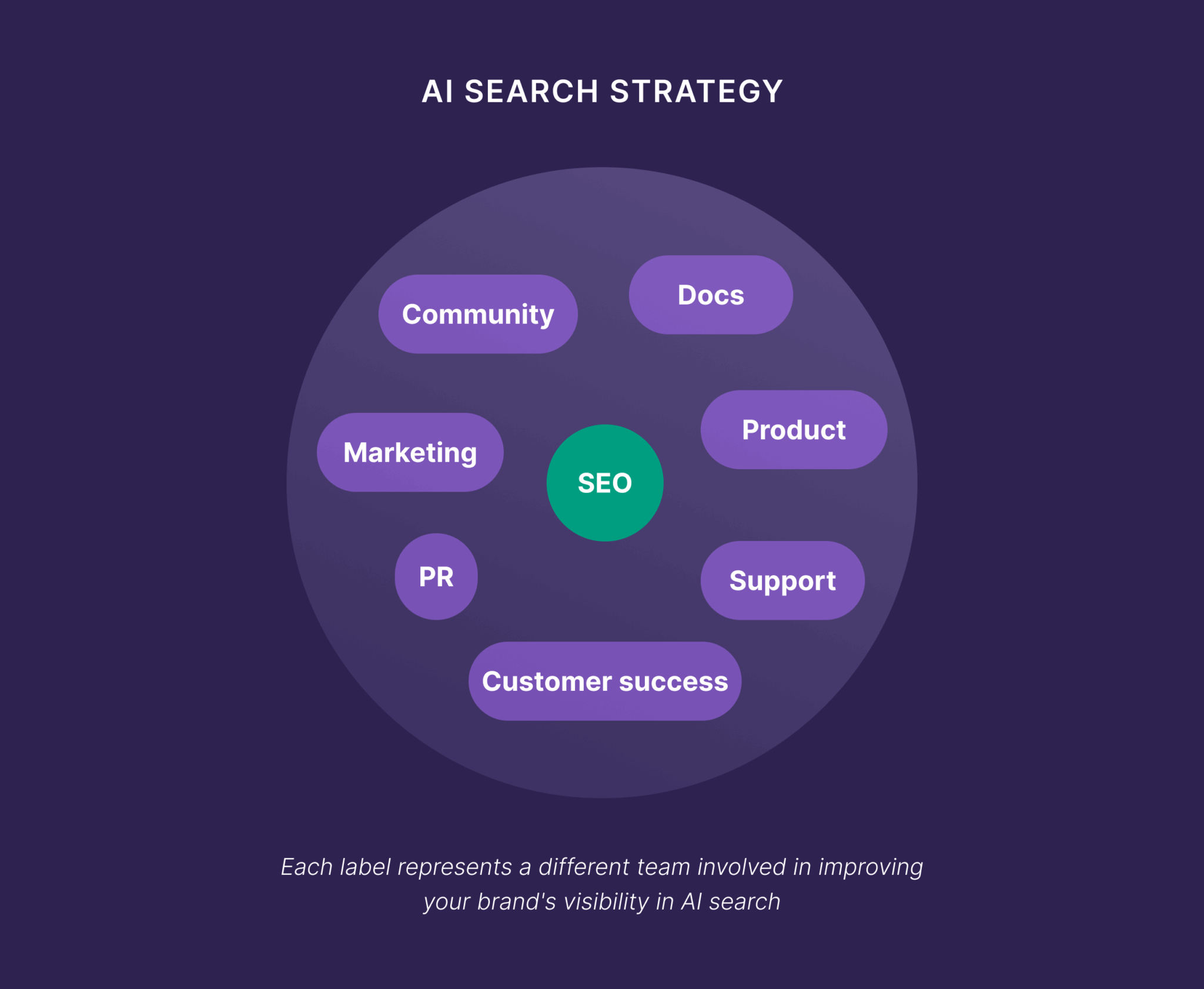
This guide shows you exactly how to fix that with two playbooks:

  • Get Seen: Win favorable mentions in AI answers
  • Be Trusted: Earn citations as a reliable source

Run them together and you give AI no choice but to recognize, reference, and recommend your brand.

Why AI Search Strategy Isn’t Just SEO’s Job

Your SEO team can optimize every page on your site and still lose AI visibility to a competitor with weaker rankings but stronger brand signals.

Why? Because AI systems pull signals from everywhere, not just your website.

What Seos Optimize For Vs What Chatgpt Actually Cites Scaled

When AI generates responses, it mines:

  • Review platforms for product comparisons
  • Reddit threads for pricing complaints
  • Developer forums for implementation details
  • News sites for company credibility
  • Support docs for feature explanations

The challenge is that these signals live across different teams.

For instance, your customer success team drives customer reviews on G2 and Capterra. But if they’re not tracking review quality and detail, AI has nothing substantive to cite when comparing products.

Similarly, your product team controls whether pricing and features are actually findable. Hide everything behind “Contact Sales” forms, and AI will either skip you entirely or make assumptions based on old Reddit threads.

Your customers search everywhere. Make sure your brand shows up.

The SEO toolkit you know, plus the AI visibility data you need.

Start Free Trial
Get started with
Semrush One Logo

Your PR team lands media coverage and analyst reports. These third-party mentions build the trust signals AI systems use to determine authority.

Your support and community teams shape what gets said in forums and Discord servers. Their responses (or silence) directly influence how AI understands your product.

SEO and content teams own the site structure and content creation. But that’s just one piece now.
Without coordination, you get strong performance in one area, killed by weakness in another.

Ai Search Strategy Scaled

To grow AI visibility, you need synchronized campaigns — not just an “optimize for AI” line item tacked onto everyone’s OKRs.

That’s where the Seen & Trusted Framework comes in. It gives every team a role in building the signals AI depends on.


Playbook 1 – How to Get Seen (The Sentiment Battle)

Getting “seen” means showing up in AI responses as a mentioned brand, even without a citation link.

When a user asks ChatGPT, “What are the best email marketing tools?” they get names like HubSpot, ActiveCampaign, and MailChimp.

These brands just won visibility without anyone clicking through.

Chatgpt Brands Won Visibility Scaled

But here’s a challenge: 

You’re fighting for favorable mentions against every competitor and alternative solution.

This is the sentiment battle. 

Because AI doesn’t just list brands. It characterizes them. 

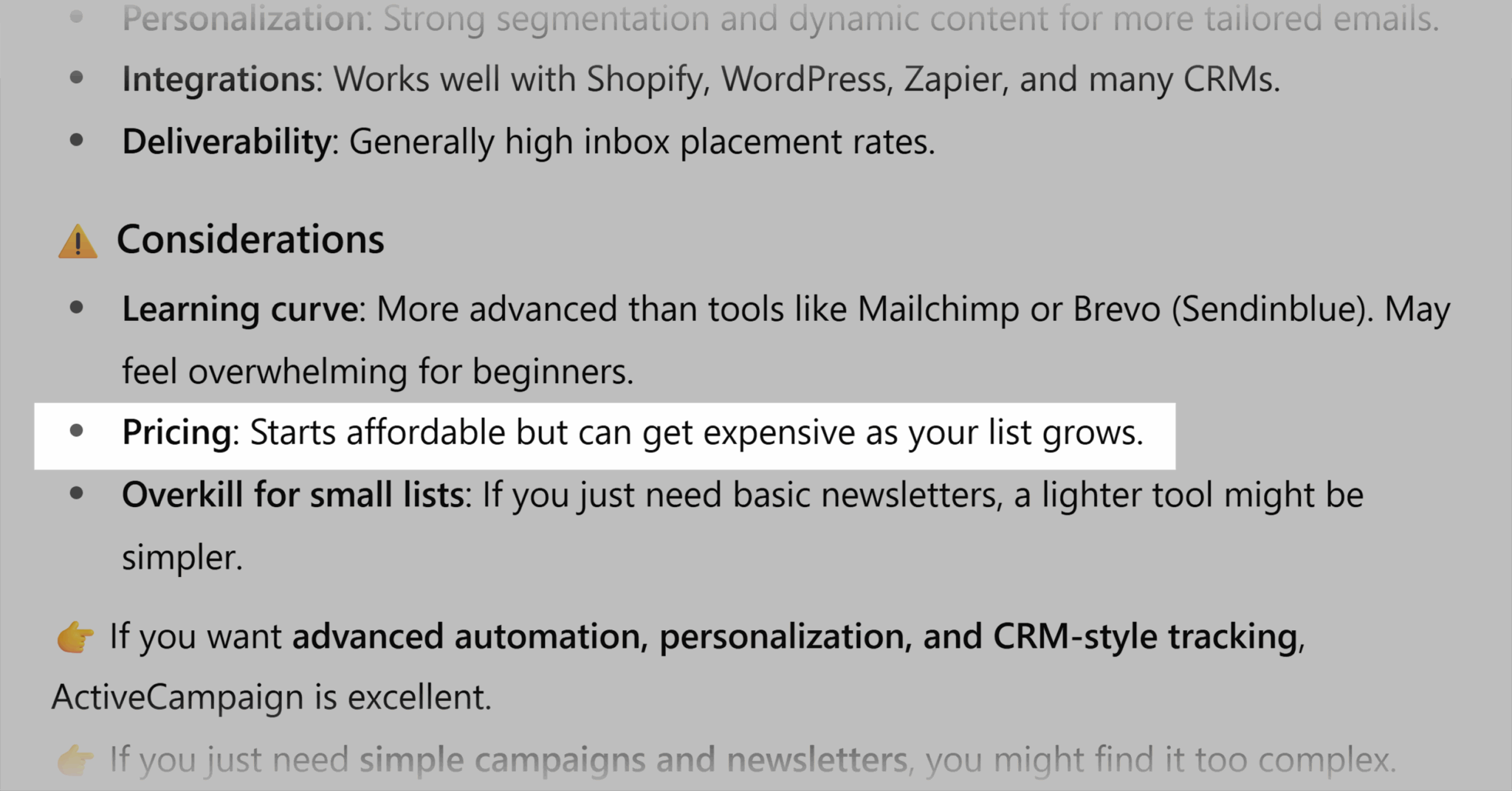
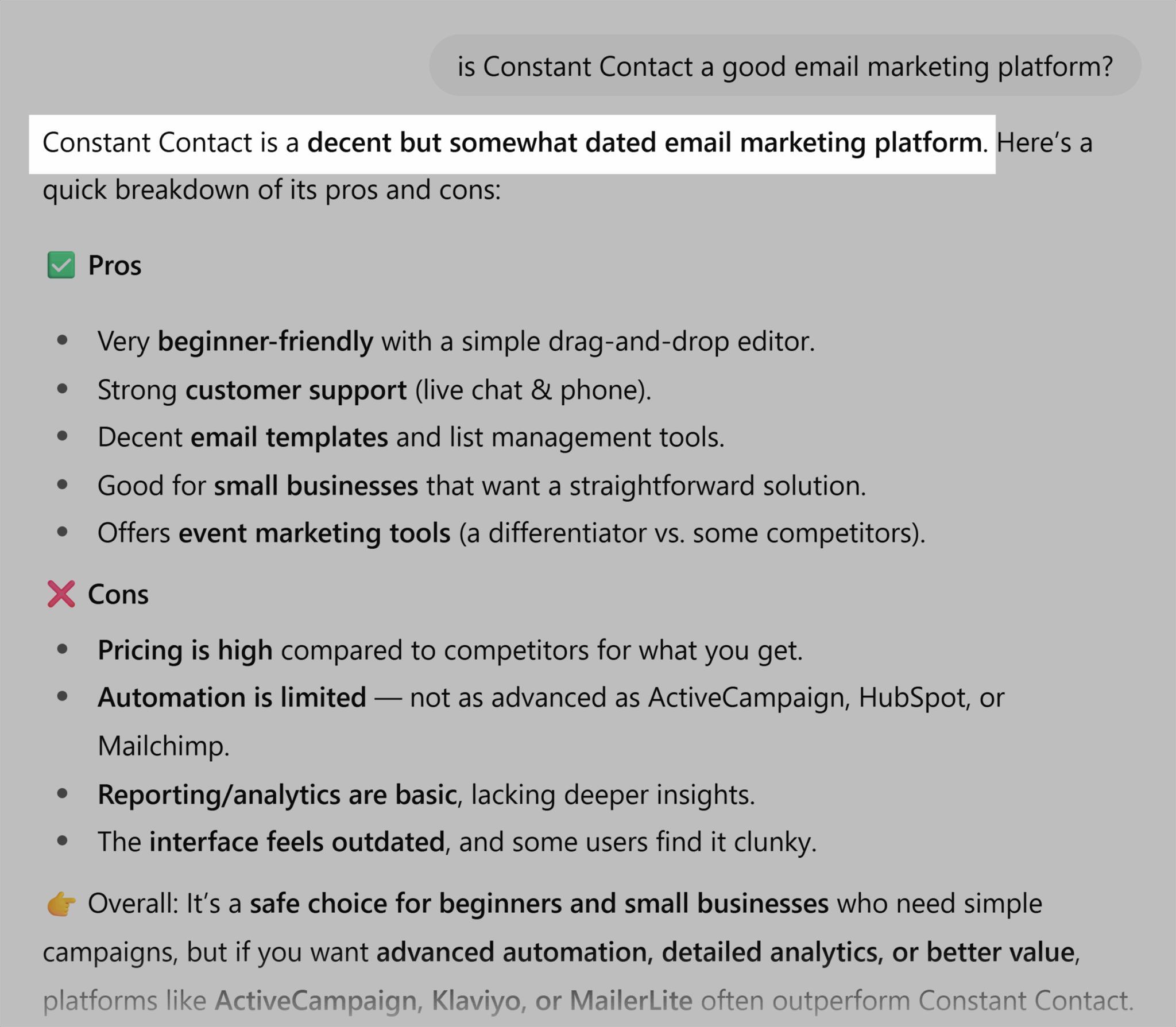
You might get mentioned as “expensive but comprehensive” or “affordable but limited.” 

Like here, when I asked ChatGPT if ActiveCampaign is a good option:

Chatgpt Prompt For Email Marketing Scaled

In some cases, the response could be more negative than neutral. Like this:

Chatgpt Respond More Negative Than Neutral Scaled

These characterizations stick.

So, how can your brand get more mentions and have a positive sentiment around?

There are four main sources that AI systems mine for context.


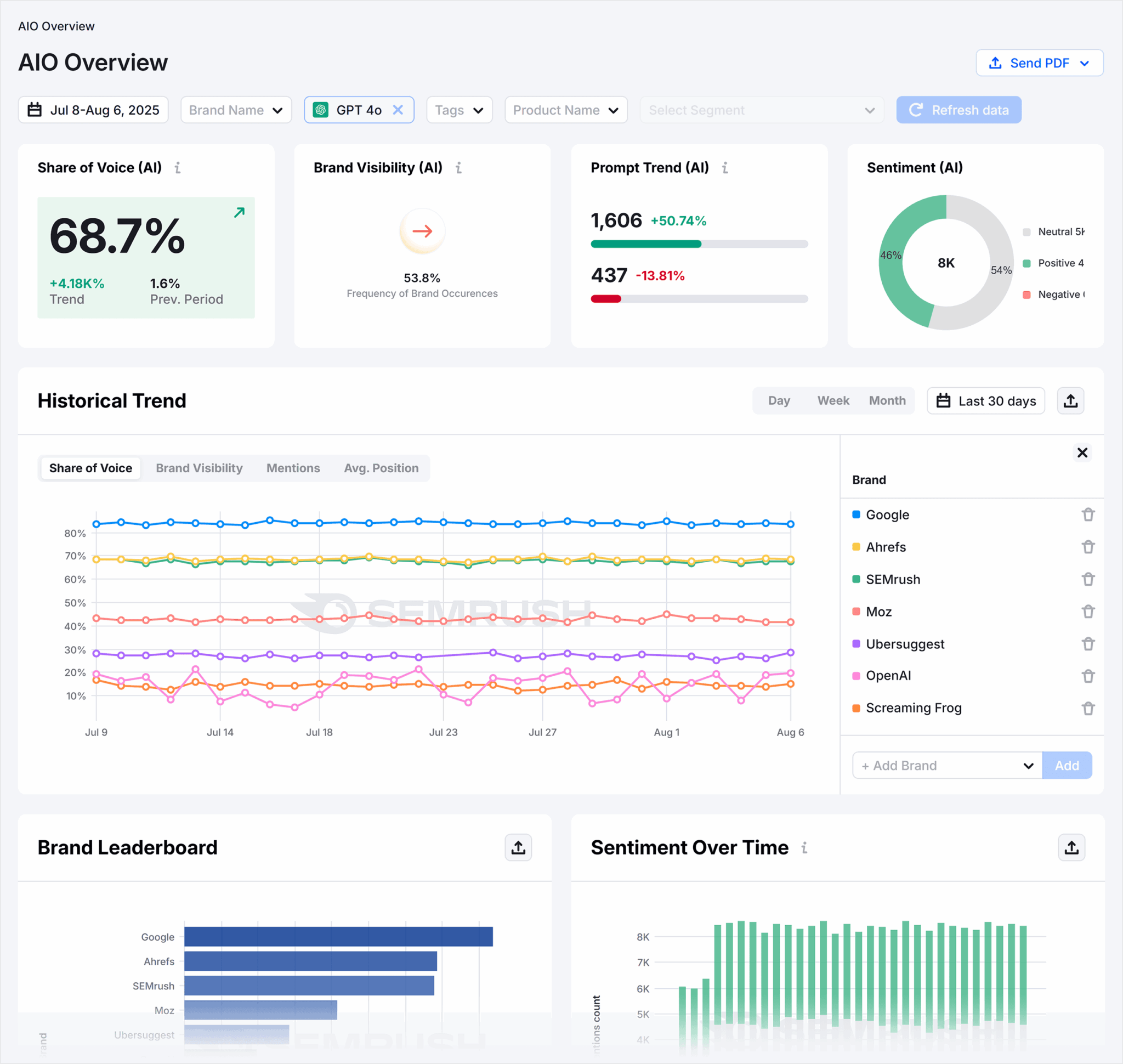
Semrush Enterprise AIO – Backlinko – AIO Overview

Step 1. Build Presence on the Right Review Sites

AI systems heavily weigh review platforms when comparing products. But not all reviews are equal.

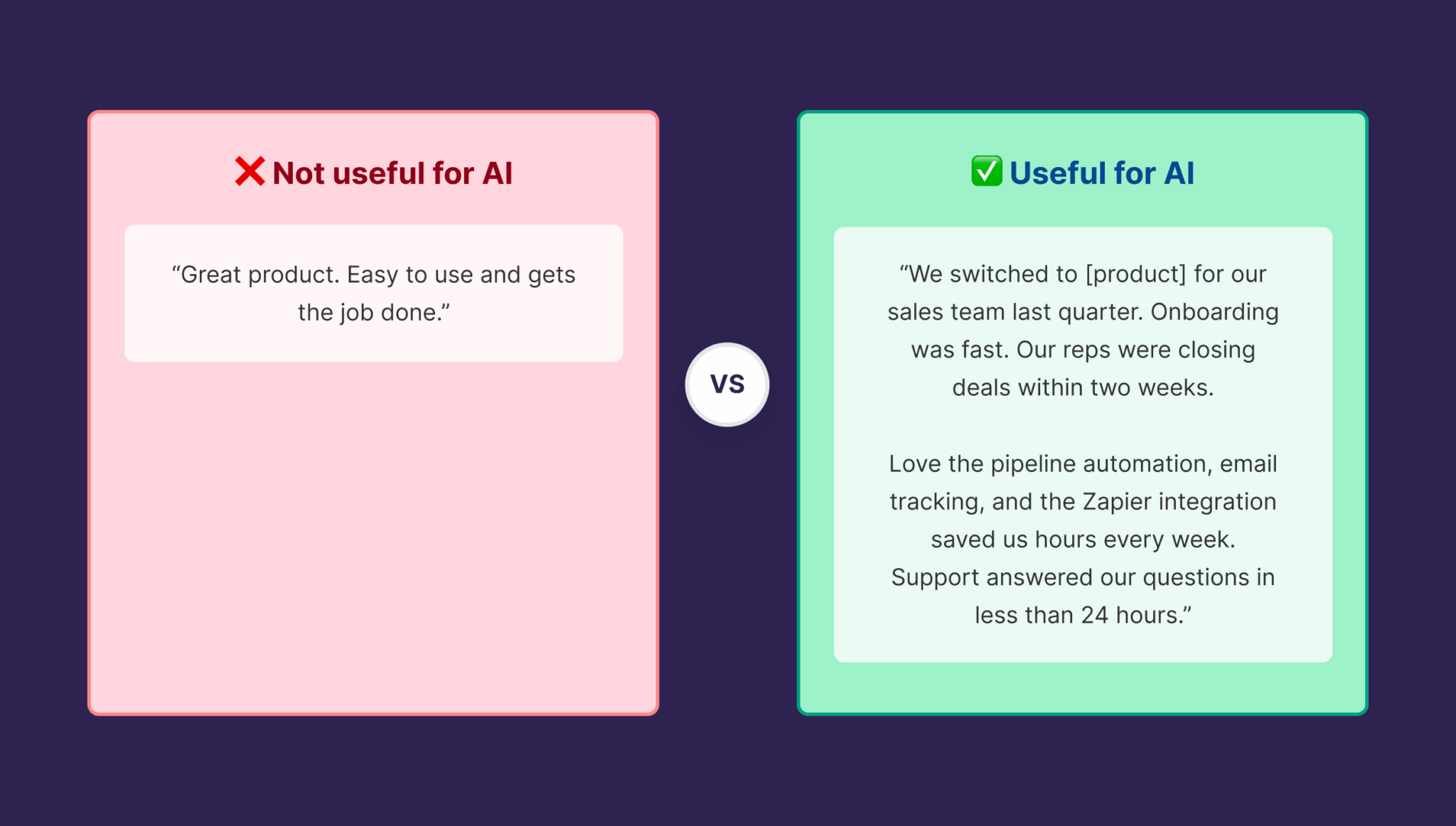
A detailed review explaining your onboarding process carries more weight than fifty “Great product!” ratings. 

AI needs substance, like specific features, use cases, and outcomes it can reference when answering queries.

Reviews Scaled

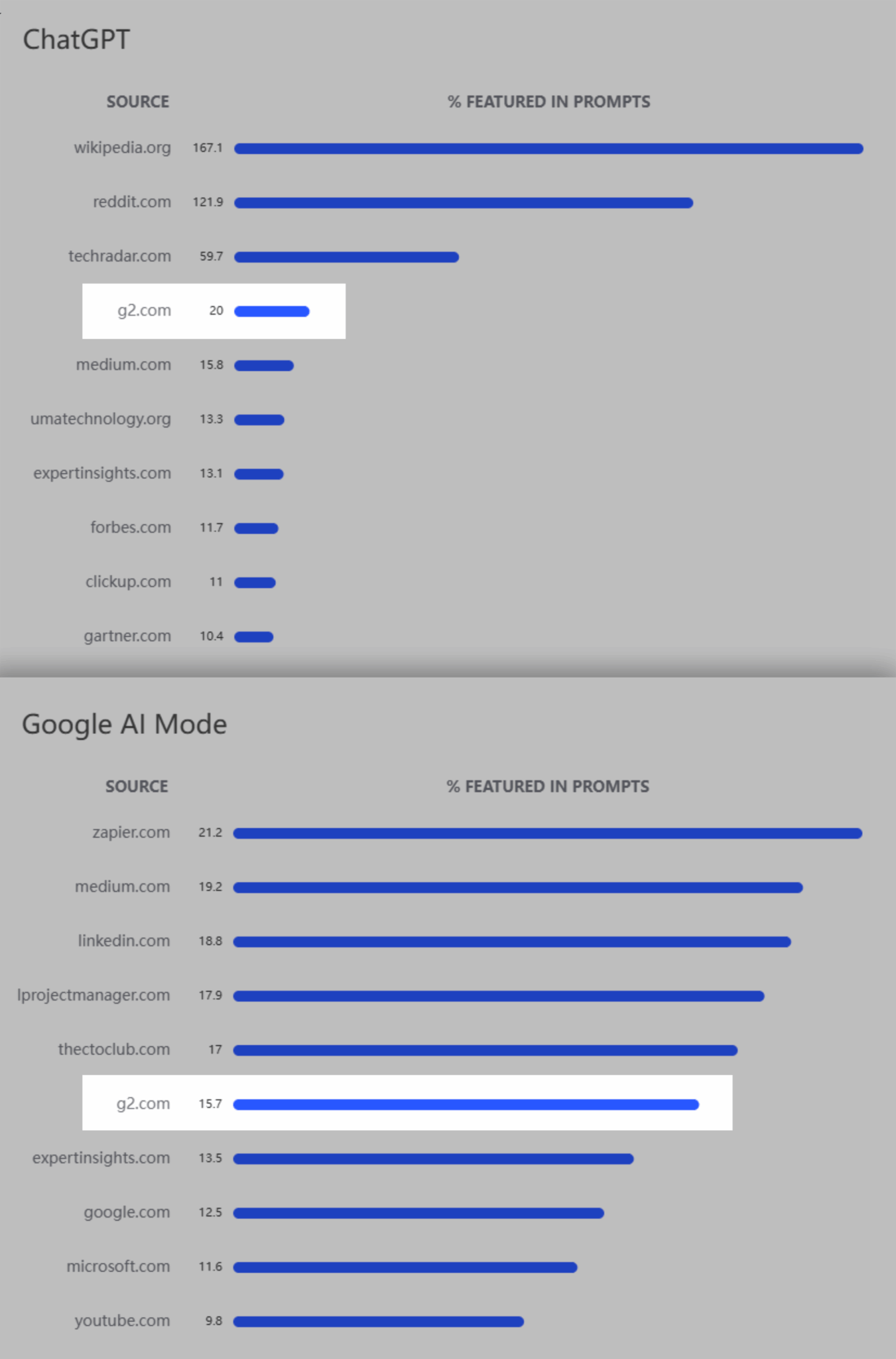
G2 is one of the top sources for ChatGPT and Google AI Mode in the Digital Technology vertical, according to Semrush’s AI Visibility Index. 

The platform gives AI everything it needs: reviews, features, pricing, and category comparisons all in one place.

Semrush Enterprise Digital Technology G2com Scaled

Slack ranks among the top 20 brands by share of voice in AI responses for the Digital Technology vertical.


Semrush Enterprise Brand Mentions Digital Technology Scaled

Part of that success comes from their G2 strategy.

When I ask ChatGPT, “Is Slack worth it?” it cites G2 as one of the sources. 

Chatgpt Is Slack Worth It G2 Citation Scaled

Look at Slack’s G2 reviews and you’ll see why. 

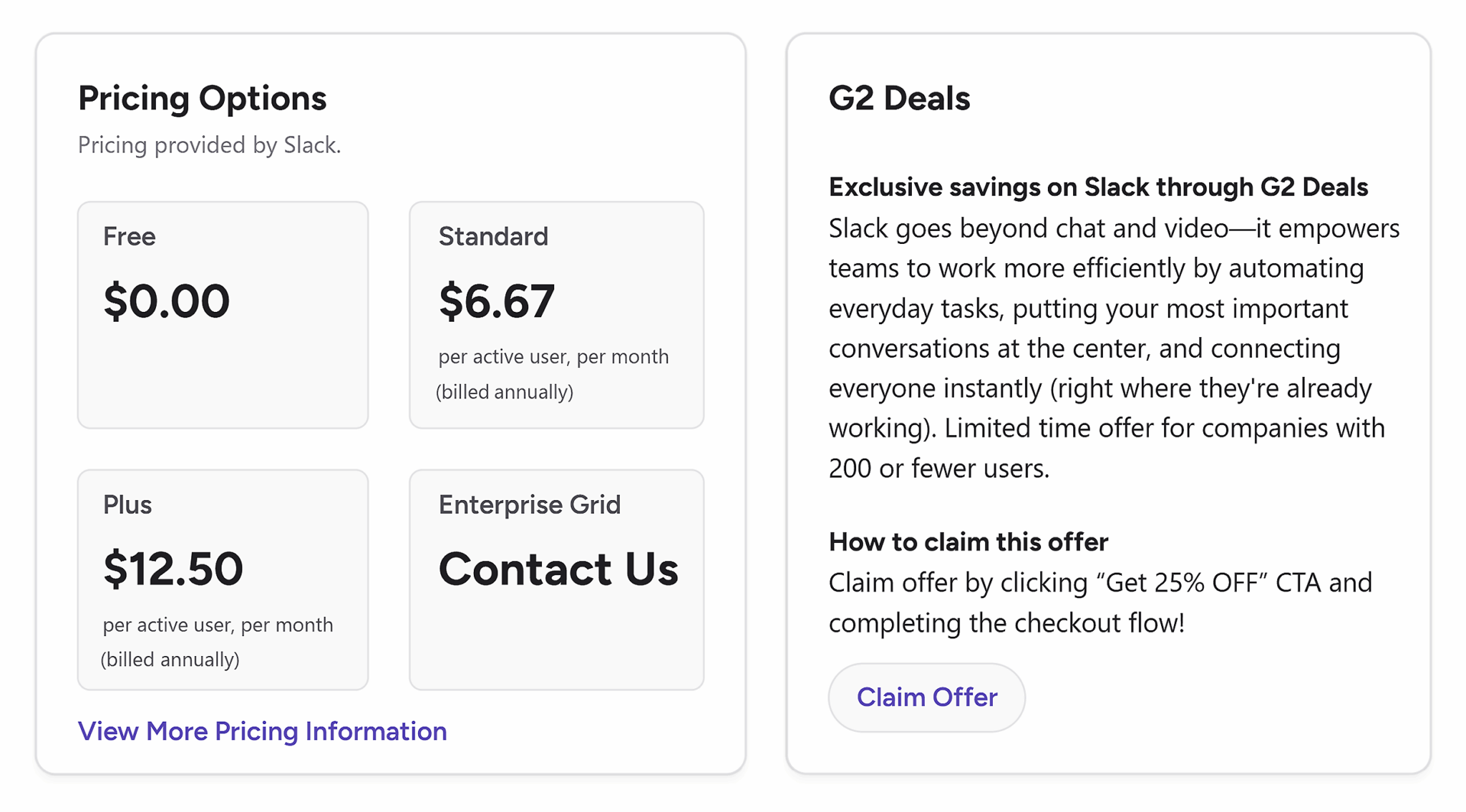
Its pricing, features, and other information are properly listed and up-to-date

Slack G2 Pricing Options Scaled

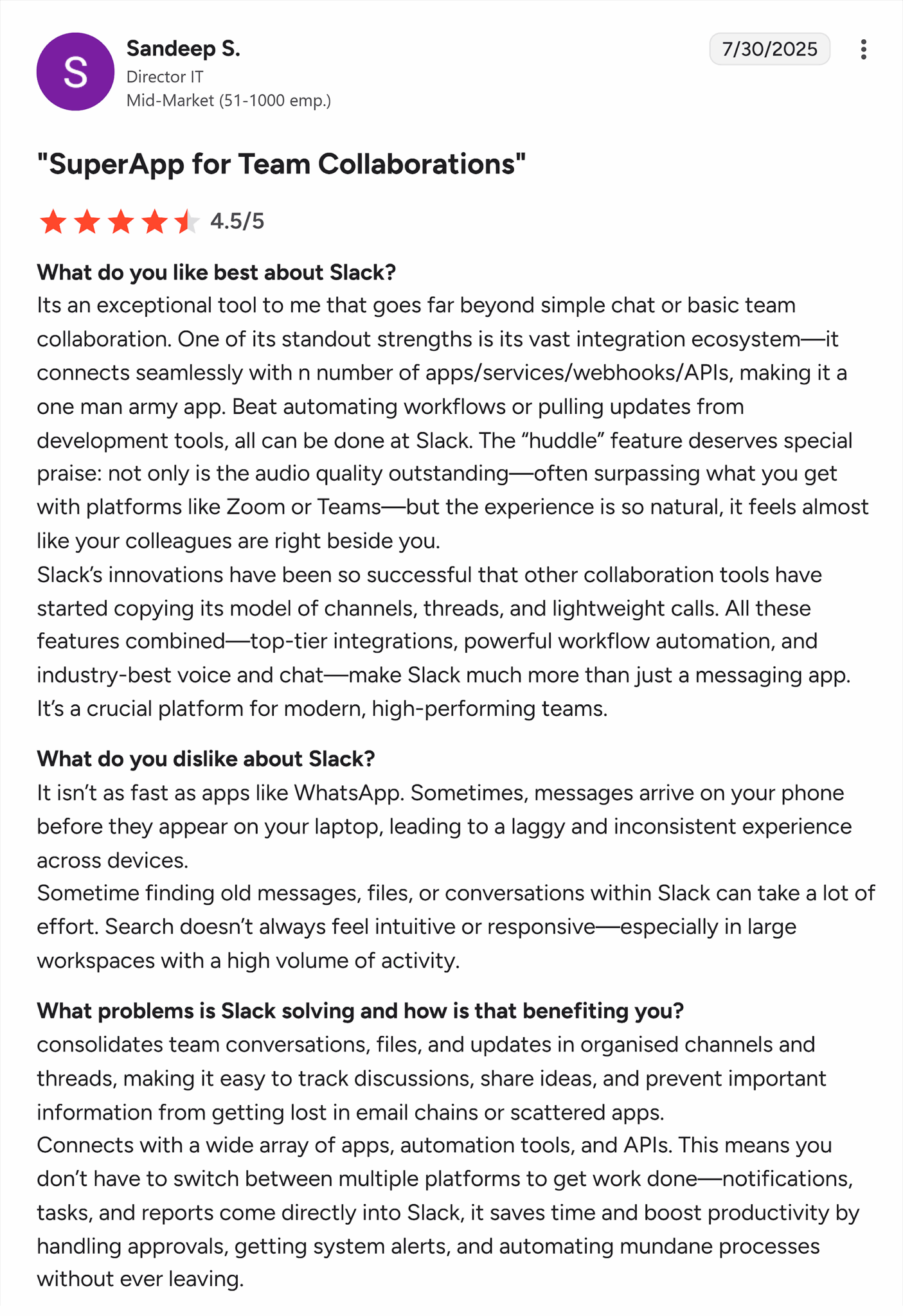
Users write detailed reviews about channel organization, workflow automation, and integration setups. 

Slacks G2 Review Scaled

G2 isn’t the only platform that matters.

  • For B2B SaaS: G2, Capterra, and GetApp
  • For ecommerce: Amazon reviews
  • For local/service businesses: Yelp and Google Reviews

In my experience, the depth of the review matters just as much as the platform — if not more.

You’ll see many very detailed product reviews as a source in AI answers from sites with low domain authority.

So, what does this mean in practice?

You need reviews from customers. And your review strategy needs four components:

  • Timing: Email customers after they’ve used your product enough to give meaningful feedbac, but while the experience is still fresh
  • Templates: Provide prompts highlighting specific features to discuss. “How did our API save you development time?” beats “Please review us.”
  • Incentives: Reward detail over ratings. A $XX credit for reviews over 200 words can generate more AI-friendly content
  • Engagement: Respond to every review. AI systems recognize vendor engagement as a trust signal.

Step 2. Participate in Community Discussions

Community platforms are where real product conversations happen. And AI systems are listening.

  • Reddit threads comparing alternatives
  • Stack Overflow discussions about implementation
  • Quora answers explaining use cases

These unfiltered conversations shape how AI understands and recommends products.

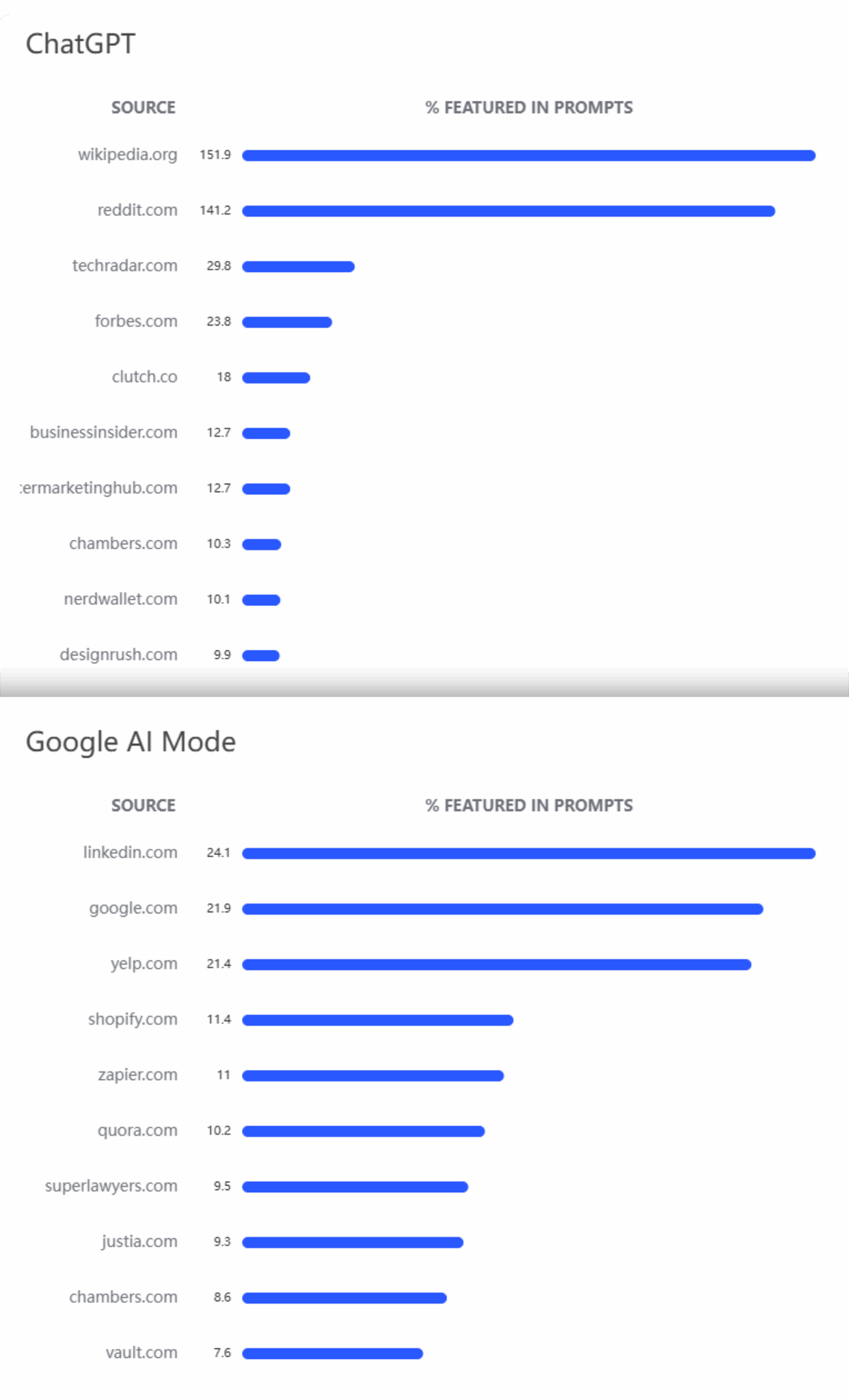
Reddit and Quora consistently rank among the top sources cited by ChatGPT and Google AI Mode across industries.

Like in the Business & Professional Services vertical here:

Semrush Enterprise Business And Professional Services Scaled

Online form builder Tally is a great example of dominating community discussions and winning the AI search.

AI-powered search is now their biggest acquisition channel, with ChatGPT being their top referrer.

This is their weekly signup growth of the past year, driven by AI search:

Tally Ai Powered Search Scaled

How are they doing this?

Marie Martens, co-founder of Tally, writes:

“Inclusion of web browsing is turned on by default, which made forums, Reddit posts, blog mentions, and authentic UGC part of the AI’s source material… We’ve invested for years in showing up in those places by sharing what we learn, answering questions, and being human.”

Here’s Marie talking about her product on Reddit:

Reddit Marie Talking About Her Product Scaled

And answering users’ questions:

Reddit Marie Answering Users Question Scaled

And partaking in ongoing conversations:

Reddit Marie Partaking In Ongoing Conversation Scaled

This authentic engagement creates the context AI needs. 

So, when I ask ChatGPT what’s the best free online form builder, it mentions (and recommends) Tally.

Chatgpt Best Free Online Form Builder Scaled

Big brands like Zoho take part in Reddit discussions as well. To answer questions, address concerns, and control their brand sentiment.

Like here:

Reddit Zoho Take Part In Discussions Scaled

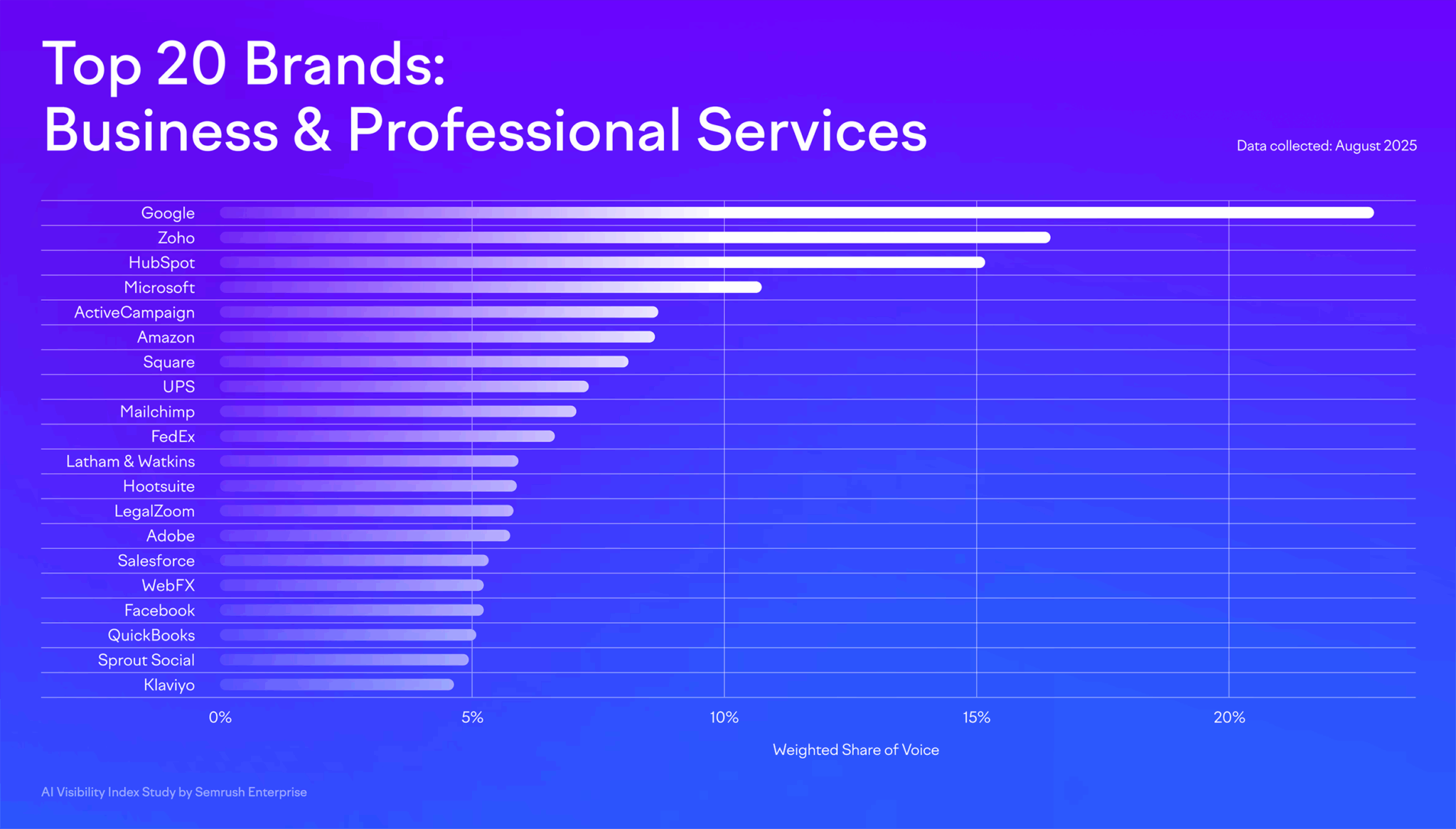
Zoho ranks among the top brands by share of voice in ChatGPT and Google AI Mode responses. Just behind Google.

Top Brands By Share Of Voice In Chatgpt And Google Ai Mode Responses Scaled

The community platforms like Reddit, Overflow, Quora, and even LinkedIn matter a lot in AI visibility:

Your community and customer success teams should be active on these platforms.

But presence alone isn’t enough. 

Your strategy needs authenticity.

How?

  • Answer questions even when you’re not the solution
  • Address common misconceptions about your product (don’t let misinformation take over threads)
  • Share your actual product roadmap, including what you won’t build
  • Give detailed, honest responses to user complaints, even if it means acknowledging past mistakes
  • Encourage your product, support, or founder teams to answer technical or niche questions directly

AI systems can detect promotional language. They prioritize helpful responses over sales pitches. 

The brands winning community presence treat forums like customer support, not marketing channels.

Step 3. Engineer UGC and Social Proof

User-generated content and social proof create a feedback loop that AI systems amplify.

  • When customers share their wins on LinkedIn
  • When users post before-and-after case studies
  • When teams document their workflows publicly

…all of this becomes training data.

Brands with strong community engagement and visible social proof see higher mention rates across AI platforms.

Patagonia is a fitting example here. 

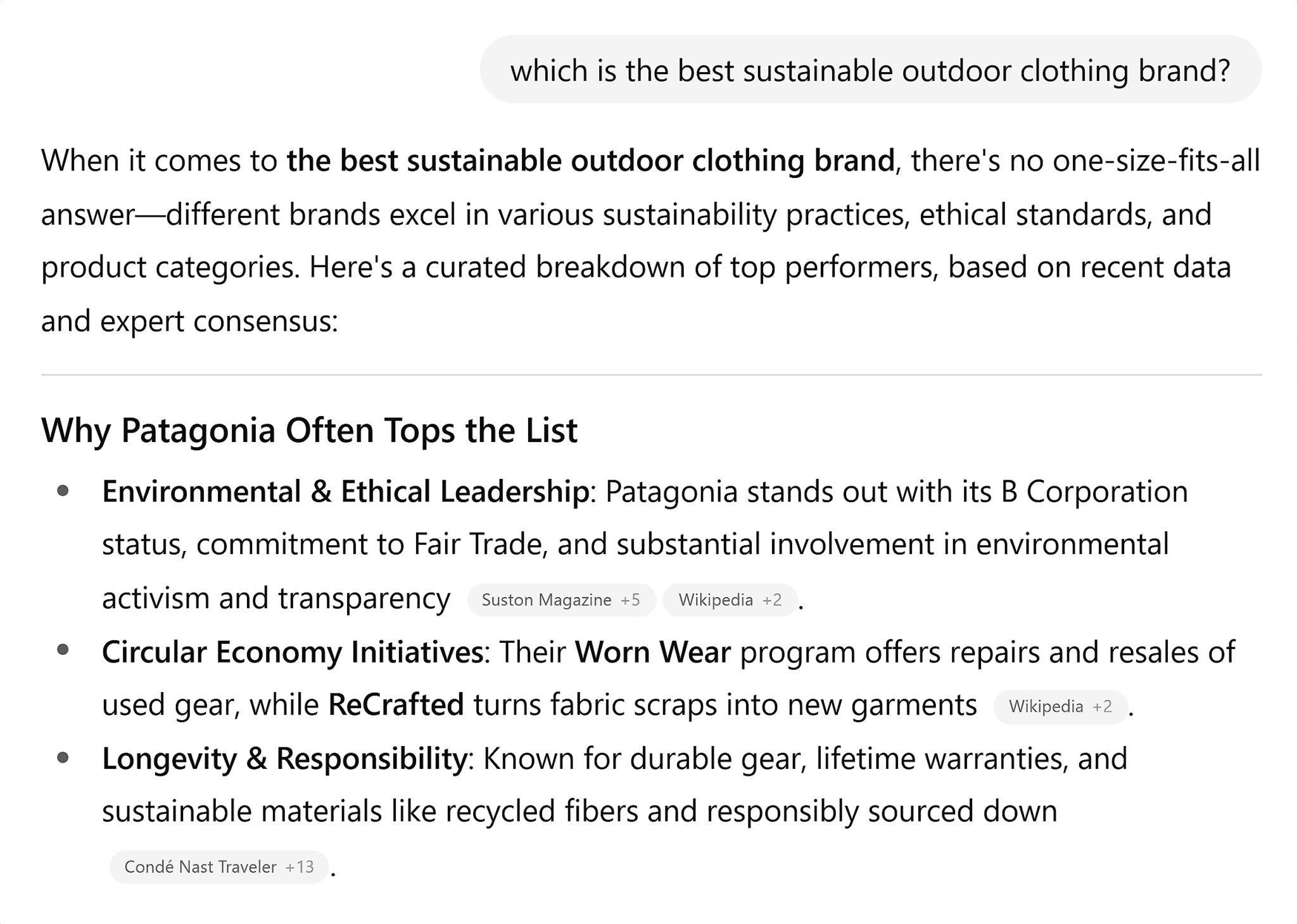
When I ask ChatGPT about sustainable outdoor brands, Patagonia dominates the response. 

Chatgpt Sustainable Outdoor Brands Scaled

In fact, Patagonia holds the highest share of voice in AI responses for the Fashion and Apparel vertical.

Fashion And Apparel Share Of Voice In Ai Responses Scaled

They consistently appear in discussions around “ethical fashion” and “sustainable brands.” 

Not because they advertise, but because customers evangelize. And that advocacy is visible everywhere.

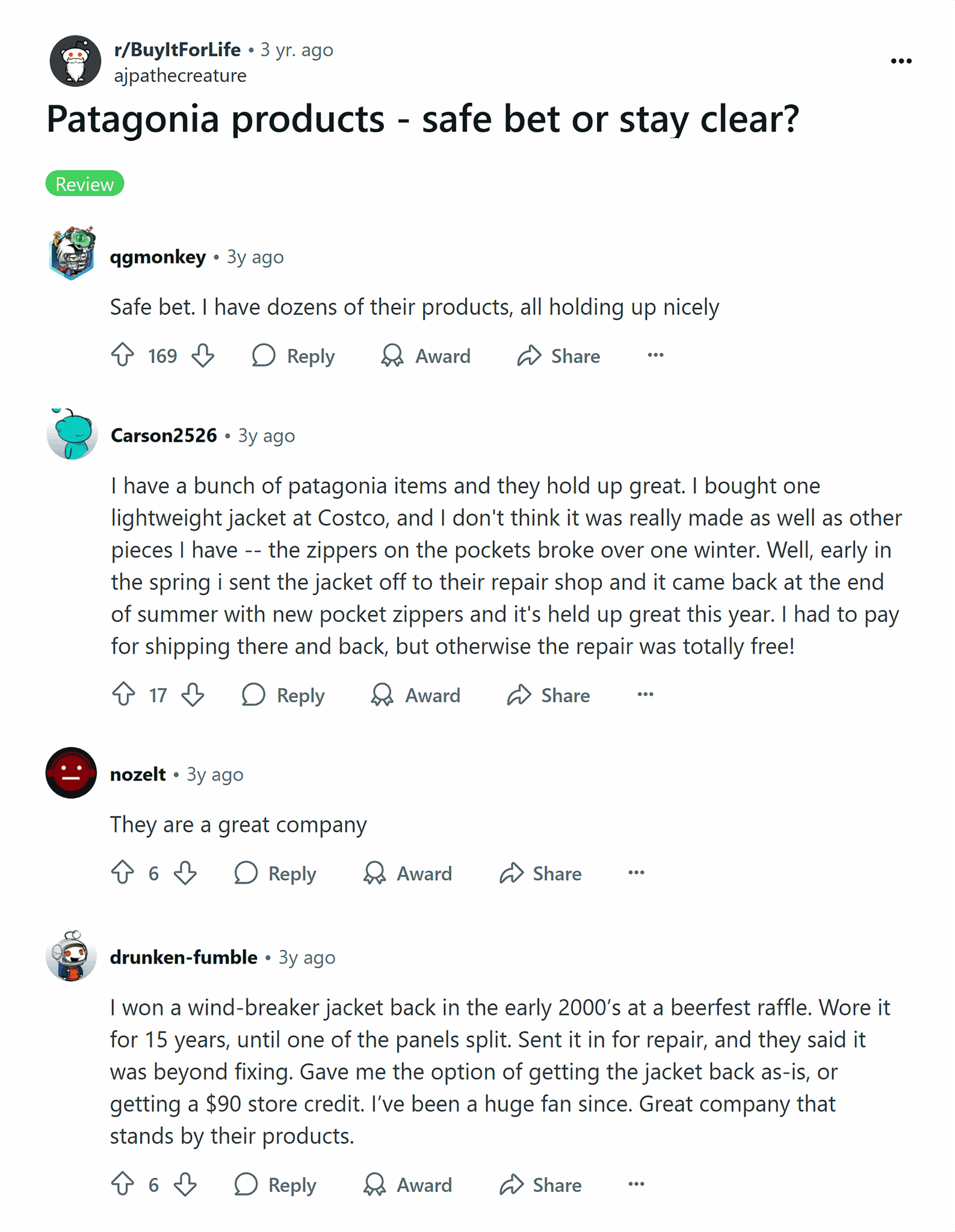
Reddit Patagonia In Discussions Scaled

Customers regularly mention their positive experience with Patagonia’s exchange policy.

Reddit Patagonias Exchange Policy Scaled

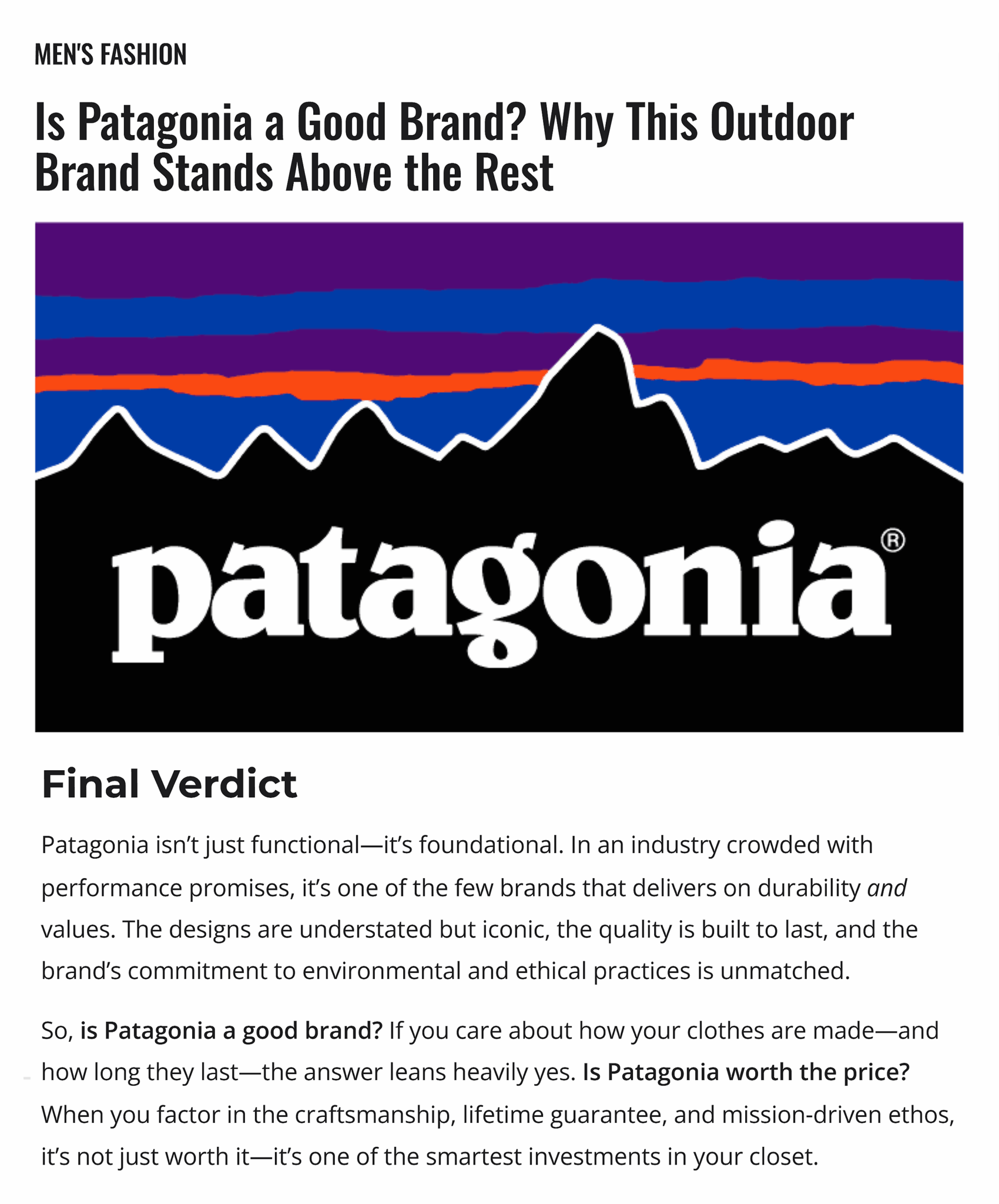
There are countless positive articles written on third-party platforms about their products.

Fashionbeans Is Patagonia A Good Brand Scaled

And on social platforms like Instagram.

Instagram About Patagonia Scaled

These real-world endorsements are the kind of social proof AI recognizes and amplifies.

No wonder Patagonia has a highly favorable sentiment score (according to the “Perception” report of the AI SEO Toolkit).

Ai Seo Toolkit Patagonia Overall Sentiment Scaled

So, how do you get people creating content (and proof) that AI pays attention to?

  • Encourage customers to leave ratings on trusted third-party sites
  • Partner with micro-influencers to share authentic product stories, tips, and reviews in their own voice
  • Invite users to post before-and-after results or creative use cases
  • Design features or experiences users want to show off (like Spotify Wrapped)
  • Reward customers who share feedback or use cases publicly (early access, shoutouts, or swag)
  • Reply to every public mention or tag because AI recognizes visible engagement

The mistake most brands make? 

Asking for just testimonials instead of conversations.

Don’t ask customers to “share their success story.” Ask them to help others solve the same problem they faced. 

The resulting content is authentic, detailed, and exactly what AI systems look for.

Step 4. Secure “Best of” List Inclusions

Comparison articles and ‘best of’ lists are key sources for AI citations.

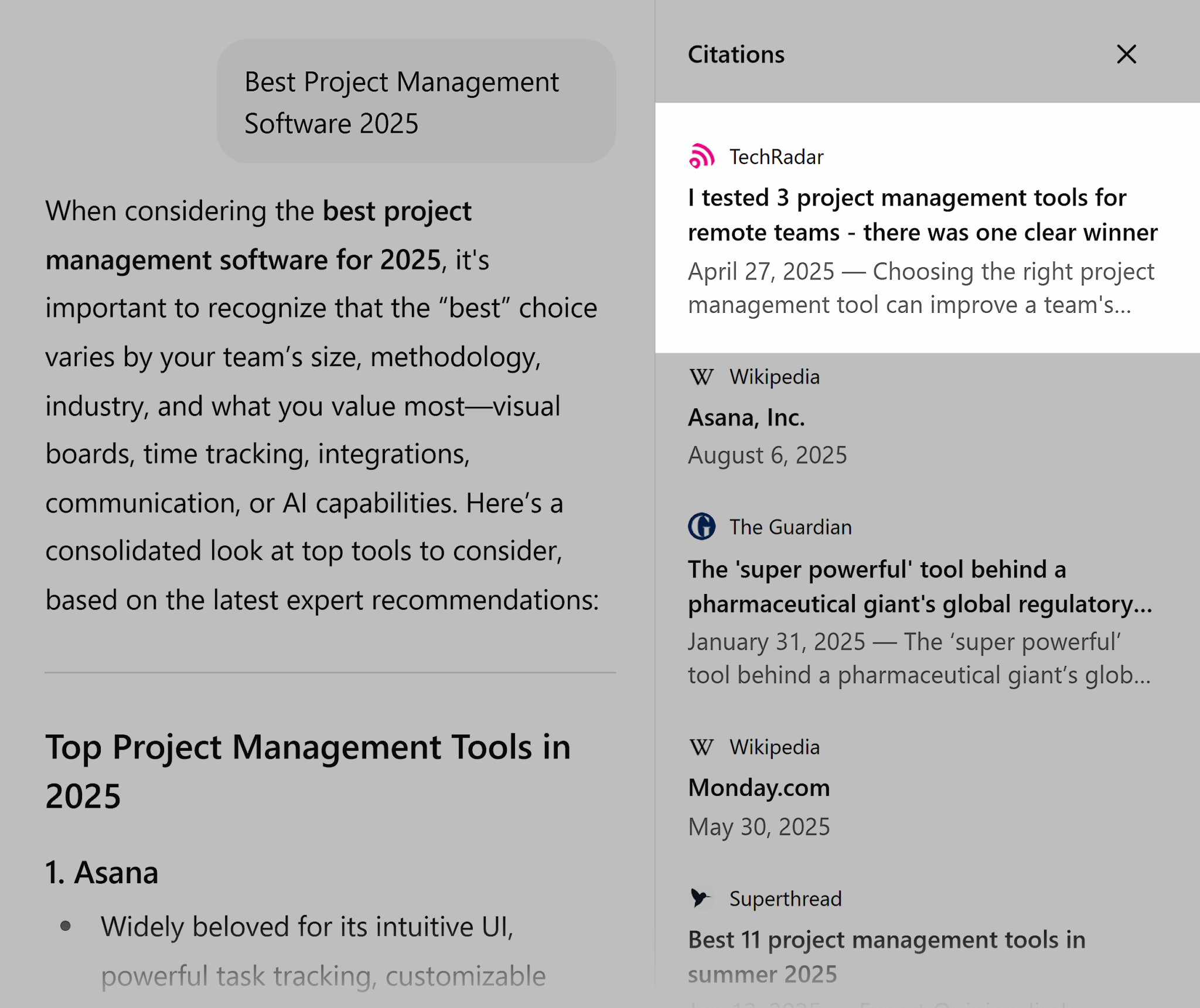
When TechRadar publishes an article on top “Project Management Tools for Remote Teams,” that article becomes source material for hundreds of AI responses. 

Chatgpt Techradar Citation Scaled

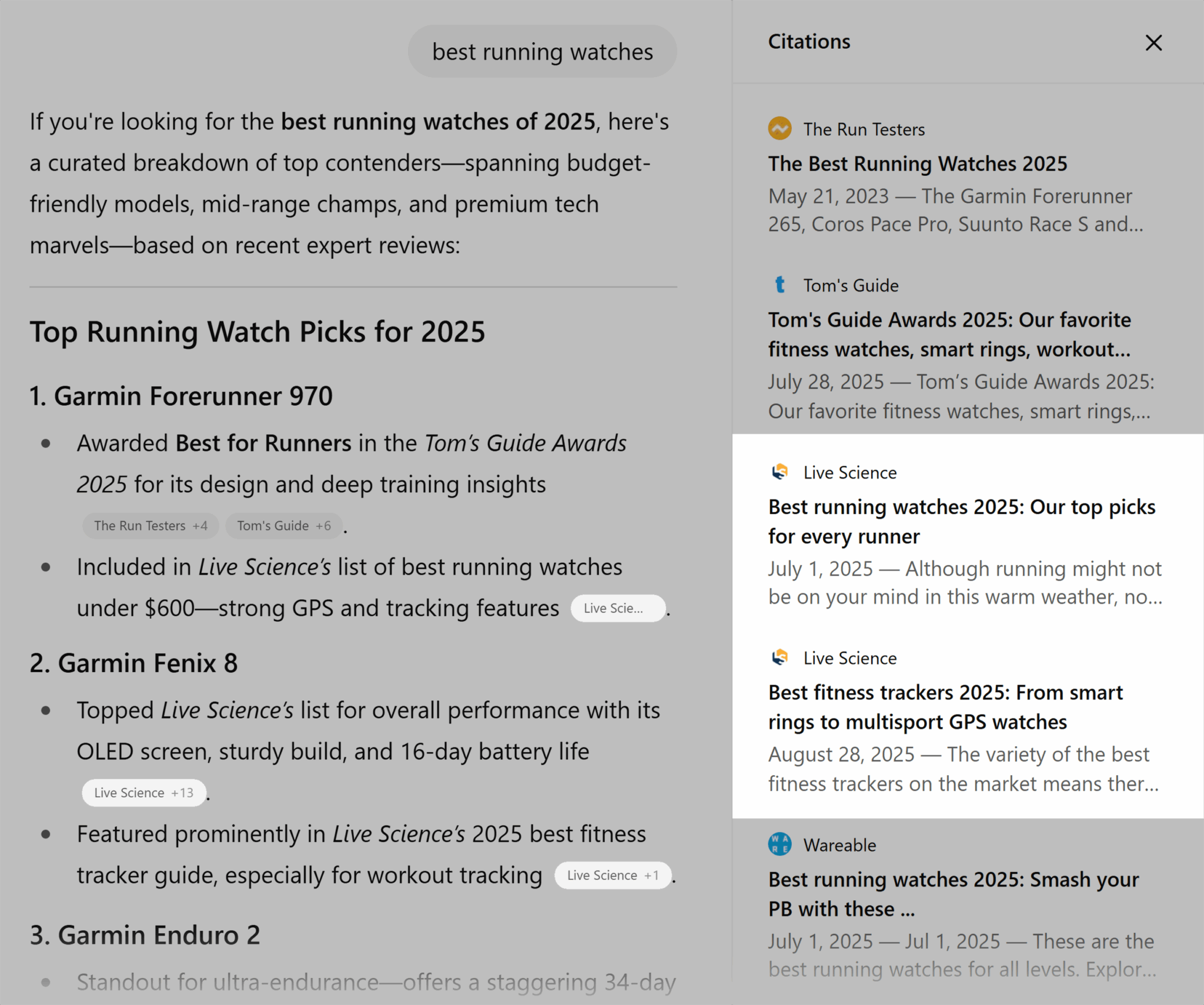
When Live Science reviews running watches, those comparisons train AI’s product recommendations.

Chatgpt Live Science Reviews Running Watches Scaled

These third-party validations carry more weight than your own content ever could.

In fact, sites that publish “best of” listicles consistently appear as top sources for AI platforms — including Forbes, Business Insider, NerdWallet, and Tech Radar.

Semrush Enterprise Overall Scaled

Garmin is a perfect example. 

Their products appear in virtually every “best GPS watch” article across running, cycling, and outdoor publications.

Like in this Runner’s World article:

Runnersworld Best Running Watches Scaled

Or this piece in The Great Outdoors:

Thegreatoutdoorsmag Piiece Scaled

But what makes their strategy work is consistency across platforms.

Yes, the specs are the same by nature. 

But what stands out is how consistently those specs, features, and images appear across independent sites.

That repetition reinforces trust for AI systems, which see the same details confirmed again and again.

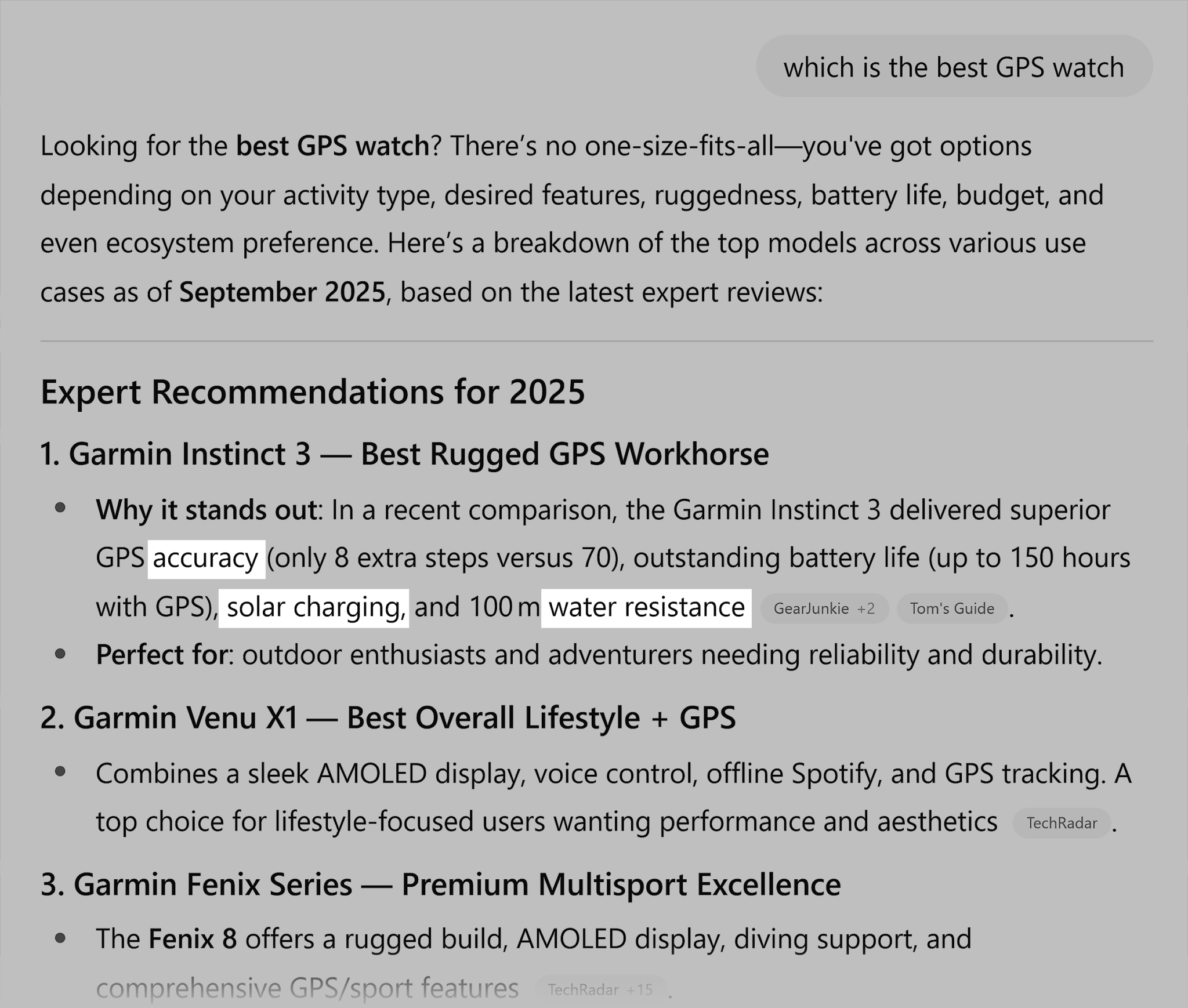
So, when I ask ChatGPT, “Which is the best GPS watch?” it mentions Garmin. 

And it doesn’t stop there. It highlights features that other third-party articles emphasize, like battery life, accuracy, solar charging, and water resistance.

Chatgpt Best Gps Watch Scaled

This consistency across independent sources is why Garmin holds one of the highest shares of voice in ChatGPT and Google AI Mode responses for the Consumer Electronics vertical.

Consumer Electronics Shares Of Voice In Chatgpt And Google Ai Mode Responses Scaled

So, how do you land in these “best of” lists?

It starts with a great product. Without that, no list will save you.

That aside, you need to make journalists’ jobs easier. Most writers work under tight deadlines and will choose brands that provide ready-to-use assets over those that make them hunt.

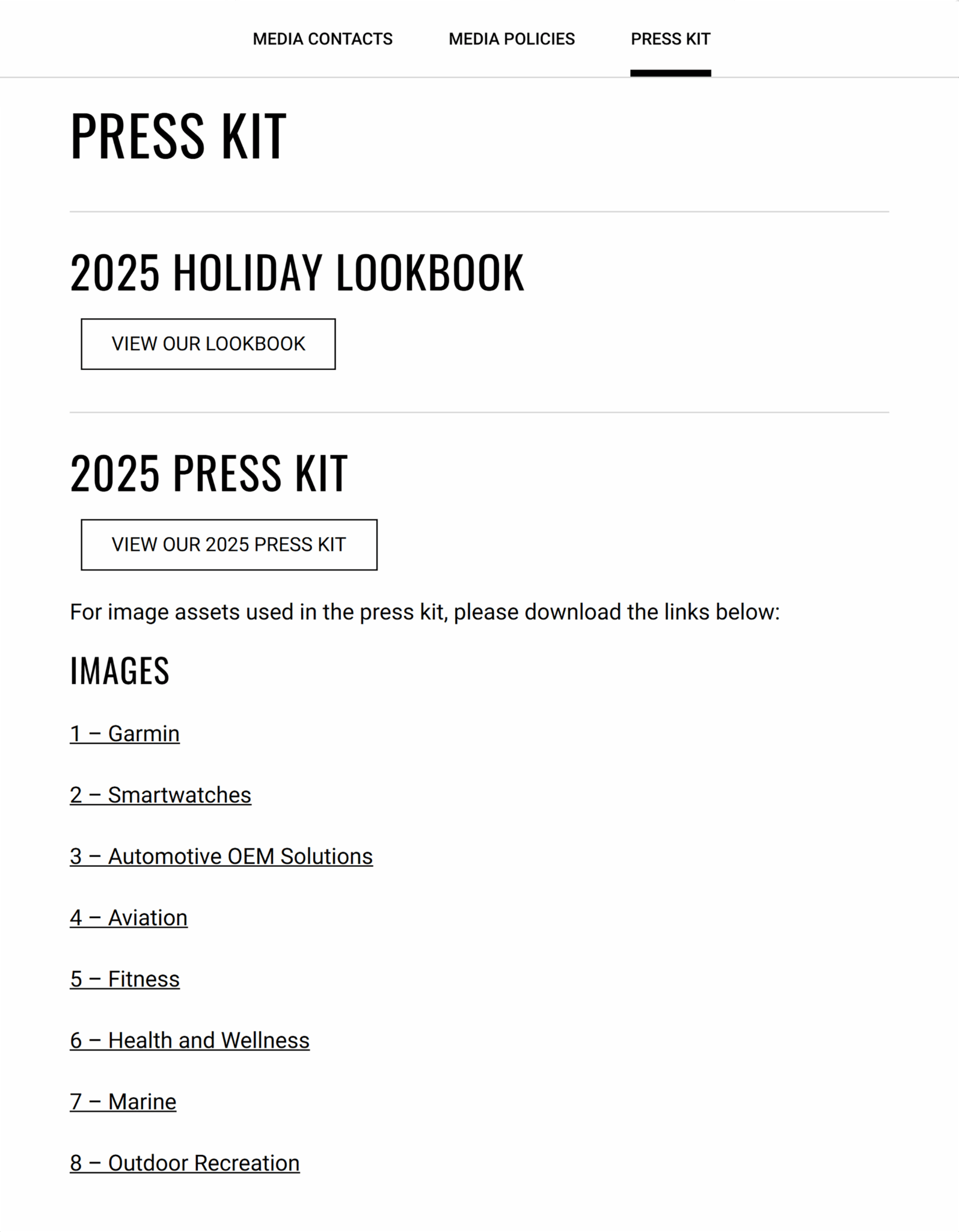
So build a dedicated press kit page with specs, pricing, high-res images, and other assets. 

Like Garmin does here:

Garmin Press Kit Scaled

Next, reach out to journalists and niche publications. Don’t wait for them to find you. 

Timing matters a lot as well. 

Most “best of” lists update annually. So, pitch your updates a few months before refreshes.

Also, don’t just target obvious lists. Focus on category expansion.

For instance, Garmin doesn’t just appear in “best GPS watch” roundups. They also feature in broader outdoor and fitness lists that cover running, cycling, and multisport gear.

That reach multiplies the mentions AI systems can cite.

The bottom line: AI visibility favors the brands that keep showing up in independent comparisons. 

Secure those “best of” inclusions, and you increase your chances of being mentioned in AI answers.

Playbook 2 – How to Be Trusted (The Authority Game)

Getting mentioned is half the battle. Getting cited is the other half.

When AI systems cite your content, they’re not just naming you. They’re using you as evidence to support their answers.

Look at any ChatGPT or Google AI Mode response. 

At the bottom or side, you’ll see a list of sources. These citations are what AI considers trustworthy enough to reference.

Google Ai Mode Which Is The Best Seo Tool Scaled

According to Semrush’s AI Visibility Index, certain sources dominate AI citations across industries. Like Wikipedia, Reddit, Forbes, TechRadar, Bankrate, and Tom’s Guide.

They have achieved, what I call, the “Citation Core” status. 


Why do these platforms get cited so often?

AI systems trust sources with verified information, structured data, and established credibility. They need confidence in what they’re citing.

This is the authority game.

You’ve earned mentions through the sentiment battle. Now you need to build the trust that also earns you citations.

This is how you maximize your AI visibility.

Here are five ways to build that authority.

Step 1. Optimize Your Official Site for AI

AI platforms can only cite what they can crawl, parse, and understand.

If your details aren’t exposed in clean, readable code, you’re invisible. No matter how good your content is.

Use semantic HTML to structure your content. 

That means marking up pricing tables, product specs, and feature lists with tags like <table>, <ul>, and <h2>.

Don’t tuck information inside endless <div>s or custom layouts that hide meaning.

Non Sematic And Sematic Html Scaled

Also, avoid relying on JavaScript to render your main content. 

AI crawlers can’t read JavaScript.

If your pricing or docs load only after scripts fire or buttons click, those details will be skipped.

Nothing Appears With Javascript Disabled Scaled

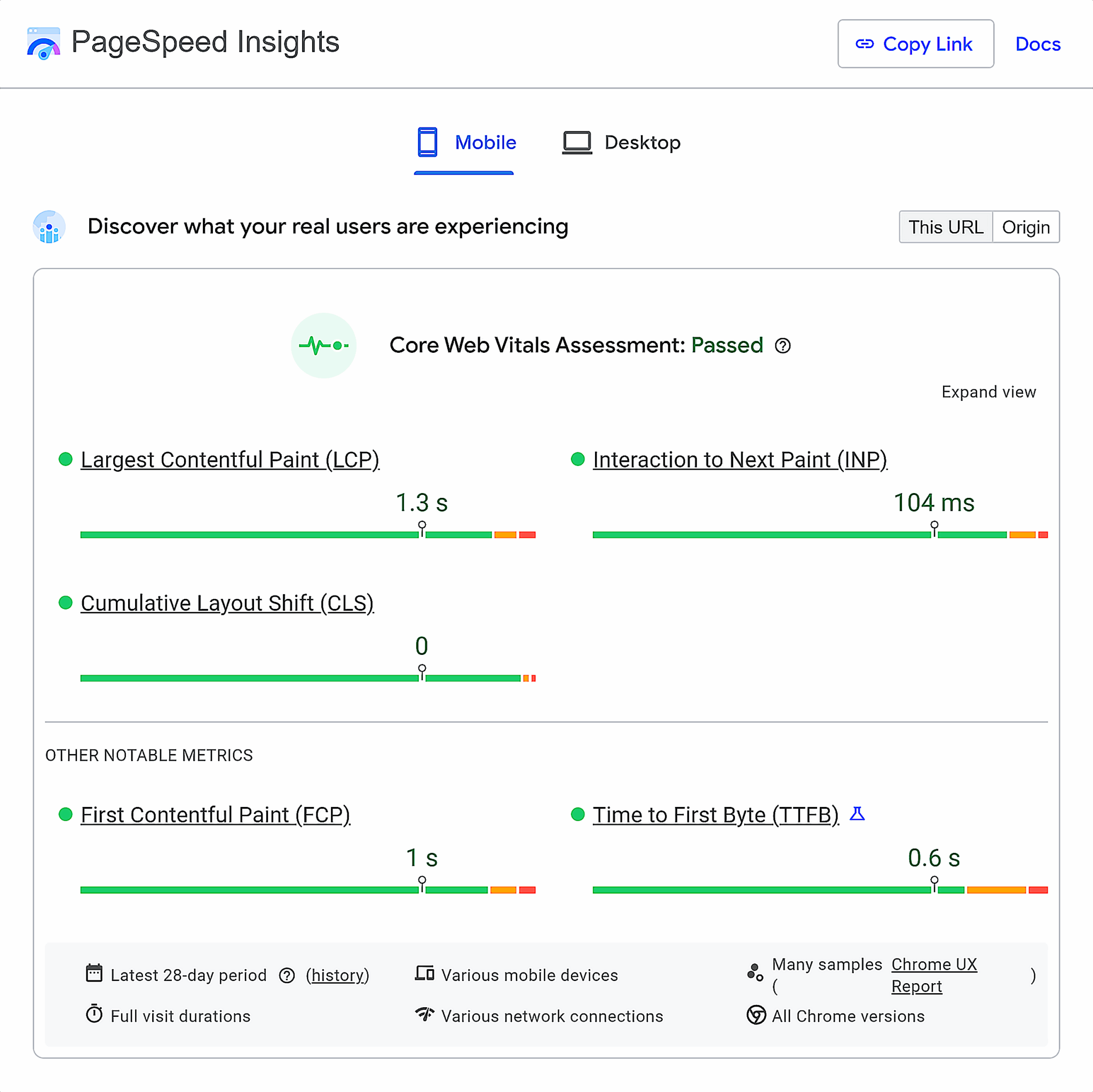
Almost every top-cited site in AI answers passes the Core Web Vitals assessment, which signals that the page loads fast, stays stable, and presents content in a clean structure.

Like Bankrate — the most cited source in Google AI Mode for the Finance vertical:

Pagespeed Insights Bankrate Mobile Scaled

Or InStyle — the 8th most cited source on ChatGPT in the Fashion & Apparel vertical.

Pagespeed Insights Instyle Mobile Scaled

These sites consistently surface in AI responses because their pages are easy to crawl, fast to load, and simple to extract structured information from.

A lot of what you’ll do to optimize your site for AI is SEO 101.

  • Structure all key information in native HTML elements (no custom wrappers)
  • Keep important content visible on initial load (no tabs, accordions, or lazy-loaded sections)
  • Use schema where it reinforces facts: pricing, product, FAQ, organization
  • Run regular audits with JavaScript disabled to see what AI sees
  • Minimize layout shifts and script dependencies that delay full render

For page-by-page analysis, you can use Google’s PageSpeed Insights. 

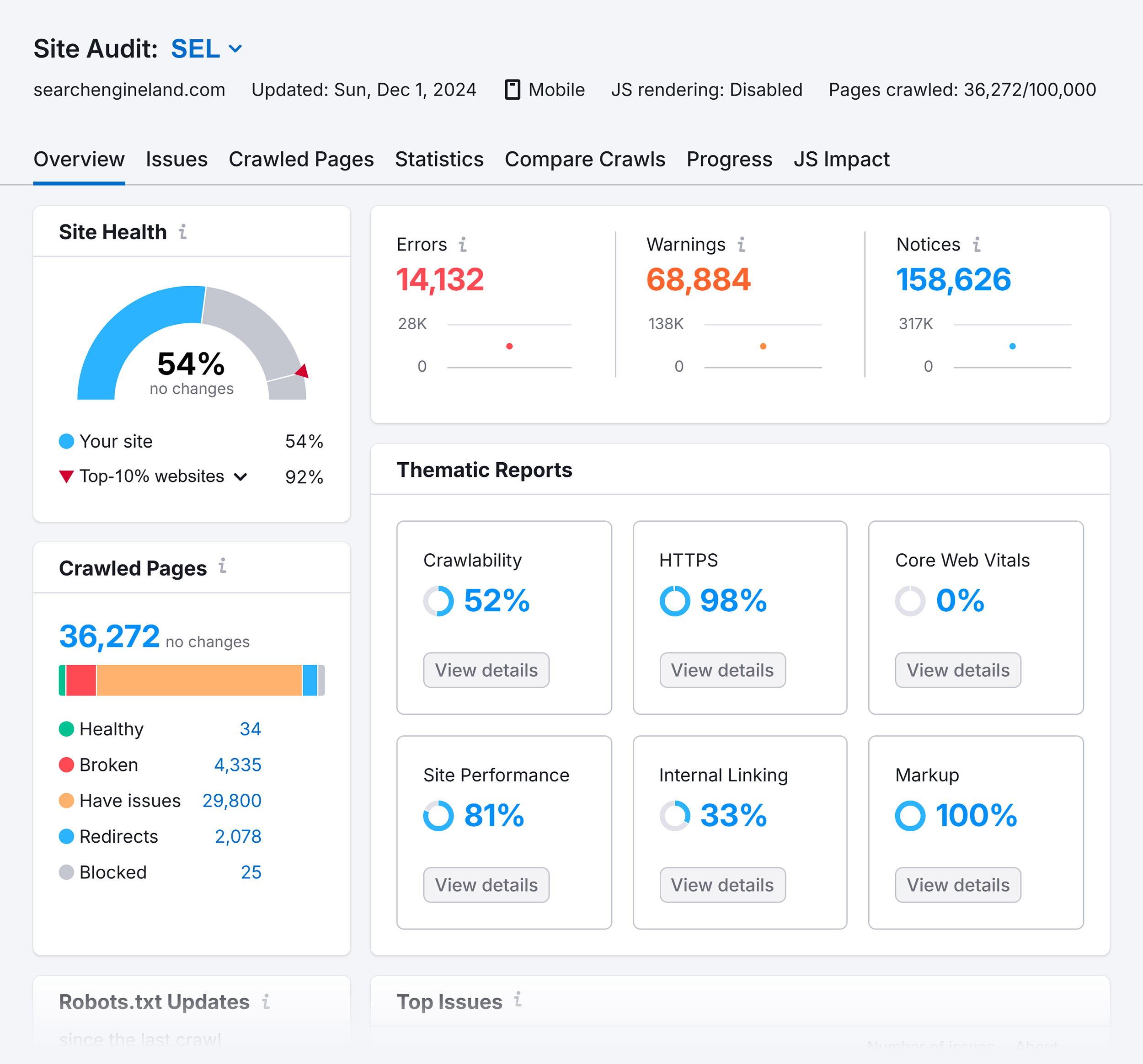
To check your entire site’s health and performance, use Semrush’s Site Audit tool. 

Get a detailed report showing technical issues on your website and how you can fix them.

Site Audit – SEL – Overview

At the end, you want a fast, stable, and easy-to-parse website.

That’s what earns AI citations.

Step 2. Maintain Wikipedia + Knowledge Graph Accuracy

AI systems rely on public data sources to build their understanding of your brand.

If that information is wrong, every answer AI generates about you will be too.

Wikipedia is one of the most cited sources on ChatGPT for all industries covered in Semrush’s AI Visibility Index.

Semrush Enterprise Overall Chatgpt And Wikipedia Scaled

Interestingly, Google AI Mode leans heavily on its Knowledge Graph to validate facts about companies and products.

Semrush Enterprise Overall Google Ai Mode Scaled

When your Wikipedia page contains outdated info — or your Knowledge Graph shows old details — those inaccuracies get baked into AI responses. 

That hurts trust, sentiment, and your chance of being cited in the long-term.

So your job is twofold:

  1. Make sure your brand exists in these systems
  2. Keep the data clean and current

Start with your Wikipedia page. 

If you have one, audit it quarterly.

Fix factual errors, like outdated product names, revenue ranges, or leadership bios.

Support every edit with a credible third-party source: news coverage, analyst reports, or industry publications.

Wikipedia doesn’t allow brands to directly promote themselves. And promotional edits get removed. 

Wikipedia Yes It Is Promotion Scaled

But updates to fix factual errors usually stick. As long as you provide solid citations.

You can use the “Talk” page of your Wikipedia entry to propose corrections.

Wikipedia Talk Page Scaled

If you don’t have a Wikipedia page, you’ll need to meet notability guidelines. 

That typically means coverage in multiple independent, well-known publications. 

Once that’s in place, a neutral editor (not on your payroll) can create the page.

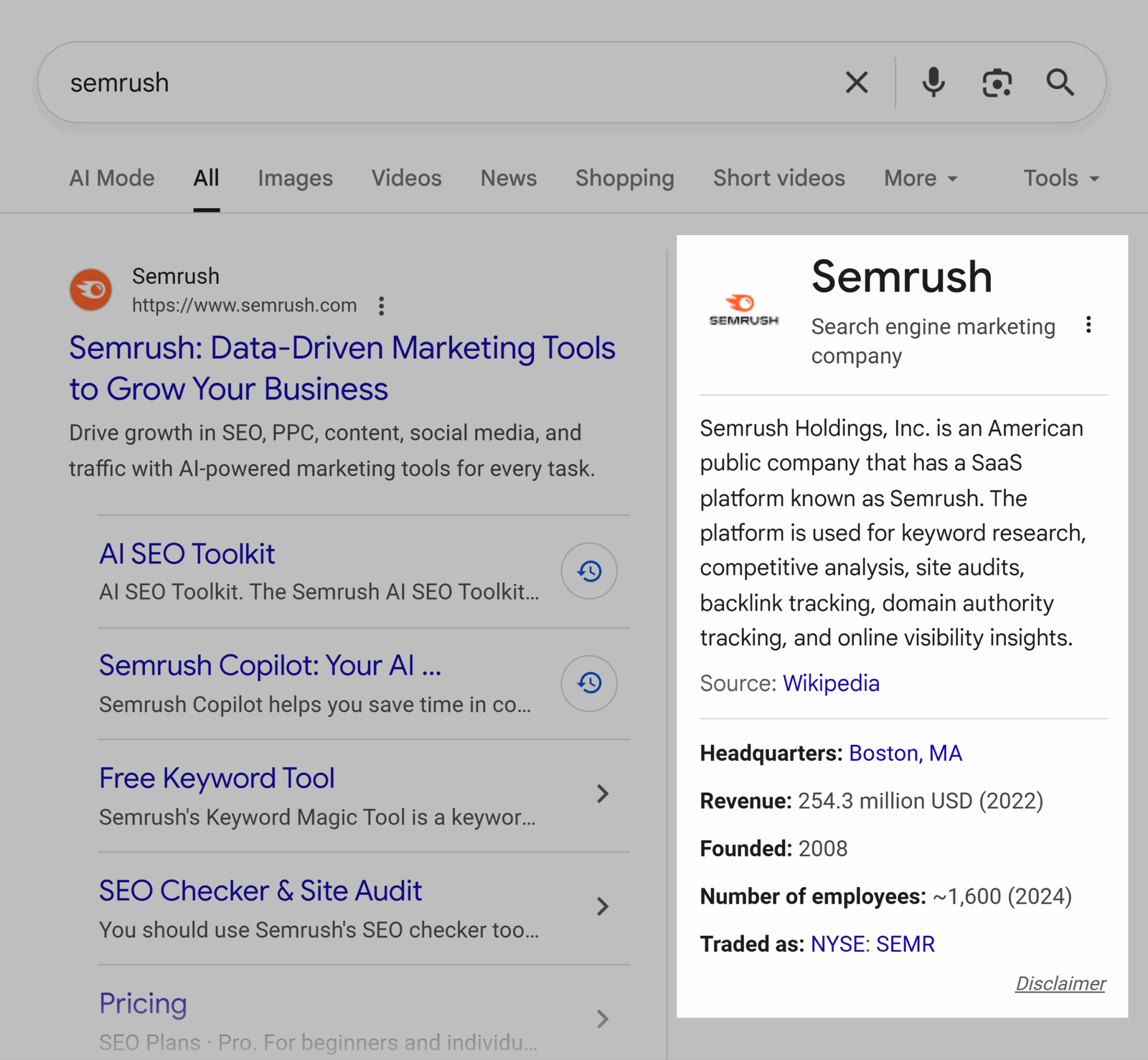
Next, fix your Knowledge Graph.

Google Serp Semrush Knowledge Graph Scaled

Google pulls its brand facts for its knowledge graph from multiple sources. Like Wikidata, Wikipedia, Crunchbase, social profiles, and your own schema markup.

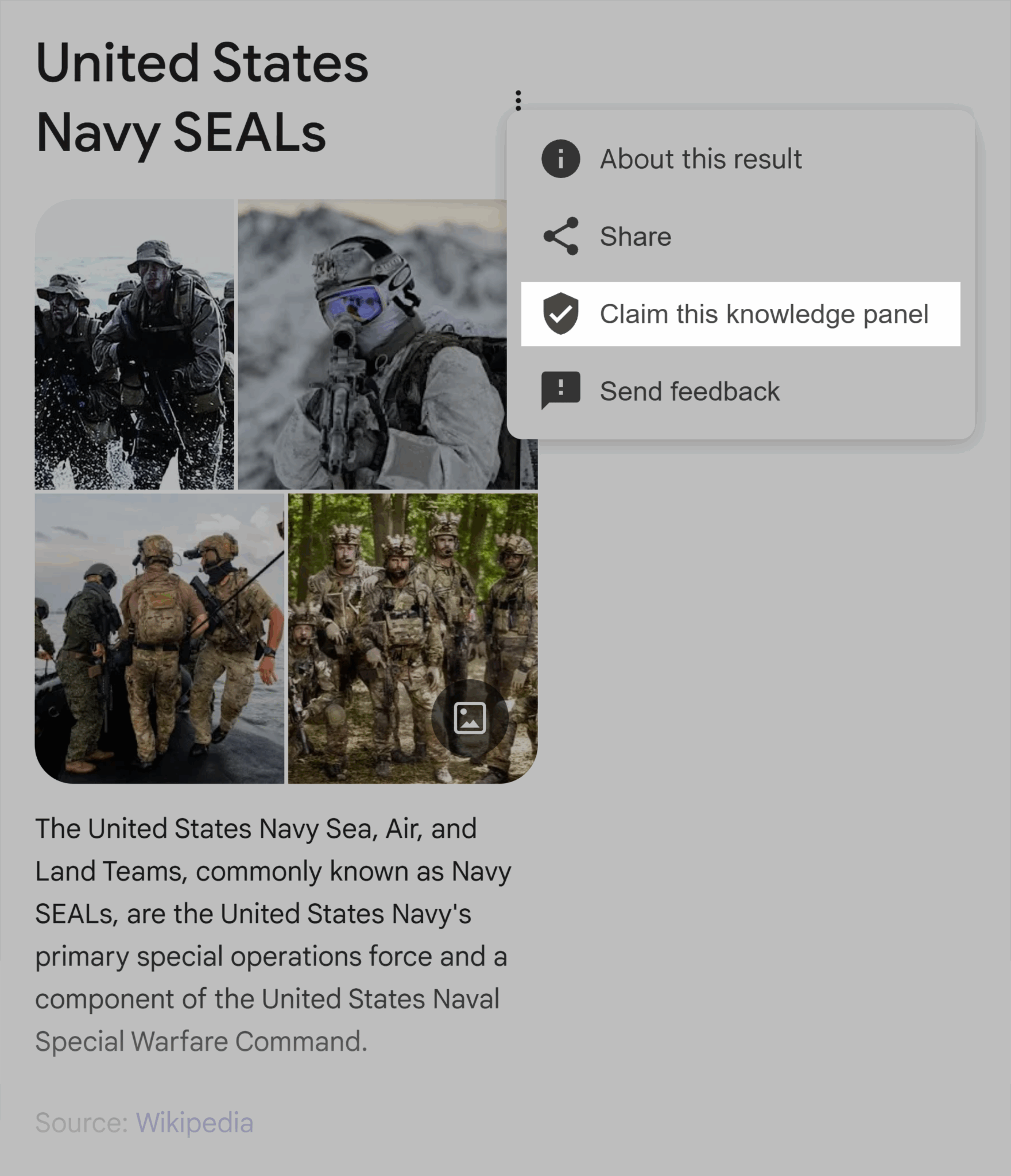
Start by “claiming” your Knowledge Panel. 

This means a knowledge panel already exists for your company when you search its name. You just have to claim it by verifying your identity.

Claim This Knowledge Panel Scaled

If you don’t see one, you’ll need to feed Google more structured signals.

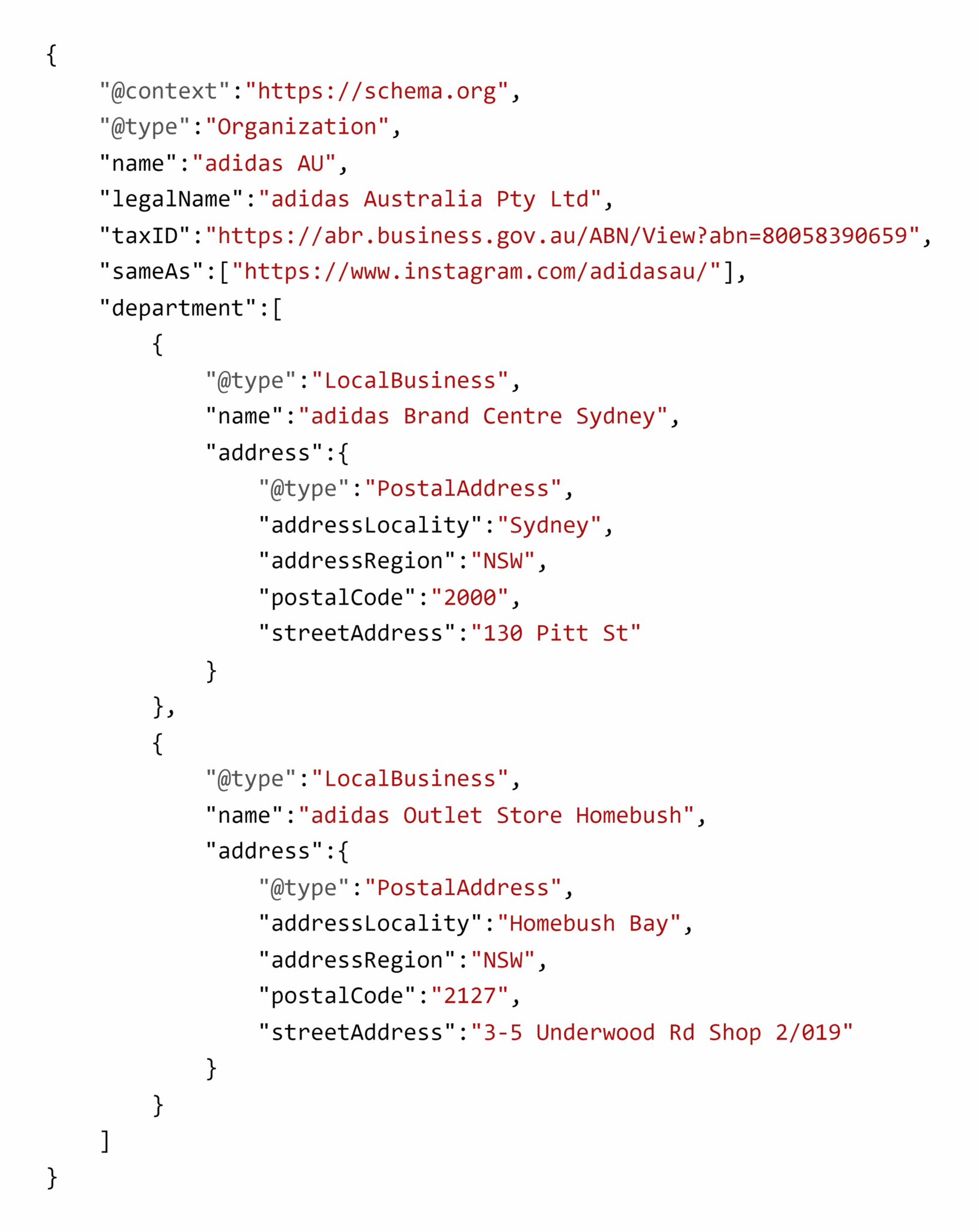
Start by adding or improving your Organization schema on your homepage.

Schema Organization Scaled

Then, make sure your company has a proper Wikidata entry. Google may use this to build its Knowledge Graph.


Wikidata Zoho Corporation Scaled

A strong Wikipedia page and Google knowledge panel shape how AI understands your brand.

Get them right, and you build a foundation of factual authority that AI systems can trust.

Step 3. Publish Transparent Pricing

Hidden pricing creates negative sentiment that AI systems pick up and amplify.

When users can’t find your pricing, they turn to Reddit and LinkedIn. And the speculation isn’t always favorable.

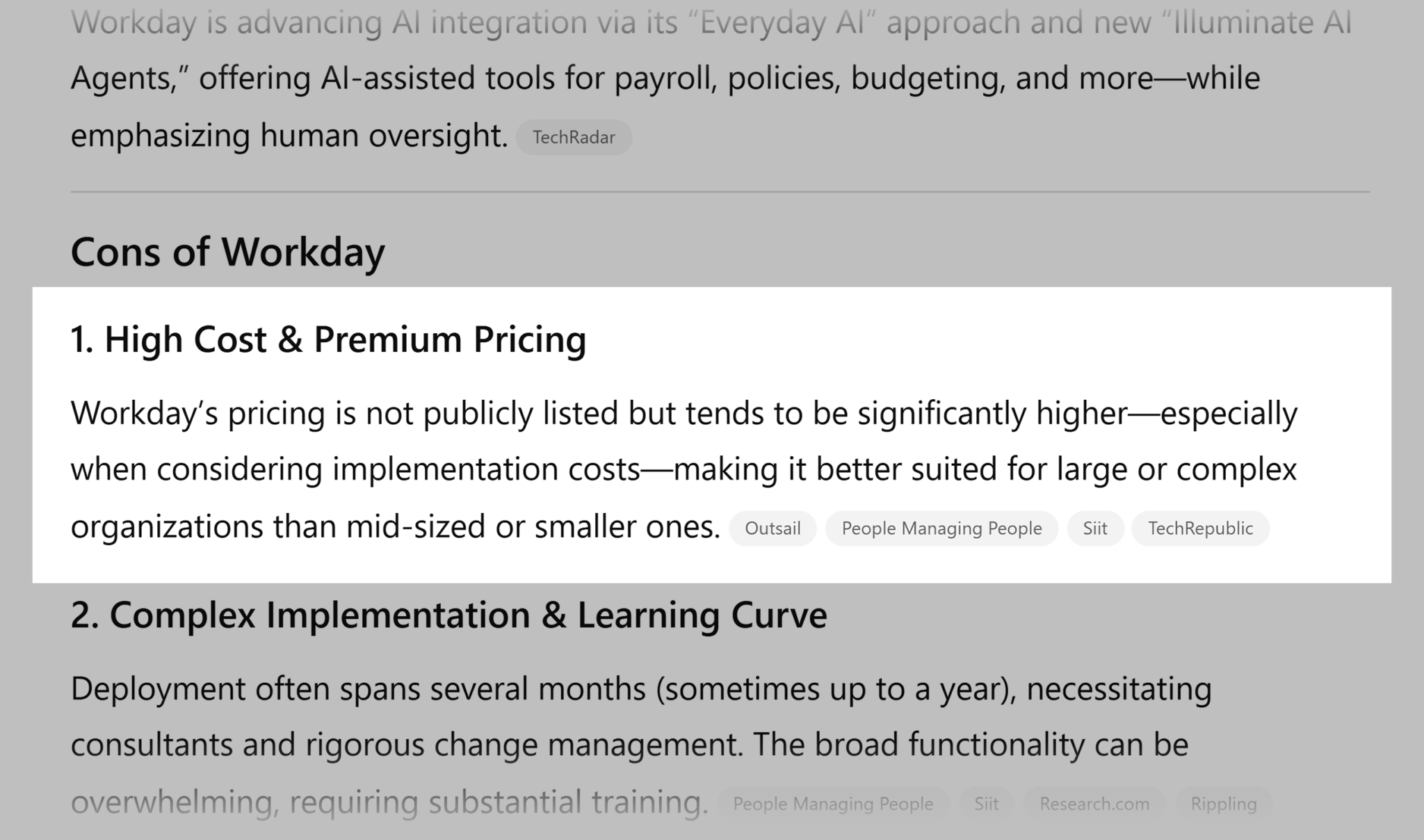
For instance, Workaday doesn’t show its pricing.

Workaday Doesnt Show Its Pricing Scaled

And the Reddit comments aren’t helpful to its potential customers.

Reddit Workaday Comments Arent Helpful Scaled

According to Semrush’s AI Visibility Index, when enterprise software hides pricing behind “Contact Sales,” AI uses speculative data points from Reddit and LinkedIn. 

And it often links that brand with negative price sentiment.

Because AI systems are biased toward answering, even if it means citing speculation. 

They’d rather quote a complaint from third-party sites about “probably expensive” than admit they don’t know.

Chatgpt Quote A Complaint Scaled

Without clear pricing, you’re also excluded from value-comparison queries like “best budget option” or “most cost-effective for enterprises.”

Publishing transparent pricing creates reliable data that AI trusts over speculation.

Now I understand this isn’t always possible for every brand. Whether to show pricing depends on various other decisions and strategies.

But if you want to build trust for higher AI visibility and positive sentiment, transparent pricing is important.

Which means:

  • Include tier breakdowns with feature comparisons
  • Spell out annual vs. monthly options
  • List any limitations or user caps
  • Update your pricing on G2, Capterra, and other review sites

When reliable sources like your pricing page and G2 have clear information, AI stops turning to speculation. 

That transparency becomes part of your brand identity and authority.

Step 4. Expand Documentation & FAQs

Your support docs and help center often get cited more than your homepage.

Because AI systems look for detailed, problem-solving content. Not marketing copy.

Apple holds one of the highest shares of voice in ChatGPT and Google AI Mode responses for the Consumer Electronics vertical.

Consumer Electronics Shares Of Voice Apple Scaled

Its support documentation appears consistently in AI citations across tech queries. 

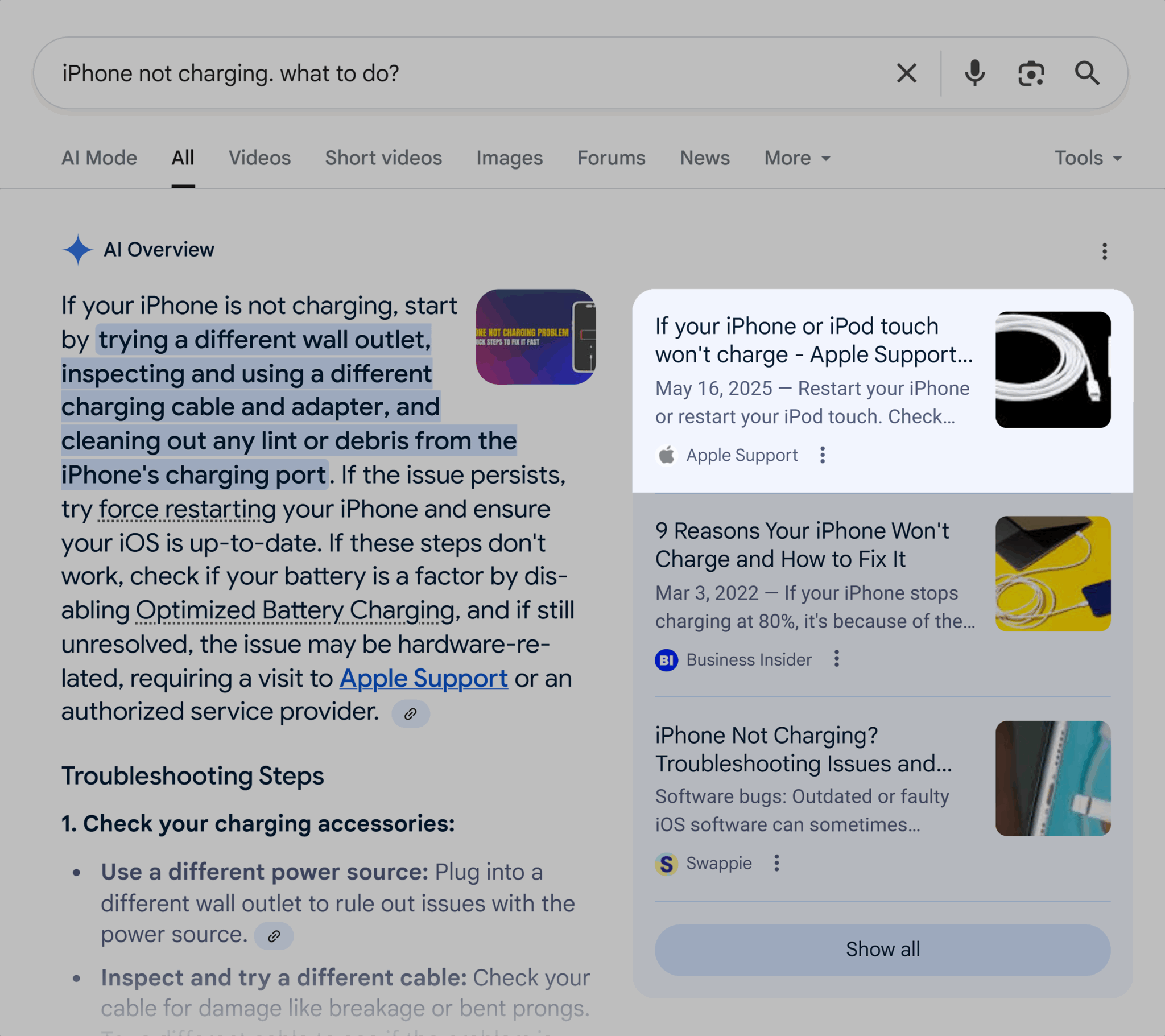
When I ask ChatGPT how to fix an iPhone issue, it cites support.apple.com.

Google Ai Mode Apple Support Scaled

Product documentation dominates citations in technical verticals.

Why?

Because it answers specific questions with step-by-step clarity.

Your product documentation is a citation goldmine if you structure it right.

Start by creating dedicated pages for common problems. “How to integrate [Product] with [Product]” beats a generic integrations page.

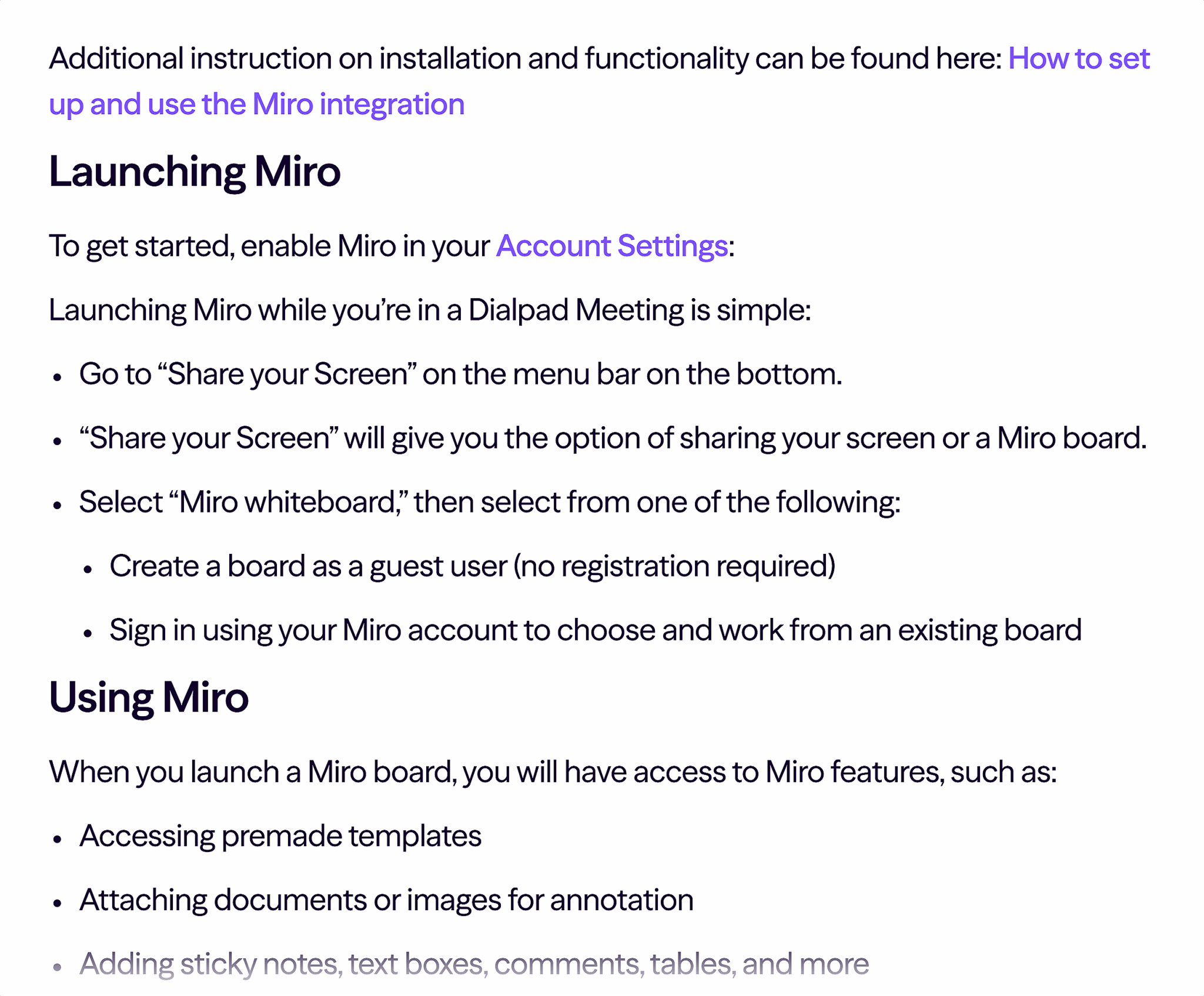
For example, Dialpad has dedicated pages for each app it integrates with.

Dialpad All Aps Scaled

And each page clearly explains how to connect both apps.

Dialpad App Marketplace Scaled

Next, write troubleshooting guides that address real user issues. 

(You can learn about these issues from your sales teams, account managers, and social media conversations.)

Also, build a comprehensive FAQ library that actually answers questions. Not marketing-friendly softballs, but the hard questions users really ask.

Make sure every page is crawlable:

  • Use static HTML for all documentation
  • Create XML sitemaps specifically for docs
  • Implement breadcrumb navigation
  • Add schema markup for HowTo and FAQ content

The goal is to become the default source when AI needs to explain how your product works.

Not through SEO tricks, but by publishing the most helpful, detailed, accessible documentation in your space.

Step 5. Create Original Research That AI Wants to Cite

Original research gives AI systems something they can’t find anywhere else. Your data becomes the evidence they need.

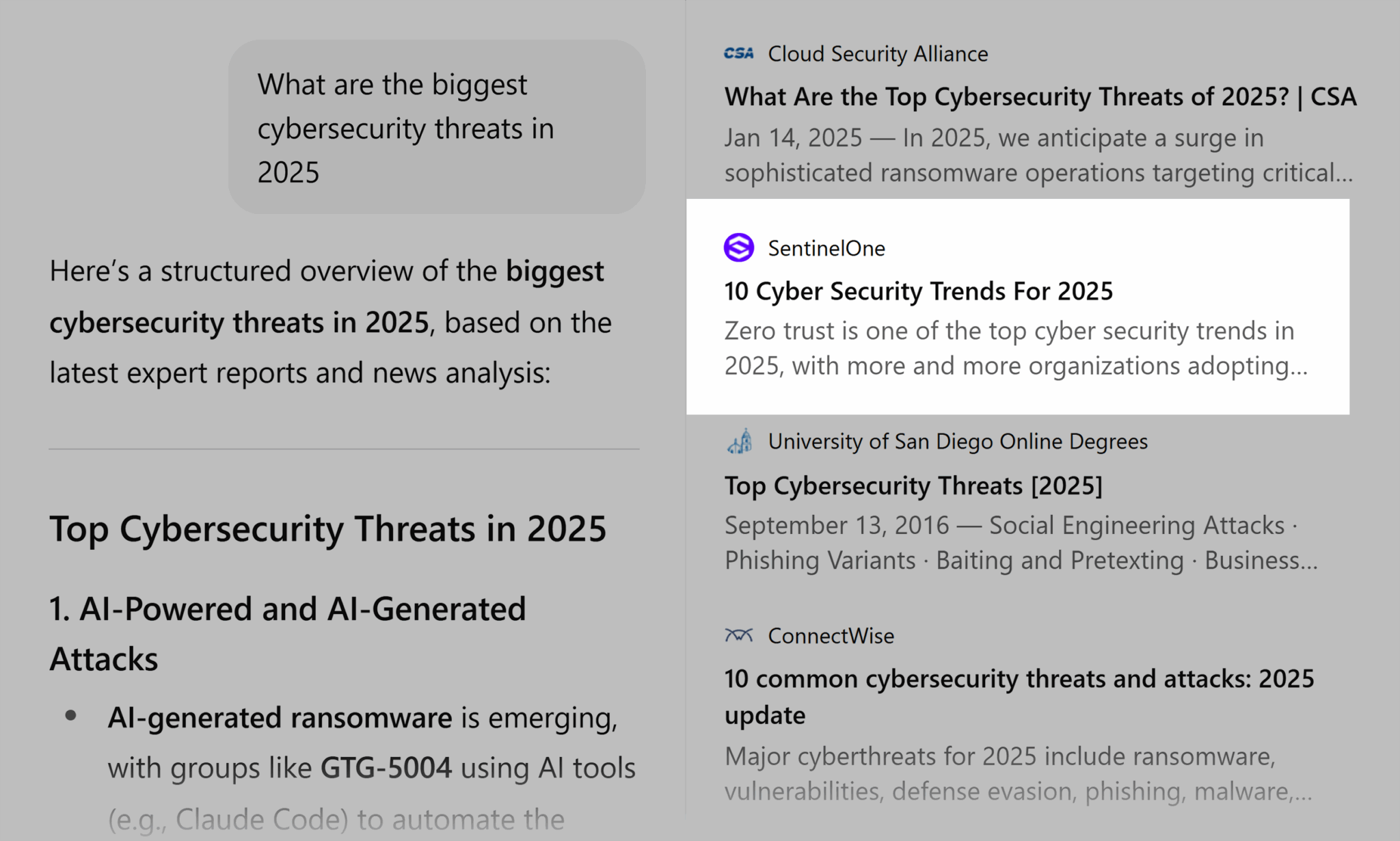
Take SentinelOne as an example. It’s a well-known brand in cybersecurity.

They regularly publish threat reports, original data, and technical insights.

Sentinel One Original Research Scaled

This is one of the reasons they often get cited as a source in AI responses. 

Chatgpt Sentinel One As Source Scaled

In the intro, I said very few brands are both mentioned and cited by AI. Remember?

SentinelOne is one of those brands that has built dual authority.

According to Semrush’s AI Visibility Index, it’s the 15th most cited and 19th most mentioned brand in the Digital Technology vertical.

Because it publishes original insights that aren’t available anywhere.

And AI systems want: verified data, industry insights, and quotable statistics.

But not all research gets cited equally.

  • Annual surveys with significant sample sizes (think: 500+) carry weight. But “State of [Industry]” reports based on 50 responses might not.
  • Benchmark studies comparing real performance data become go-to references. But thinly-veiled sales pitches disguised as research might get ignored.

You can use your proprietary data to create original research reports.

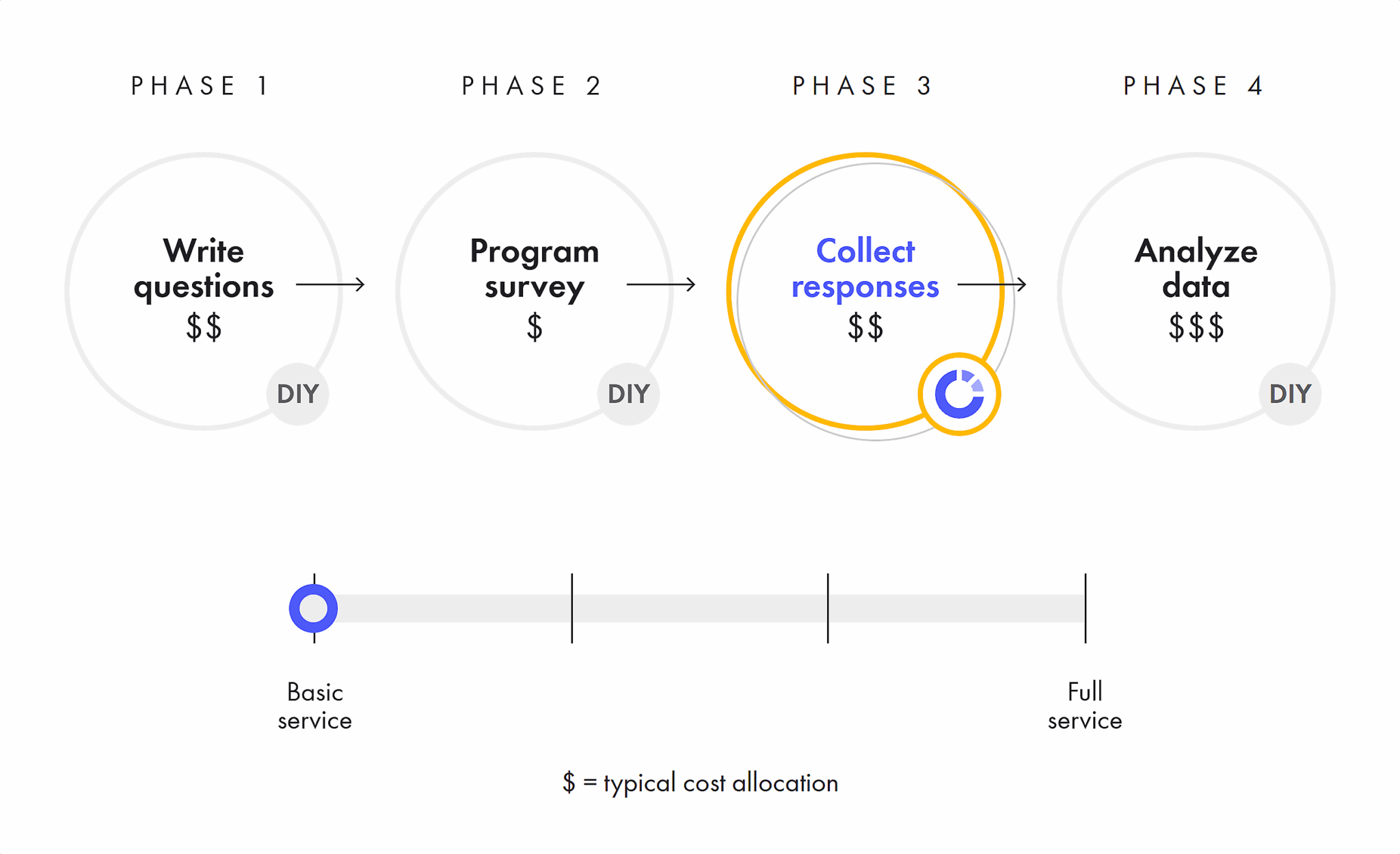
Or team up with market research companies like Centiment that can help you collect data through surveys.

Centiment Survey Lifecycle Scaled

When creating these reports:

  • Lead with key findings in bullet points
  • Include methodology details for credibility
  • Provide downloadable data sets when possible
  • Add structured data markup for datasets

Also, promote findings through press releases and industry publications. 

When Forbes, TechCrunch, and other leading publications cover your research, AI systems are more likely to notice.

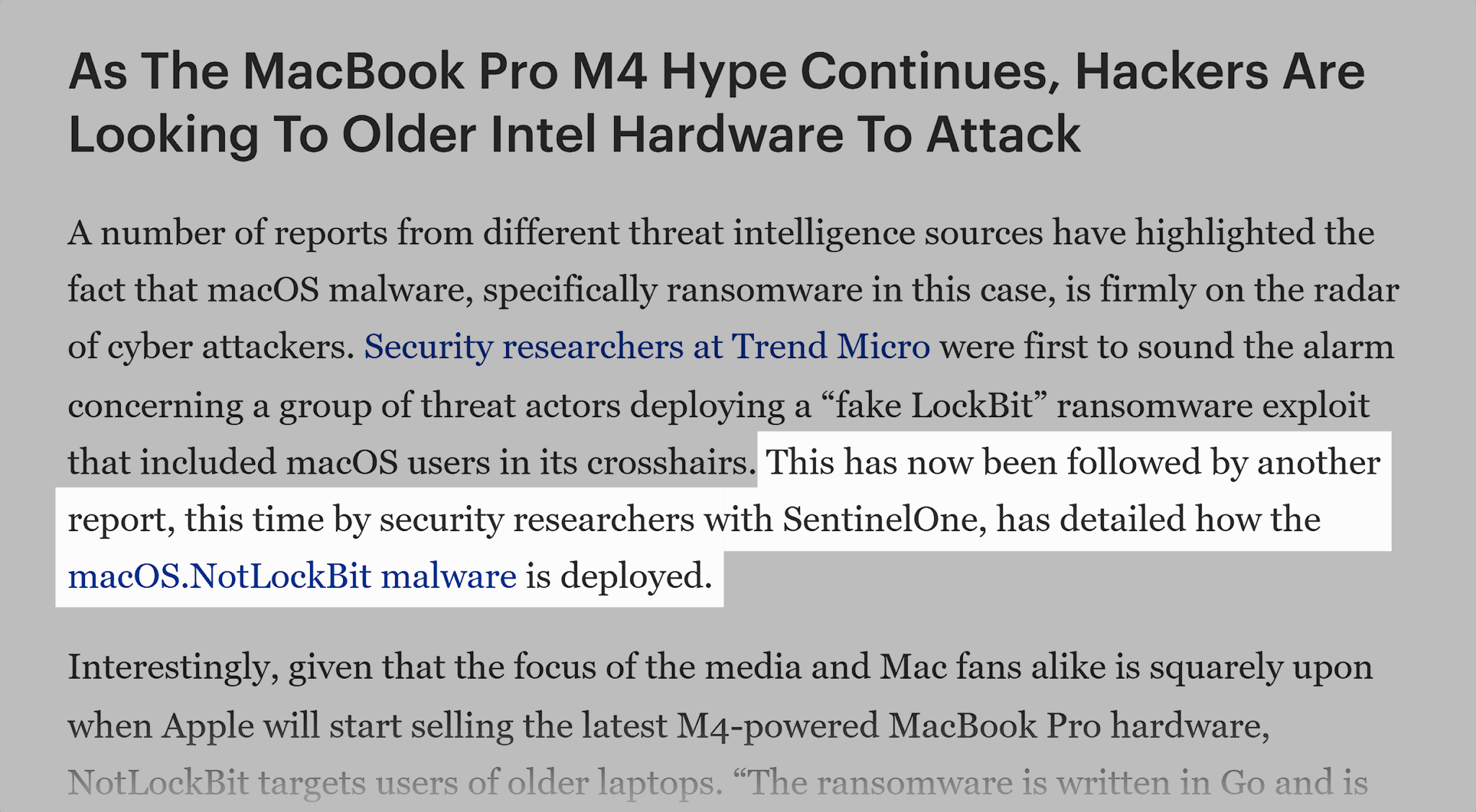
Like this SentinelOne report covered by Forbes:

Forbes Sentinel One Report Scaled

The compound effect here is powerful. 

Your research gets cited by news outlets → which gets cited by AI → which drives more coverage → which builds more authority.

That’s how you go from being mentioned to being the source everyone (including AI) trusts.

Pulling It All Together – Running Both Playbooks

You’ve seen the framework. Now it’s time to execute.

Step 1. Audit Your Current AI Visibility

Start by understanding your baseline.

Run test queries in ChatGPT and Google AI Mode. Search for your brand, your category, your product, and the problems you solve.

Note where you’re mentioned (in the answer itself) and where you’re cited (in the source list). Screenshot everything.

If you’re using Semrush’s Enterprise AIO, you can use Competitor Rankings to see how often your brand shows up in AI answers compared to your competitors.

Semrush Enterprise AIO – Backlinko – Brand changes and rankings

Step 2. Build Parallel Campaigns

Both playbooks need to run simultaneously. 

You can’t wait to be “seen” before building trust.

  • Playbook 1 (Seen): Customer success drives review campaigns. Community managers engage in forums. PR pushes for “best of” list inclusion.
  • Playbook 2 (Trusted): Product publishes transparent pricing. SEO and engineering improve site structure. Support expands help content. Marketing creates original research.

The key is coordination. 

Create a shared dashboard to track each team’s contributions to AI visibility.

Step 3. Monitor and Iterate

AI visibility shifts fast. What worked last month might not work today.

Track your mentions and citations monthly. 

Use an LLM tracking tool like Semrush or a manual prompt list to see how you’re showing up (and how often).


Watch for imbalances. 

Strong mentions but weak citations? Focus on authority signals from Playbook 2.

Cited often but rarely mentioned? Ramp up your community and sentiment work.

Also: watch your competitors. When someone jumps in AI visibility, reverse-engineer what changed. 

New PR coverage? More reviews? A pricing update?

The brands winning AI search aren’t waiting for perfect strategies. They’re testing, learning, and adjusting faster than their competition.


The AI Visibility Window is Open

In addition to listing your brand, AI platforms influence what buyers see, trust, and choose.

And right now, AI visibility is anyone’s game. Only a few brands in each industry have cracked the code of being both mentioned and cited.

That means even established giants can be outmaneuvered if you move faster on AI strategy.

So while competitors debate whether AI search matters, you can build the presence that captures tomorrow’s buyers.

The Seen & Trusted Framework gives you the direction.

Run both playbooks. At once