Unlock massive growth with programmatic SEO. Learn how to automate content at scale, target long-tail keywords, and dominate SERPs with smart systems.
Imagine that your competitors are ranking for thousands of long-tail keywords you’re not even targeting. While you manually create one blog post per week, they’re systematically capturing entire keyword clusters with programmatic content strategies.
Their campaigns scale rapidly, dominating the search results. You feel like you’re struggling just to catch up.
Programmatic SEO solves this problem of scale by using templates and structured data to generate relevant, optimized pages for specific search queries. When executed correctly, companies can leverage SEO and automation tools to capture search traffic across thousands of keyword variations without pouring extensive resources into creating each page individually.
As a result, it’s particularly useful for large companies serving diverse, distinct audiences or which have expansive products or services. Sites like Yelp use programmatic SEO to create directory pages and Zapier, a software company that helps to automate and integrate more than 8,000 web-based applications, uses it for their expansive integration pages.
However, you need the right strategy in place to ensure you’re incorporating enough editorial oversight and offering enough value to align with search intent and demonstrate E-E-A-T on each page.
In this guide, you’ll learn about the systematic approach behind these content powerhouses, learn when programmatic SEO makes sense for your business, and get proven frameworks for scaling quality content that aligns with Google’s helpful content update.
What is programmatic SEO? (And why is it a high-leverage growth tactic)
Programmatic SEO is the practice of creating large volumes of SEO-optimized pages using templates, structured data, and automated content systems.
You aren’t manually creating each page, which allows large brands to create relevant content for a variety of search phrases quickly.
For example, if you’re looking for a local painter, you don’t want a list of the 10 best painters of all time. You want local painters you could actually hire. This is why sites like Yelp have directory pages for each individual city, which makes it easy for people to find the exact information they’re searching for.

Modern programmatic SEO isn’t exclusively about the volume of output just for the sake of having more pages. Instead, the most successful implementations focus on three key principles:
- Relevance: Each generated page targets specific search intent with genuinely useful information, not keyword-stuffed content. Yelp’s pages, for example, target specific cities; this is more effective than trying to target “painter near” keywords for multiple cities on a single page.
- Quality: Templates incorporate unique data, expert insights, or proprietary tools that provide real value to searchers and offer a positive user experience.
- Structure: Pages follow consistent patterns that search engines can easily understand and index efficiently.
Companies like Zapier have a large number of pages that detail different integrations available for specific tools. In the example below, the Salesforce integration page shows that it pairs with apps like Slack, Google Sheets, and Gravity Forms. The page also highlights automations available, like “Send new Unbounce leads to Salesforce.”

Their approach is effective because it provides the information users need quickly, showing which integration and automation options are available for the specific tool they’re searching for.
It’s useful and actionable because users can take action quickly. In the example above, this means identifying potential integrations and automations that they can set up in just a few clicks—even if they didn’t know about those automations to begin with.
Popular programmatic SEO use cases
Programmatic SEO is commonly used to scale the production of specific types of site pages, including:
- Location pages
- Landing pages for different products or product variations
- Integration pages featuring specific tools
- Use case templates
- Product or feature comparisons
When and why to use programmatic SEO
Programmatic SEO becomes essential when manual page creation would be unrealistic given the scope of what you need to make—especially when you’re creating multiple versions of a single type of page.
For example, if you’re missing traffic because competitors cover more keyword variations or because users are searching for terms you’re not optimizing for, a programmatic approach could level the playing field quickly. While it will require developer resources, it can help you scale up your output.
Let’s discuss what this may look like in action.
Cognism, a sales intelligence platform, uses comparison pages as part of their marketing funnel. These pages focus on specific direct competitors in detail. By creating distinct pages, they can show up in search results for each individual competitor.
In this case, users likely searched for phrases like “Apollo alternatives” or “Cognism vs. Apollo.” They’re trying to determine which tool is best for them so they can make a purchase decision and may be stuck between the two tools.

When determining if you should use programmatic SEO, it’s important to consider both advantages and potential disadvantages. That way, you can decide whether it’s right for you—or if you’re biting off more than you can chew.
The advantages of programmatic SEO include:
- The ability to rapidly scale your reach across thousands of keyword targets, giving you the potential for greater visibility across relevant keywords thanks to the now-available content. This can also increase conversion potential.
- That it allows for the ability to create systematic coverage of long-tail search opportunities, which are longer and more specific search phrases like “best 5-star Boston hotels” instead of “Boston hotels.” These keywords may be relatively low-competition and help you stack search rankings to build momentum.
- You can better maintain consistent optimization across a large collection of specific pages (or “page sets”) for increased efficiency.
- The opportunity to leverage your resources more efficiently for a large volume of content creation, compared to the more time-consuming manual creation of content. This may free up your team’s time to focus on other projects.
And the disadvantages of programmatic SEO include:
- There’s a risk of thin or duplicate content penalties, which could reduce visibility or fail to give customers the specific information they need.
- It’s not a “beginner” form of SEO or a good option for teams with limited resources, as it requires a team or even developers to implement correctly
- It requires significant upfront template development, which can take up a lot of time and effort without delivering an immediate payoff.
- There are ongoing maintenance and quality monitoring needs, contributing to the requirement for continued resources.
- It may not work if you’re covering topics requiring deep expertise or original research; that type of content typically requires manual and individualized creation.
- Google penalties could occur if the strategies aren’t executed well and it violates Google’s spam policies.
- You could experience indexation issues if Google sees the pages as duplicates, which may result in certain pages not getting indexed or receiving visibility in the SERPs.
Scenarios where manual SEO doesn’t scale
Sometimes, the manual effort tied to traditional content creation is still your best bet. This is particularly true if you’re creating unique, complicated, or in-depth content.
For example, Zapier’s integration pages are highly scalable thanks to templates that can source important information quickly.
If Zapier wanted to feature a tutorial on integrating Gmail into your Salesforce for improved collaboration, manual creation of a long-form resource would be better. It would allow for more in-depth discussion of a unique and nuanced topic.

That said, manual content creation breaks down when you need to target 1,000+ long-tail keyword variations of a single page. Writing individual pages for every product comparison, location variation, or use case combination becomes resource-prohibitive for most teams. Enter programmatic SEO strategy to tackle these web pages.
For example, Two Men and a Truck is a national moving company. If people are searching for moving services, they’ll want to quickly find a solution that services their area. As a result, the company has landing pages for specific cities or regions to increase search traffic and customer relevance.

Since potential customers don’t have to wonder if this mover services their area, they can quickly move forward with a quote. Since they’re a national company, programmatic SEO can help this company create individual location pages at scale.
Types of businesses that benefit most
Certain types of businesses are most likely to benefit from programmatic SEO due to the scale of output. These businesses include:
- SaaS companies like Zapier that need to create pages for every industry, use case, integration, or feature combination their software supports
- Marketplaces like eBay that need pages for every product category, brand, price range, and feature filter combination
- Multi-location businesses like Two Men and a Truck that require pages for every service offered in every geographic market they serve
- Aggregators and comparison sites like G2 or Yelp that cover every possible product or service comparison their audience might search for
As a note: Some teams may benefit more from using AI to create scalable content campaigns instead of programmatic SEO.
AI doesn’t require developer resources in the same way as the programmatic SEO we’re covering, though it does often involve manual review. As a result, you may want to assess whether AI-scaled campaigns would benefit your team more than programmatic SEO.
How to align programmatic SEO with business goals
Programmatic SEO will be most impactful when it aligns with your business goals to help ensure that your scaled campaigns are worth the payoff.
If you want to increase bookings at different locations across the country, for example, creating landing pages that detail local services is a good move. Similarly, SaaS companies looking to expand into new markets could use programmatic SEO to create landing pages for each specific industry in your ideal customer profile (ICP) and drive up conversion rates.
Prioritize templates with high conversion potential
Start by mapping your programmatic content to actual business value, not just search volume. Pages targeting bottom-funnel keywords (like “[your product] for [specific use case]”) typically drive higher-converting traffic than generic informational content (like “what is [general industry topic]).
When prioritizing templates by conversion potential, keep the following in mind:
- High-value templates target commercial intent keywords where searchers are actively evaluating solutions. These are pages like product comparison pages, pricing-focused content, and use-case specific landing pages typically convert better than informational guides.
- Medium-value templates capture research-phase traffic that may not convert immediately but influences later purchasing decisions. Some examples are industry guides, feature explanations, and educational content to build brand awareness and trust.
- Low-value templates focus on broad, informational queries. While these can drive traffic, prioritize them only after high-conversion templates are performing well.

Direct product comparisons, for example, will be helpful to users who are actively determining what product to purchase. If you have a strong product comparison page that users find, they may decide to purchase from you. This could drive an immediate conversion.
Meanwhile, industry guides are still helpful, but they may target users who are in the middle of their buyer’s journey. They can build trust and provide valuable information, which can help to start a relationship. These templates may help influence a conversion decision later, but are unlikely to result in an immediate purchase now.
Map programmatic content to customer journey stages

Programmatic content can be mapped to different stages of the customer journey to ensure you’re reaching customers with the right messaging at the most effective times. Here’s what that may look like:
- Awareness stage: If your user is in the awareness stage, you want to create templates that educate prospects about problems they might not fully understand yet. For example, “[Industry] challenges” or “Why [solution category] matters” page types work well here.
- Consideration stage: To reach customers during the consideration stage, you can build comparison templates and feature-focused pages that help prospects evaluate different approaches or solutions.
- Decision stage: You can win over customers in the decision stage by developing use-case specific and implementation-focused templates that demonstrate exactly how your solution solves specific problems.
Ensure brand voice consistency across scale
Template-generated content should sound like it came from your team, not a content mill (or AI). Develop style guidelines that include your brand’s tone, terminology preferences, and messaging frameworks that can be systematically applied across thousands of pages.
Content frameworks are structured approaches or templates that guide the creation and even organization of your content. They can help ensure consistency and quality even when you’re creating large volumes of new pages quickly.
When well executed, content frameworks preserve quality while scaling efficiency. This means defining standard approaches for introductions, explanations, examples, and calls-to-action that maintain your brand voice regardless of the specific keyword target.
You may require that blog posts start with a story-based approach that connects to a pain point, for example. Or, that all CTAs include a specific conversion action like signing up for a newsletter or booking a demo.
How to scale programmatic SEO without triggering penalties
The key to avoiding Google penalties for duplicate content is to ensure that every programmatic page serves specific search intent with unique, actionable information. Google’s helpful content guidelines specifically target low-value, template-generated pages that don’t provide genuine value.
Improperly implemented programmatic SEO could trigger Google’s quality or helpful content penalties. These penalties could deprioritize you in the SERPs, impacting your rankings and visibility, so it’s essential to make sure that you find a scalable process without triggering those penalties.
Start by focusing on high-intent queries with specific solutions
Each template should target searchers with clear, specific needs. Instead of generic “[keyword] guide” pages, focus on “[specific problem] solution for [specific target audience]” patterns that match actual search behavior.
For example, “CRM software” is too broad for programmatic content. But “CRM software for real estate agents with MLS integration” targets specific intent that a well-designed template can genuinely address.
How to avoid thin, duplicate content
Thin programmatic SEO pages can result in near-duplicate content. While Google doesn’t automatically “penalize” duplicate content, it will decide which pages should rank for certain keywords—which could cause other “duplicate” pages to not rank as a result.
These strategies can help you ensure that your programmatic pages are offering real value:
Use modular content blocks with dynamic data
Build templates from interchangeable components that combine differently based on the target keyword.
For example, a location page template might include local statistics, nearby landmarks, regional testimonials, and area-specific pricing—all pulled from structured data sources.
For example, G2 has a dynamic review module on its product review pages. It automatically updates rankings and pros and cons based on customer views to ensure ever-accurate overviews.

Include human-authored introductions
Start each programmatic page with manually written content that provides context, explains the specific value proposition, or addresses unique aspects of that keyword variation. This can increase the relevance and quality of the content right away.
For example, each Yelp “top 10” page might have a custom-written introduction that uses popular local references or location-specific slang. A restaurant directory might mention getting a “pop,” instead of a “coke” or “soda,” depending on the regional dialect locals use.
Embed proprietary data, tools, or visuals
The strongest programmatic pages include elements competitors can’t replicate: your own research data, custom calculators, exclusive interviews, or original graphics tailored to each page’s focus—and resulting in truly authoritative, unique content.
Scale structure instead of creating boilerplate content
Templates should standardize page architecture (headings, sections, calls-to-action placement) while allowing for content variation. Avoid repeating identical paragraphs across multiple pages with only keyword substitutions.
Conduct regular audits
Regular audits can identify content or keyword cannibalization, which involves targeting the same keywords with multiple pages. Keyword overlap can prevent you from ranking well for each asset. Once identified, you can revise your keyword strategy or optimize pages with keyword overlap.

Building flexible templates that scale without sacrificing quality
Successful programmatic templates balance automation with customization to generate genuinely useful pages rather than assembly-line content. The goal is creating frameworks that serve real user needs while maintaining efficiency at scale.
Essential template elements include:
- SEO-friendly titles and meta descriptions: Build dynamic title formulas that include target keywords naturally while remaining compelling to searchers. “Best [category] for [audience] in [year]” works better than “[keyword] – [brand]” patterns, for example. Use modifiers strategically, informed by your keyword research and target audience’s habits.
- Audience-tailored introductions: Instead of generic keyword-focused openings, craft intros that speak directly to the searcher’s situation. Address their specific pain points, goals, or constraints. A vacuum’s product page, for example, might stress that it’s lightweight if it’s targeting seniors who may struggle with heavier models.
- Structured data integration: Include relevant schema markup for each page type. For example, product comparison pages need product schema, location pages need LocalBusiness markup, and FAQ sections should use FAQ schema to enhance search result appearance.
- Strategic calls-to-action: Place conversion opportunities that match the user’s search intent. Top-funnel informational pages might encourage users to download content like checklists, while bottom-funnel product pages should drive users to sign up for free trials or demos.
Let’s take a look at Airbnb’s listing pages that do most of this well. They often have strong, search-friendly titles, custom-written introductions by hosts, and dynamic modules that show pricing and “cancel by” dates. They also encourage users to reserve their booking with color-contrasted CTAs.

Certain types of dynamic content modules can add unique value to each page, but remain highly scalable. These may include:
- Interactive maps and local data: Location-based pages can include real-time information like local weather, demographic data, or nearby business listings that provide genuine utility.
- Comparison filters and sorting options: Product or service comparison pages should let users customize views based on their specific criteria, creating personalized experiences from template foundations.
- FAQ sections with targeted answers: Build FAQ modules that address questions specific to each keyword variation. For example, a moving company shouldn’t include a question about securing trucks overnight on long-distance moves on a landing page advertising short-distance local moves.
- User-generated content integration: Include reviews or case studies relevant to each page, adding social proof and unique perspectives. A home renovation company, for example, shouldn’t feature testimonials about their flooring installation on a landing page promoting their plumbing services.
Let’s take a look at what this looks like in practice. G2’s product pages, for example, each have multiple key components that would be relevant to readers. Notice how they have “top rated alternatives” in a block beneath the featured product? This information block shows up-to-date ratings for different competitors for each tool.

Avoiding index bloat to maintain a clean search footprint
The goal of programmatic SEO is ensuring that search engines focus on your most valuable content while avoiding penalties for low-quality pages. Large-scale programmatic SEO can quickly create indexation challenges if it’s not managed strategically.
To manage these challenges, start by setting clear index rules, which should include the following:
- Noindex low-value variants: Pages targeting extremely specific or low-volume keywords that don’t drive meaningful traffic should be excluded from search results. Focus indexation on pages with genuine search demand and business value.
- Canonicalize similar templates: When multiple programmatic pages are targeting the same or similar keywords, you can use canonical tags to designate the most comprehensive or user-friendly version as the preferred result.
- Redirect or consolidate thin pages: Monitor programmatic pages that fail to gain traction after six months. These may need content improvements, consolidation with related pages, or removal to prevent index bloat.
- Implement dynamic robots.txt rules: Instead of permanent, static rules, implement a robots.txt system that can be quickly updated when you need to hide parts of your site from search engines. This is particularly useful during website updates, A/B testing, or when rolling out new content that isn’t ready for public discovery.
Use indexation quality assurance tools
Regular indexation audits prevent small issues from becoming large-scale problems that could impact your entire site’s search performance.
Tools like Google’s Search Console and Semrush can help identify indexation issues. Monitor for crawl errors, duplicate content warnings, or pages excluded due to quality concerns. Regular site audits can systematically check meta tags, internal linking, and technical SEO elements across thousands of programmatic pages simultaneously.
To run a site audit with Semrush, you can follow these steps:
1. Start on the home dashboard. Click on “SEO” > “Site Audit.”
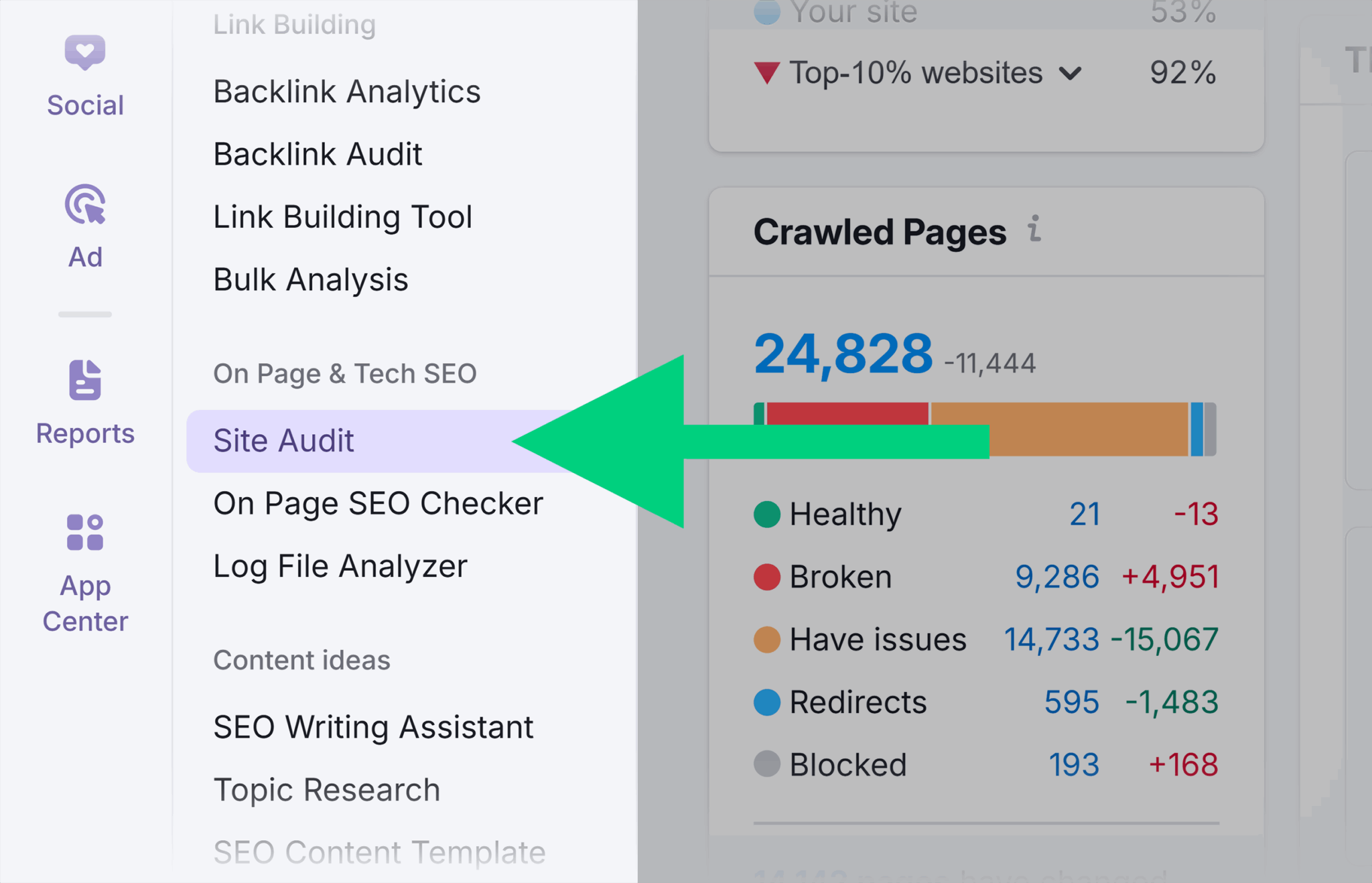
2. Click the “+ Create project” button.

3. Enter a domain name, and name your project. Click “Create project.”

4. Once completed, you’ll have a full site audit that identifies potential issues across your entire website—including your programmatic SEO pages.

Tracking the performance and ROI of programmatic SEO pages
Measuring success across thousands of programmatic pages requires systematic tracking that provides both high-level insights and granular performance data.
Teams can benefit from frameworks that can identify winning templates. Using detailed analytics tools and the right KPIs can be essential in discovering optimization opportunities for improved and ongoing performance.
1. Use GA4 for template-level analysis
Google Analytics 4 (GA4) has multiple features that can help you assess the performance of different templates.
Page path rules let you group programmatic pages by URL patterns, allowing analysis of entire template categories rather than individual pages. For example, tracking all “/location/[city]” pages as a group.
Content groups organize pages by business logic rather than URL structure. You might group all “product comparison” pages regardless of their specific URLs, making it easier to analyze performance by content type.

Image source: Google
Further reading: Master GA4: Google Analytics 4 tips & tutorials
Build segmented dashboards in Looker Studio
Google’s Looker Studio has business intelligence features that can help marketers assess performance based on different types of segmentation. Examples include:
- Page type segmentation: Compare performance between different programmatic templates (location pages vs. product comparisons vs. integration guides) to identify your most effective formats.
- Keyword cluster analysis: Group pages by search intent (informational, commercial, transactional) to understand which programmatic content drives the most valuable traffic.
- Intent group tracking: Monitor how different programmatic pages contribute to your conversion funnel, from initial awareness through final purchase decisions.
- Capture micro-conversions and assisted conversions: Assess how different pages drive different types of conversions. This is particularly valuable when evaluating long-tail research queries that may not drive immediate sales but influence later purchasing decisions.

Image caption: Looker Studio
Further reading: The ultimate Looker Studio SEO campaign dashboard for 2025
3. Evaluate success through blended metrics
Evaluating multiple key metrics can help identify which programmatic templates deliver the strongest ROI. Tracking multiple essential metrics can inform your decisions about scaling successful formats and improving underperforming content types.
You can use auditing tools like Semrush and analytics like Google Analytics or Google’s Search Console to track the following metrics and assess your programmatic SEO effectiveness.
Indexed rate
Your indexed rate tracks the percentage of pages that are successfully indexed by search engines like Google. You can track this metric in Google Search Console.
Tracking your indexed rate ensures that your pages are being crawled, indexed by Google, and have the potential to show up in search results.

Click-through rate (CTR)
Your click-through rate tells you how often users see your page in search results and click through to view your page. You can track this metric in Google Search Console, which will show you how many impressions your page got in search and how many users clicked.
This can help you monitor whether your programmatic pages attract clicks when they rank in search engines. High click-through rates indicate that a page’s title and meta description are aligning with the user’s search intent. ement metrics
Engagement metrics help you to assess how users are engaging with your programmatic SEO pages, which can be tracked with platforms like Google Analytics. They include key performance indicators (KPIs) like:
- Measure scroll depth: This metric tells you how far down the page users scrolled. The further down they scroll, the better. If they drop off halfway, however, it may mean that you need to improve your messaging early on.
- Time on page: This metric tells you how long users spend on a single page, on average. The longer they spend on the page, it’s safe to assume that the content was more relevant to them.
- Call to action clicks: This metric helps you determine how many users clicked your CTA button or links. A high number of clicks indicates that you’re both reaching the right audience and that they’re finding your offer compelling.

Conversion attribution
Use GA4’s attribution modeling or CRM integration to understand how programmatic pages contribute to business goals, both directly and through assisted conversions. You can track how many conversions occur and what types of conversions are generated.
Conversions may include:
- Booked demos
- Email sign-ups
- Purchases
- Registrations
- Downloads
- Direct contact or contact form submission

Scale programmatic SEO strategically for sustainable growth
Programmatic SEO offers exceptional opportunities to capture long-tail search traffic at scale, but success depends on prioritizing quality and user value over pure volume.
The most successful implementations start small with proven templates. Then, they’ll scale systematically based on performance data. Focus on creating high-quality programmatic content that genuinely helps searchers accomplish specific goals rather than simply targeting keyword variations.
You can use this SEO programmatic roadmap to get started:
- Create high-intent templates that target bottom-funnel keywords. These pages can demonstrate clear business value and user utility. As a result, they’re more likely to drive conversions and are a strong place to start since they can drive ROI.
- Build quality controls into your content generation process. These controls should include human review workflows and automated quality checks that prevent thin content publication.
- Monitor performance continuously. Use the tracking frameworks that we outlined above to identify and optimize successful templates. Retire underperforming content.
The companies dominating competitive search landscapes aren’t just creating more content—they’re creating more relevant, useful content that search engines want to rank. Programmatic SEO, executed strategically, can be your path to similar search dominance.


No comments:
Post a Comment