⭐ If you would like to buy me a coffee, well thank you very much that is mega kind! : https://www.buymeacoffee.com/honeyvig Hire a web Developer and Designer to upgrade and boost your online presence with cutting edge Technologies
Showing posts with label Workshops. Show all posts

Saturday, September 23, 2023

Facilitating Inclusive Online Workshops (Part 2)

 Running a workshop can be an effective alternative to traditional, long-standing meetings. However, if workshops aren’t designed with inclusivity in mind, participants may feel apprehensive about contributing, fearing criticism from others. To help ensure the success of a workshop, Ben Shih introduces the concept of an inclusive workshop. In Part 2 of the series, you will continue to delve deeper into several key principles and guidelines that you can follow during and after the workshop to encourage an inclusive atmosphere.

Earlier in the first part of the series, we defined inclusivity and how it contributes to enriching the workshop experience. We established that inclusivity is about ensuring everyone has an equal opportunity to participate and contribute, regardless of their background or identity. It goes beyond merely having diversity in attendance. It’s about creating an environment where different perspectives are valued and used to drive innovative outcomes.

In the second part, I will introduce you to the principle of the inclusive workshop through the acronym P.A.R.T.S. (which stands for Promote, Acknowledge, Respect, Transparency, and Share). After the principle is explained, we will dive into what you can do during and after the workshop to implement this principle.

The P.A.R.T.S. Principle #

Often, we fall into the trap of thinking, “I’ve got a mixed group of folks here. My inclusivity job is done!”

Yes, having a diverse set of individuals is often an essential first step. But it’s just that — a first step. It’s like opening the door and inviting people in. However, the real task begins after the guests have arrived. That’s when you need to ensure they feel welcome, heard, and valued.

As a facilitator, how can you make sure that people feel safe to express their ideas and participate actively during the workshop? Here’s where the P.A.R.T.S. principle comes in.

The P.A.R.T.S. principle is an acronym that encapsulates five key principles that can form the foundation of any inclusive workshop: Promote, Acknowledge, Respect, Transparency, and Share.

P — Promote #

Promote active participation from all attendees.

This begins with creating an environment where participants feel at ease sharing their ideas, opinions, and experiences. As a facilitator, your role is to set this tone from the beginning. One practical way to promote participation is by establishing some ground rules that encourage everyone to contribute. Another approach is to use different facilitation techniques to draw out quieter participants, such as having a quiet brainstorming session where participants can spend more time on their own to contribute their ideas or having round-robin techniques where everyone gets a turn to speak.

A — Acknowledge #

Acknowledging participants’ contributions validates their input and makes them feel heard and valued.

This can be as simple as saying, “Thank you for sharing,” or “That’s an interesting perspective.” It’s also about demonstrating that you’ve understood their input by summarizing or paraphrasing what they’ve said. By doing this, you not only confirm their feelings of being heard but also model listening behavior for other participants.

R — Respect #

Respect for all ideas, experiences, and perspectives is fundamental to an inclusive workshop.

This starts with setting expectations that all ideas are welcome, no matter how outside-the-box they may seem. It also means respecting the varied communication styles, personalities, and cultural backgrounds of the participants. As a facilitator, you should encourage respect by addressing any inappropriate comments or behaviors immediately and decisively.

T — Transparency #

Transparency involves clear and open communication.

As a facilitator, it’s essential to articulate the workshop’s goals and processes clearly, address questions and concerns promptly, and keep channels for feedback open and responsive. This can be done by stating the agenda upfront, explaining the purpose of each activity, and regularly checking in with participants to ensure they’re following along.

S — Share #

Share the workshop’s objectives, expectations, and agenda with all participants.

This shared understanding guides the workshop process and provides a sense of direction. It also empowers participants to take ownership of their contributions and the workshop outcomes.

The P.A.R.T.S. principle is a high-level principle you can try to implement in your workshop to make sure that all voices are heard, but to guide you further into how the principle can be used, here are some practical steps you can follow before, during, and after the workshop.

Applying The P.A.R.T.S. Principle: Before And During The Workshop #

Step 1. Set The Stage #

Setting the stage for your workshop goes beyond just a simple introduction. This is the point at which you establish the environment and set the tone for the entire event. For example, you can set rules like: “One person speaks at a time,” “Respect all ideas,” “Challenge the idea, not the person,” and so on. Clearly stating these rules before you start will help create an environment conducive to open and productive discussions.

A screenshot of an example of how ground rules can be presented. The heading in the screenshot says ‘Heads-up!’ and below, a few rules are listed: ‘This is an experiment, so any feedback is welcomed afterward. - We will work together but alone. - Be patient; it’s going to be amazing once you see the results. - Our time is limited, and to keep this session efficient, let’s try to keep all our work within the timeframe.’
An example of setting the stage with some ground rules and instructions. (Large preview)

It’s important to let participants know that every workshop has its “highs” and “lows.” Make it clear at the outset that these fluctuations in pace and energy are normal and are part of the process. Encourage participants to be patient and stay engaged through the lows, as these can often lead to breakthroughs and moments of high productivity later, during the highs.

A screenshot of how AJ&Smart presents the highs and lows of the workshop process. The headline on the screenshot reads ‘Trust the Process!’, with a graph below and the words ‘start’ and ‘finish’ on the leftmost and rightmost sides; a winding line connects ‘start’ and ‘finish’
How AJ&Smart presents workshop’s highs and lows during the introduction of a workshop. (Large preview)

Step 2. Observe The Participants #

As a facilitator, it’s essential for you to observe and understand the dynamics of the group — to ensure everyone is engaged and participating effectively. Below, I’ve outlined a simpler approach to participant observation that involves looking for non-verbal cues, tracking participation levels, and paying attention to reactions to the content.

Here are a few things you should be paying attention to:

  • Non-verbal cues
    Non-verbal cues can be quite telling and often communicate more than words. Pay attention to participants’ body language as captured by their cameras, such as their posture, facial expressions, and eye contact. This also applies to in-person workshops where it is, in fact, much easier to keep track of the body language of participants. For instance, leaning back or crossing arms might suggest disengagement, while constant eye contact and active note-taking might indicate interest and engagement. When you’re facilitating a remote workshop (and there is no video connection, so you won’t have access to the usual body language indicators), pay attention to the use of emojis, reactions, and the frequency of chat activity. Also, look for signals that people want to speak; they might be unmuting themselves, using the “raise hand” button, or physically raising their hands.
  • Participation levels
    Keep track of how often and who is contributing to the discussion. If you notice a participant hasn’t contributed in a while, you might want to encourage them to share their thoughts. You could ask, “We haven’t heard from you yet. Would you like to add something to the discussion?”. Conversely, if someone seems to be dominating the conversation, you could say, “Let’s hear from someone who hasn’t had a chance to speak yet.” It’s all about ensuring a balanced participation where every voice is heard.
  • Reactions to content
    Observe participants’ reactions to the topics which are being discussed. Nods of agreement, looks of surprise, or expressions of confusion can all be very revealing. If you notice a reaction that suggests confusion or disagreement, don’t hesitate to pause and address it. You could ask the participant to share their thoughts or provide further explanations to clarify any possible misunderstandings.
  • Managing conflict
    At times, disagreements or conflicts may arise during the workshop. As a facilitator, it’s your role to manage these situations and ensure a safe and respectful environment. If a conflict arises, acknowledge it openly and encourage constructive dialogue. Remind participants of the ground rules, focusing on the importance of respecting each others’ opinions and perspectives. If necessary, you could use conflict resolution techniques, such as active listening and meditating or even taking a short break to cool down the tension.

Another helpful tip is to have a space for extra ideas. This could be a whiteboard in a physical setting or a shared digital document in a virtual one. Encourage participants to write down any thoughts or ideas that come up, even if they are not immediately relevant to the current discussion. These can be revisited later and may spur new insights or discussions.

A screenshot of the parking lot template on Miro. In the center is a large ‘P’ (Parking) sign. On the left, there are yellow notes with the heading ‘Open questions’ on top and below, ‘How will we make sure all the parked questions get addressed?’, ‘Is there a way to categorize or prioritize the questions and ideas in the Parking Lot?’ ‘How can we encourage shy participants to contribute to the Parking Lot?’. On the right, the heading is ‘Ideas to discuss’ and below, ‘Randomly pick a parked question or idea at the end of the workshop and award a small prize to the participant who posted it,’ ‘Allow participants to vote on which questions or concepts they find most relevant,’ ‘Use the Parking Lot as a way to track which concerns have been addressed over a series of workshops’
Having a “parking lot” section in your whiteboard tool allows the team to move forward while not ignoring people’s ideas. Find more about the Parking Lot template from The Facilitator’s School. (Large preview)

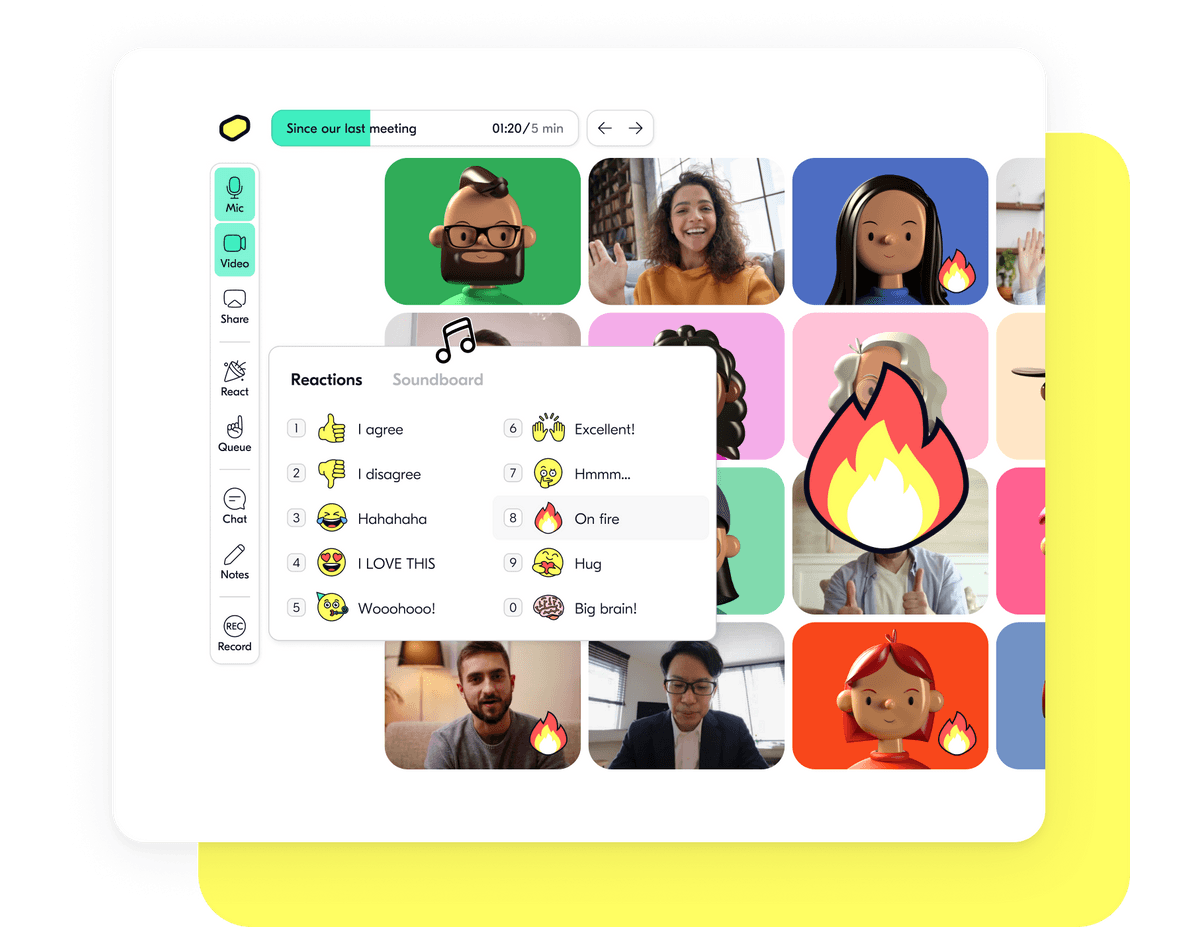
Another tip is to use workshop-specific tools such as Butter, where participants can express their emotions through the emoji reaction features and be queued to ask their questions without interrupting the speakers. Lastly, if you have a group larger than 5-6 people, consider dividing them into sub-groups and using co-facilitators to assist in managing these sub-groups. This will make the workshop experience much better for individual participants.

Observing others through laptop cameras can be difficult when there are more than 5-6 people in the virtual room. That’s a big reason why you’ll need to set the stage and establish a few ground rules at the beginning. Rules such as “Speak one person at a time,” “Use the ‘Raise Hand’ button to speak,” and “Leave questions in the chat space” can really improve the experience.

Remote workshops might not be able to replace the full experience of in-person workshops, where we can clearly see people’s body language and interact with each other more easily. However, with the right combination of tools and facilitation tips, remote workshops can probably match very closely the in-person experience and make the participants happy.

Step 3. Respect Your Schedule #

As you go about your workshop, respecting your agenda is essential. This is all about sticking to your plan, staying on track, and communicating clearly with the participants about what stage you’re at and what’s coming next.

Scheduled breaks are equally as important. Let’s say you’ve planned for a 10-minute break every 45 minutes, then stick to this plan. It offers participants time to rest, grab a quick snack (or coffee/tea), refresh their minds, and prepare for the next part. This is particularly significant during online workshops where screen fatigue is a common problem.

We know workshops don’t always go as planned — disruptions are often part of the package. These could range from a technical glitch during a virtual workshop, a sudden question sparking a lengthy discussion, or just starting a bit late due to late arrivals. This is where your “buffer time” will come in handy!

Respecting the buffer time allows you to handle any disruption that may come up without compromising on the workshop content or rushing through sections to recover the lost time. If there are no disruptions, this time can be used for additional discussions or exercises or even finishing the workshop earlier — something that participants usually appreciate.

Remember to stay focused. As the facilitator, you should keep discussions on track and aligned with the workshop’s goals. If the conversation veers off-topic, gently guide it back to the main point.

Applying The P.A.R.T.S. Principle: After The Workshop #

Step 1. Follow Up #

A critical part of concluding your workshop is following up with participants. This not only helps solidify the decisions and actions that were agreed upon but also maintains the collaborative momentum even after the workshop ends.

  • Meeting Minutes
    Send out a concise summary of the workshop, including the key points of discussion, decisions made, and next steps. This serves as a reference document for participants and ensures everyone is on the same page.
  • Action Plan
    Detail the agreed-upon action items, the person responsible for each, and the deadlines. This provides clarity on the tasks to be accomplished post-workshop.
  • Next Steps
    Clearly communicate the next steps, whether that’s a follow-up meeting, a deadline for tasks, or further resources to explore. This ensures that the momentum from the workshop continues.

Step 2. Celebrate #

Completing a workshop is no small feat. It takes dedication, focus, and collaborative effort from all participants. So, don’t let this moment pass uncelebrated. Recognizing everyone’s contributions and celebrating the completion of the workshop is an essential concluding step.

This not only serves as a token of gratitude for the participant’s time and effort but also reinforces the sense of achievement, promoting a positive and inclusive culture. Reflect on the journey you all undertook together, emphasizing the progress made, the skills developed, and the insights gained.

In your closing remarks or a follow-up communication, highlight specific achievements or breakthrough moments from the workshop. You might also share key takeaways or outcomes that align with the workshop’s objectives. This helps to not only recap the learning but also underscore the value each participant brought to the workshop.

Consider personalized gestures to commemorate the workshop — certificates of completion, digital badges, or even just a special mention can make participants feel recognized and appreciated. Celebrations, no matter how small, can build camaraderie, boost morale, and leave everyone looking forward to the next workshop.

Conclusion #

Let me conclude Part 2 by quoting Simon Raybould, who wonderfully encapsulates the art of facilitation, by saying:

“The secret of facilitating is to make it easy for people to learn. If you’re not making it easy, you’re not doing it right.”
— Simon Raybould

I couldn’t agree more. The inclusive workshop is not just about getting things done; it represents the symphony of diverse voices coming together, the exploration of ideas, and the collective journey toward shared objectives. Embracing this essence of inclusivity and embedding it into your workshop design and delivery makes for an environment where everyone feels respected, collaboration is enhanced, and innovative thinking flourishes.

As a facilitator, you have the power to make the workshop experience memorable and inspiring. The influence of your efforts can extend beyond the workshop, cultivating an atmosphere of respect, diversity, and inclusivity that spills over into all collaborative activities. This is the true impact and potential of well-executed, inclusive workshops.

Further Reading & References #

Here are a few additional resources on the topic of workshops. I hope you will find something useful there, too.

  • Gamestorming: A Playbook for Innovators, Rulebreakers, and Changemakers, by Dave Gray, Sunni Brown, and James Macanufo
    This well-known playbook provides a wide range of strategies and activities for designing workshops that encourage a creative, productive thinking environment. If you’re leading workshops and wish to encourage more out-of-the-box thinking, this book is a perfect source of inspiration.
  • Sprint, by Jake Knapp, John Zeratsky, and Braden Kowitz
    This is another well-known book in the workshop space. The book focuses on mastering the facilitation of Design Sprint, a workshop method by Google aimed at solving business problems and fostering collaboration. If you’re keen on leading tech teams or startups, this book is a great pick.
  • The Workshop Survival Guide, by Devin Hunt and Rob Fitzpatrick
    This guide navigates you through the end-to-end process of designing and conducting successful workshops. Whether you’re a newbie or an experienced facilitator, this resource gives comprehensive support to facilitate workshops confidently.
  • Invent To Learn: Making, Tinkering, and Engineering in the Classroom, by Sylvia Libow Martinez and Gary S. Stager
    Even though it is primarily for school educators, the book shares a wide range of methods and techniques that you can adapt to any workshop setting to create inclusive, creative, and hands-on learning environments. Highly recommended for those interested in creating an inclusive environment in any setting.
  • No Hard Feelings: The Secret Power of Embracing Emotions at Work, by Liz Fosslien and Mollie West Duffy
    Although it doesn’t focus on workshops specifically, the book gives useful insights on managing emotions at work from both participant and facilitator perspectives. It offers a broad overview of different personalities at work and how to foster emotional inclusivity, which can be valuable when facilitating workshops.
  • A Comprehensive Checklist For Running Design Workshops,” by Slava Shestopalov
    Slava’s article is a thorough guide to designing and conducting a successful workshop. This is a highly recommended read for designers, product managers, or even engineers looking to understand the nuances of running a design-centric workshop.
  • The Workshopper Playbook — A Summary” (AJ&Smart)
    The summary of “The Workshop Playbook” discusses the 4C technique that AJ&Smart developed for constructing any workshop. The 4C’s — Collect, Choose, Create, and Commit — form an exceptional workshop framework that adheres to the double-diamond method of workshop creation. If you’re interested in gaining a more profound understanding of the 4C framework, consider reading the full book by AJ&Smart.
  • The Secret To Healthy Remote Work: Fewer Meetings, More Workshops,” by Mehdi En-Naizi
    The article promotes the shift from traditional meetings to workshops in remote work settings to boost productivity and decrease stress. It highlights the workshops’ effectiveness, enhanced focus, and their role in promoting team unity and social interactions.
  • 10 Tips On Running An Online Meeting Your Team Won’t Hate (And Free Templates To Try!),” Anamaria Dorgo and Cheska Teresa
    This guide provides a detailed approach to overcoming the fatigue and frustration often associated with online meetings. The tips include clearly defining the meeting’s purpose, sticking to an agenda, creating an inclusive space for active participation, scheduling regular breaks, and using breakout rooms for more focused discussions.
  • How Silent Brainstorming Easily Engages Introverts On The Project Team,” by Annie MacLeod (DPM)
    Try out this brainstorming technique next time you need to get the team’s input on a problem or solution or if you’re working on a team with a lot of introverts.
  • Dot Voting: A Simple Decision-Making and Prioritizing Technique in UX,” Sarah Gibbons (NN/g Nielsen Norman Group)
    A few UX workshop activities work well in any situation, and dot voting is one of them. Dot voting is a simple tool used to democratically prioritize items or make decisions in a group setting. It is an easy, straightforward way to narrow down alternatives and converge on a set of concepts or ideas.
  • How Do You Encourage Introverts And Quiet Participants To Share Their Ideas In A Meeting?” (LinkedIn — Meeting Facilitation)
    Meetings are essential for collaboration, creativity, and innovation. But not everyone feels comfortable speaking up in a group setting. Some people may be introverted, shy, or simply prefer to listen and process information before sharing their thoughts. How do you encourage these quiet participants to contribute their valuable ideas in a meeting?
  • Teacher Toolkit: Think-Pair-Share” — YouTube, (Think-Pair-Share webpage)
    This versatile tool can be used in any classroom. The discussion technique gives students the opportunity to respond to questions in written form before engaging in meaningful conversation with other students. Asking students to write and discuss ideas with a partner before sharing with the larger group builds confidence, encourages greater participation, and results in more thoughtful discussions.
    (Editor’s Note: The Teacher Toolkit webpage is temporarily down. Until their server is restored, you can use a full webpage copy preserved by the WayBack Machine. — MB)
  • Fishbowl Conversation
    Fishbowl Conversation is great for keeping a focused conversation when you have a large group of people. At any time, only a few people have a conversation (the fish in the fishbowl). The remaining people are listeners (the ones watching the fishbowl). The caveat is that the listeners can join the discussion at any moment.
  • Lightning Talks” (Design sprints by Google)
    Lightning Talks are a core Design Sprint method and a powerful opportunity to build ownership in the Design Sprint challenge. Plan and set up Lightning Talks before your Design Sprint begins. After all the Lightning Talks are finished, hold an HMW sharing session to capture and share all the opportunities your team has come up with.
  • AJ&Smart’s Remote Design Sprint
    The lightning demo activity from Design Sprint is a perfect example of the “Idea Gallery” type of activity. Participants work individually to create a visual or written representation of their ideas (like a poster), and then everyone walks around to view the “gallery” and people discuss the ideas.
  • Poster Session” (Gamestorming)
    The goal of a poster session is to create a set of compelling images that summarize a challenge or topic for further discussion. Creating this set might be an “opening act,” which then sets the stage for choosing an idea to pursue, or it might be a way to get indexed on a large topic.
  • Jigsaw Activities” (The Bell Foundation)
    Jigsaw activities are a specific type of information gap activity that works best when used with the whole class. The class is first divided into groups of four to six learners who are then given some information on a particular aspect of the topic, which they later become experts in.
  • Disney Brainstorming Method
    The Disney method was developed in 1994 by Robert Dilts based on Walt Disney’s creative approach. It’s a good mix of creativity and concreteness as it’s not only about generating ideas but also looking at them with a critical eye and, eventually, having a few of them ready to be further explored and implemented.
  • Support Extroverted Students in Remote Environment — Group Discussions
    Several video platforms have options for small group discussions. If you’re using one of these, breaking into small groups can be a great opportunity to help your extroverted students feel fulfilled (and for your more introverted students to “warm up” for group discussion).
  • 37 brainstorming techniques to unlock team creativity,” by James Smart (SessionLab)
    It’s important to find a framework and idea-generation process that empowers your group to generate meaningful results, as finding new and innovative ideas is a vital part of the growth and success of any team or organization. In this article, several effective brainstorming techniques are explored in detail in categories such as creative exercises and visual idea-generation games.
  • Round-Robin Brainstorming” (MindTools blog)
    It’s all too easy to start a brainstorming session with good intentions but then overlook or miss potentially great ideas simply because one assertive person sets the tone for the entire meeting. This is why a tool like Round-Robin Brainstorming is so valuable. This method allows team members to generate ideas without being influenced by any one person, and you can then take these ideas into the next stages of the problem-solving process.
  • Eysenck’s Personality Theory” (TutorialsPoint)
    What is Eysenck’s Personality Theory? This theory has been influential in personality psychology and used to explain various phenomena, including individual differences in behavior and mental health.
  • Meeting Design: For Managers, Makers, and Everyone, a book by Kevin Hoffman
    Meetings don’t have to be painfully inefficient “snoozefests” — if you design them well. Meeting Design will teach you the design principles and innovative approaches you’ll need to transform meetings from boring to creative, from wasteful to productive.
  • State of Meetings Report 2021
    How did meetings actually change in 2020? What will the long-term impact of this change be? And could 2020 have changed the way we meet for good? These are questions that will be answered in this detailed report.
  • Social Identity Theory (Science Direct)
    Social identity theory defines a group as a collection of people who categorize themselves as belonging to the same social category and internalize the category’s social identity-defining attributes to define and evaluate themselves — attributes that capture and accentuate intragroup similarities and intergroup differences.
  • Clarizen Survey Pins Falling Productivity Levels on Communication Overload” (Bloomberg)
    A new survey by Clarizen, the global leader in collaborative work management, finds that companies’ efforts to improve collaboration among employees by opening new lines of communication can have the opposite effect.
  • Conflict Resolution Skills: What They Are and How to Use Them” (Coursera)
    Handling conflict in any context is never fun. Often, issues become more complicated than needed if the people involved need more conflict resolution and general communication skills. In this article, you’ll learn more about conflict resolution and, more specifically, how different conflict resolution skills may be useful in various situations.
  • Meeting Parking Lot” (The Facilitator’s School)
    A free template for handling off-topic questions, topics, and discussions. Available in Miro Template and Mural Template format.
  • SmashingConf Online Workshops
    Finally, do meet the friendly Smashing Magazine front-end & UX workshops! These remote workshops aim to give the same experience and access to experts that you would have in an in-person workshop without needing to leave your desk or couch. You can follow along with practical examples and interactive exercises, ask questions during the Q&A sessions, and use workshop recordings and materials to study at your own pace, at your own time.

Facilitating Inclusive Online Workshops (Part 1)

 Running a workshop can be an effective alternative to traditional, long-standing meetings. However, if workshops aren’t designed with inclusivity in mind, participants may feel apprehensive about contributing, fearing criticism from others. To help ensure the success of a workshop, Ben Shih introduces the concept of an inclusive workshop. In Part 1 of the series, you discover the fundamentals of inclusivity and get some solid guidance on how to plan an inclusive remote workshop.

Have you ever found yourself trapped in an hour-long meeting, listening to someone’s endless talk without understanding their main point? Or sat through a discussion where everyone speaks, but no actions are decided upon in the end? Or perhaps felt like the meeting you’re participating in is simply a waste of time?

If you have, you’re not alone.

According to a survey conducted by Clarizen and Harris Poll (2017), three in five employed adults reported that preparing for a meeting “takes longer than the meeting itself,” and 35% of those who attend status meetings called them a waste of time. In fact, 46% of employed Americans would rather engage in any unpleasant activity than sit in a meeting.

Meetings, when organized well, can serve as an effective way to share information and make decisions. The harsh reality, however, is that many meetings are poorly structured, ending up as a drain of resources.

One of the possible ways to replace meetings with something better and more effective is the implementation of workshops. But while workshops can be a highly effective way to foster collaboration and generate innovative solutions, they often require active participation from everyone involved. Yet, not everyone feels comfortable voicing their thoughts or taking the lead in a group setting, even though these quieter voices can be just as valuable and insightful. This is what led to the concept of an “inclusive” workshop — a workshop that ensures everyone feels heard, connected, and comfortable expressing their ideas.

What’s Inclusivity, And What’s Its Impact? #

Before we dive into the concept of an inclusive workshop, let’s first talk about the foundation. At its core, inclusivity means recognizing, appreciating, and respecting the diverse tapestry of human individuality. It’s about valuing the uniqueness everyone brings to the table, from attributes like ethnicity, gender, age, and religion to less apparent characteristics such as cognitive style or socioeconomic background.

Inclusivity is deeply rooted in the social identity theory, introduced by Tajfel & Turner in 1979. This theory suggests that our identities — who we think we are — are partly defined by the social groups we feel part of. It’s human nature to seek acceptance and to want to belong to a group that appreciates us for who we are. This need for social acceptance influences how we view ourselves and how we interact with others.

An inclusive environment embraces this diversity and uses this as an advantage to create a collaborative environment. Think of an orchestra, for example. Every instrument, whether it’s a violin, a trumpet, a cello, or a drum, brings with it its unique sound. Some may play a melody, others a harmony, and some keep the rhythm. Each of these sounds is different, but when combined, they create a harmonious symphony. In an inclusive setting, each person, with their distinct qualities, comes together with others to form a symphony of collaboration and understanding.

However, people are beautifully complex, and although this complexity is what often breathes life into a workshop, it can also introduce an element of unpredictability, which, if not managed well, can potentially lead to discord among the participants.

The only thing we can do is acknowledge the fact that not everyone will be comfortable speaking up, particularly in group settings. There could be various reasons for this, including individual personality traits, cultural backgrounds, past experiences, or simply the fear of judgment. As a facilitator, it is your responsibility to ensure that every individual in the room feels comfortable expressing their opinions and ideas. In the remainder of this article, I will be introducing some practical principles and techniques that could guide you in facilitating an inclusive workshop.

Preparing For An Inclusive Workshop #

If you are familiar with design thinking and design in general, you’ll find similarities between the design process and structuring an inclusive workshop. In design, we start by trying to understand our users, identifying their goals, and then crafting an effective user experience to guide them from start to finish. The same principles apply to designing an inclusive workshop:

  1. Understand the participants,
  2. Recognize their goals,
  3. Plan an engaging experience to achieve these goals.

Here are some “pre-works” you can do to better prepare for your workshop.

Step 1. Make Sure You Include The Right People #

The most important thing in any meeting or workshop is including the right participants. Failing to do so could prevent you from guiding the team in order to reach the goals of the workshop.

If you are facilitating a workshop for your own team (or within your company, which you know well), ask yourself the following questions so as to decide if a person should be included:

  • Is the meeting relevant to this person’s work and core responsibilities?
  • Can this person provide critical information, aid in the decision-making, or contribute meaningfully to the conversation?
  • Is this person’s presence necessary to achieve the meeting’s goals?

On the other hand, if you’re facilitating a workshop with an external team, provide a list of criteria that outlines what the ideal participant looks like and ask your client to include all the relevant individuals.

At this stage, bear in mind that adding a new participant not only means that you are bringing in a new viewpoint but you’re also increasing the number of necessary agreements among the members of the group. This could potentially lead to more disagreements and conflicts among different parties. Have a look at the points of agreement graph (below) to better understand how this mechanism works.

An image that shows the number of agreement points between 3 people (3 nodes) and 7 people (21 nodes)
Point of agreement. The number of agreements in a meeting between three people (left) vs. between seven people (right). (Image credits: Meeting Design: For Managers, Makers, and Everyone, a book by Kevin Hoffman) (Large preview)

Step 2. Know Your Participants Well #

Once your participant wish list is set, it’s important to invite all the participants to the workshop in a manner that is welcoming and inclusive — for example, not just sending a calendar invite and expecting them to show up. If it’s feasible, try to arrange a pre-workshop call or meeting with each participant to gain a better understanding of them. Building these personal connections before the workshop is important in ensuring your workshop activities are inclusive and productive.

Here are some more detailed steps to consider.

Personalize The Invitation #

Instead of a generic invite, personalize your invitations. Clearly outline the workshop’s purpose and activities and why you think they would be a valuable addition. Be open to participant’s opinions and concerns about attendance. If there’s uncertainty about their availability or relevance to the workshop, offer them an option to contribute asynchronously if they can’t participate in real-time.

An example message could be crafted along these lines:

“Hey Lewis, I am reaching out as I am planning to run a workshop with Max to brainstorm around how we can build the AI dashboard (which is the next initiative on our roadmap), and I would love to invite you to the workshop as I believe your front-end knowledge will help us a lot to understand the tech limitations. How does that sound to you? The workshop will be approximately two hours long and is scheduled for next week. Here’s the high-level agenda...”

A message like this — where you can explain what the workshop will be about, who will be involved, and how they can contribute to the workshop — will help the participant decide whether their involvement will be useful or not.

Schedule Pre-Workshop Conversations #

If possible, have a brief, informal chat with the participants, especially if you’re unfamiliar with them. This could be as simple as a quick coffee chat where you just talk about your hobbies and favorite movies. Such interactions can help build rapport before the workshop and provide insights into the participant’s goals and expectations.

Identify Personality Types And Preferences #

The personality traits of your workshop participants can be grouped along two main axes: their preference for group work (individualistic vs. collaborative) and their communication style (introverted vs. extroverted). By understanding and accommodating these preferences, you can create a workshop environment that truly values and harnesses the benefits of diversity.

  • Individualistic participants
    They may prefer tasks they can work on independently and discussions in smaller groups. Designing certain portions of the workshop that allow for individual thinking and ideation can help engage these participants.
  • Collaborative participants
    They enjoy large group discussions and team activities. Incorporating collaborative tasks where everyone can contribute can keep these participants involved and motivated.
  • Introverted participants
    They might feel more comfortable with structured turn-taking or with written contributions. They might not voice their thoughts as readily in a group setting, but that doesn’t make their ideas any less valuable. Establishing clear turn-taking rules or offering opportunities for written input can help ensure their voices are heard, too.
  • Extroverted participants
    They might be more engaged in free-flowing discussions or roles that involve presenting to the group. Ensuring that the workshop format has room for open discussions can cater to their preference.
A matrix that helps a facilitator to map the personalities of the participants. The image is split into four squares, and there are two double arrows between them, crossed in the center. Top arrow reads ‘extroverted,’ bottom arrow reads ‘introverted’, right arrow reads ‘collaborative’, and left arrow reads ‘individualistic’
A matrix to help you map the personalities of the participants in your workshop. (Download the FigJam template: Personality Matrix) (Large preview)

Step 3. Plan The Workshop Steps #

Once you have defined your participant list and understand the participants well, the next step is to plan the workshop accordingly to meet their needs.

In the next section, I will share some high-level tips relevant in particular to inclusivity.

The specifics of planning an entire workshop is another topic altogether — I recommend reading a few books on this topic, such as Gamestorming by Dave Gray, Sunni Brown, and James Macanufo and Facilitator’s Guide to Participatory Decision-Making by Sam Kaner, as well as Smashing Magazine articles that will help you dive deeper into the specifics of crafting a workshop. You might also want to look at the 4C framework developed by AJ & Smart, which can guide you in structuring your workshop logically.

Start By Defining The Break Time #

No matter the nature of your workshop, it’s important to plan regular breaks which will promote an inclusive environment.

Catering to individuals’ unique needs, be they physical or cognitive, is very important. Breaks help counter the “Zoom fatigue” prevalent in virtual workshops and respect cultural sensitivities by allowing time for personal and cultural practices.

Numerous studies indicate that people can generally focus effectively for about 45 to 50 minutes at a time. Hence, consider scheduling a 5–10 minute break every hour. These intervals offer participants time to relax, regroup, and reset their mental focus, thereby maintaining engagement and productivity throughout the session.

“Excessive focus exhausts the focus circuits in your brain. It can drain your energy and make you lose self-control. This energy drain can also make you more impulsive and less helpful. As a result, decisions are poorly thought out, and you become less collaborative. So what do we do then? Focus or unfocus? In keeping with recent research, both focus and unfocus are vital. The brain operates optimally when it toggles between focus and unfocus, allowing you to develop resilience, enhance creativity, and make better decisions too.”

— Srini Pillay, “Your Brain Can Only Take So Much Focus” (Harvard Business Review)

Choose The Right Tools #

The selection of tools in a remote environment can substantially influence participants’ experience. Complex or unfamiliar tools can affect the effectiveness of even the most well-planned workshop. Thus, it’s important to select tools that can help with collaboration, address diverse participants’ needs, and are accessible and straightforward to use.

Below, you’ll find a list of some popular tools for facilitating workshops, including their advantages, disadvantages, and best-suited participant types.

Whiteboard Tools #

  • Miro
    Miro is a popular and user-friendly digital whiteboard tool known for its intuitive interface and collaborative features. It’s great for visual learners and those who thrive on a free-form canvas. Additionally, for facilitators, a wide range of workshop templates is provided so that you don’t need to start from scratch. However, this tool can be overwhelming for those who prefer more structured interfaces. In addition, in Miroverse, there are more than 1000+ templates for you to get inspired by and to better plan your workshop.
  • Mural
    Another alternative digital whiteboard platform, Mural, is known for its ability to onboard new users easily. People can join and edit your Mural board without the need to create an account, which reduces friction. However, for facilitators who wish to have more powerful features such as AI, tables, charts, and integrations, Mural might not completely satisfy their needs.
  • FigJam
    FigJam is a top choice for designers and those familiar with Figma. It combines the flexibility of a digital whiteboard and design-focused features. This tool suits visually oriented and design-minded participants alike but may feel less intuitive to those unfamiliar with design software in general.
An example of a Miro Template (screenshot)
Miro is a popular tool for online collaboration, including remote workshops; and in Miroverse there are more than 1000+ templates available. (Large preview)

Video Conferencing Tools #

  • Microsoft Teams, Zoom, and Google Meet
    These are the “traditional” tools that almost everyone knows how to use. While their interfaces may lack extensive interactive features (which leads to a somewhat basic look and feel), their key strength lies in their consistent performance and accessibility. Their familiarity among users ensures a low learning curve, contributing to smooth and efficient workshop sessions.
  • Butter
    This tool is purpose-built for running interactive workshops, offering creative features specifically focused on workshops and collaborative meetings. Butter can cater to a broad range of personality types. For extroverted participants, it enables easy active engagement in discussions, while it also allows more introverted participants to express themselves using reactions, emojis, or GIFs in a less confrontational manner.
A screenshot of Butter that shows the ability to interact with other people via emoji reactions
Butter offers many features that make it easy for participants to react and interact with facilitators and other people, including reactions, soundboard, comments, and more. (Large preview)

Group Discussion Tools #

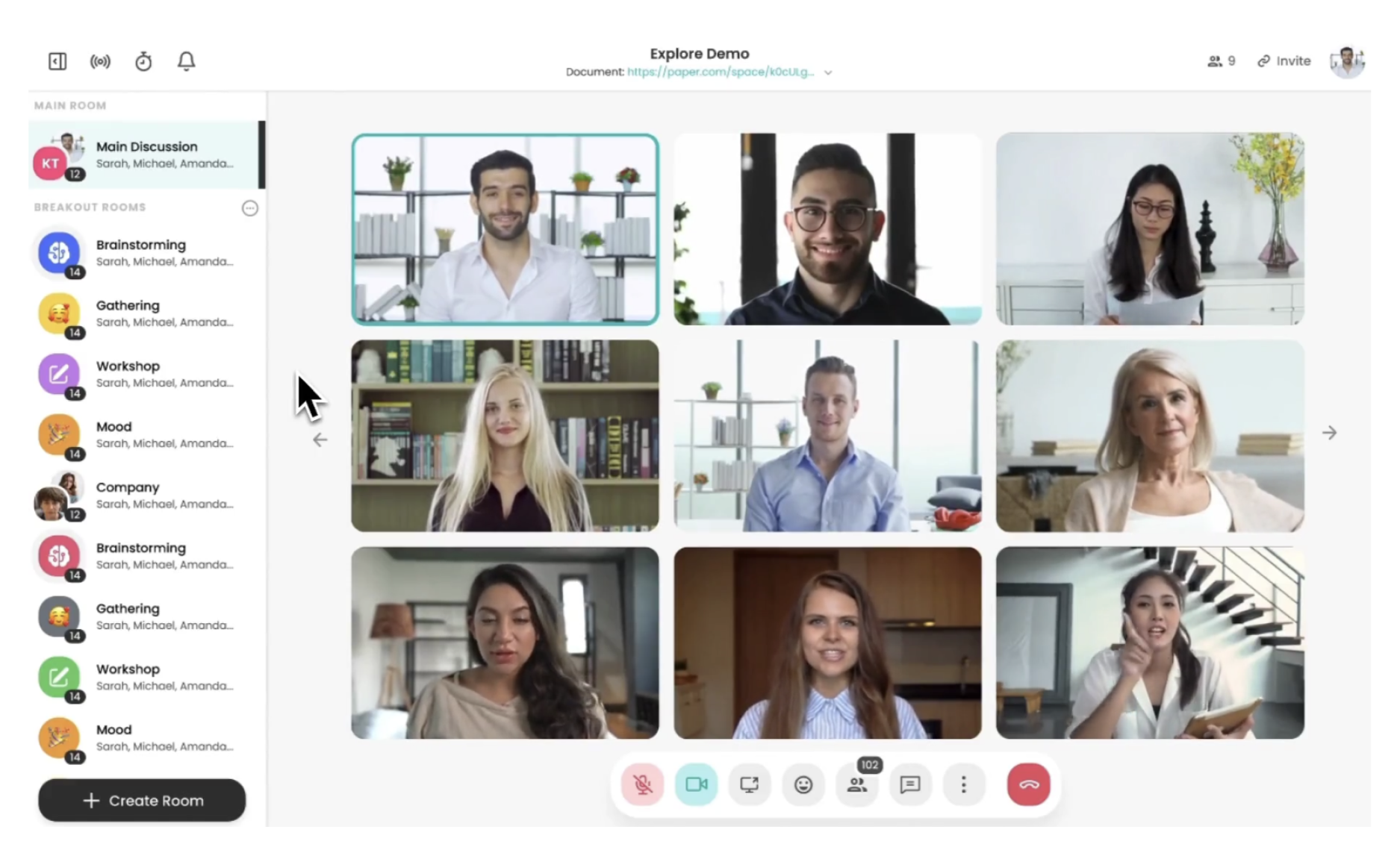
  • Mixerchat
    This platform facilitates interactive group discussions. Participants can freely navigate different breakout rooms, engaging in breakout sessions or world café-style activities.
A screenshot of Mixerchat that shows the ability to switch between different breakout rooms easily. The right side of the Mixerchat window is occupied by nine webcam views, each one with a person in the center of it
Mixerchat makes it easy for participants to switch between different breakout rooms. (Large preview)

Choose The Activities And Communication Methods #

The next and perhaps most critical step is to carefully choose activities that cater to the diversity of your participants. Use the personality types and goals you identified in Step 2 to guide your decisions. Here are some suggestions to help you get started.

If most of your participants are Introverted & Individualistic.
These participants prefer to think through ideas independently before sharing them, and they may be more comfortable in a quieter setting. A few activities for this group of people could be:

  • Silent Brainstorming: Each participant works individually to generate ideas and write them down. After a set period, everyone shares their ideas one by one. This approach gives introverted participants time to think and formulate their ideas before sharing them.
  • Silent Dot-Voting: These tools allow participants to share their views or vote on ideas anonymously, which can be less intimidating than speaking up in a group.

If most of your participants are Introverted & Collaborative.
These participants may enjoy working in groups, but they prefer quieter, more thoughtful discussions. A few activities for this group of people could be:

  • Small Group Discussions: Divide participants into smaller groups of 3-4 people to discuss a topic or question. This setup can feel less overwhelming than large group discussions.
A screenshot of a group discussion Miro template
Miro template of a small group discussion workshop. (Download the template: Breakout Groups & Collaboration) (Large preview)
  • Think-Pair-Share: In this activity, participants first consider a question or problem individually, then they pair up to discuss their thoughts, and finally, they share their ideas with the larger group.
  • Fishbowl Conversation: A small group sits in a circle (the fishbowl) to discuss a topic while the rest of the participants observe. After a while, allow participants to switch places, ensuring everyone gets a chance to contribute.

If most of your participants are Extroverted & Individualistic.
These participants enjoy expressing their ideas and might prefer to work independently. A few activities for this group of people could be:

  • Lightning Talks: Each participant prepares a short presentation on a topic related to the workshop’s theme. This activity allows participants to express their ideas and share their expertise.
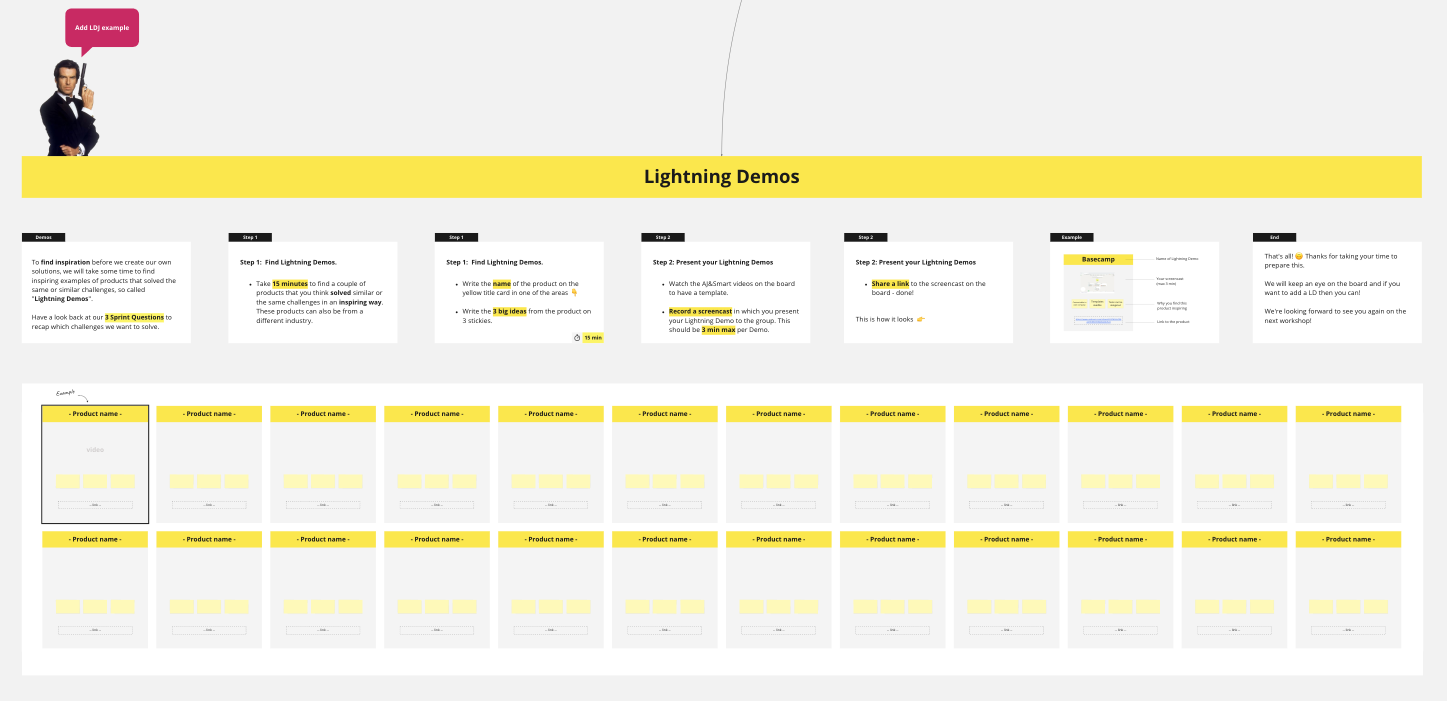
  • Idea Gallery/Lightning Demo: Participants work individually to create a visual or written representation of their ideas (like a poster), then everyone walks around to view the “gallery” and discuss the ideas.
    Note: The idea is not new and is also known as a “Poster Session.” The goal of a poster session is to create a set of compelling images that summarize a challenge or topic for further discussion. Creating this set might be an “opening act,” which then sets the stage for choosing an idea to pursue, or it might be a way to get indexed on a large topic. The act of creating a poster forces experts and otherwise passionate people to stop and think about the best way to communicate the core concepts of their material.
A screenshot of the lightning demo activity from Design Sprint
The lightning demo activity from Design Sprint is a perfect example of an “Idea Gallery” type of activity. Find out more about this example: AJ&Smart’s Remote Design Sprint. (Large preview)
  • Jigsaw Activity: In this exercise, each participant becomes an “expert” in a specific aspect of a larger topic. They then share their knowledge with the group, allowing for individual exploration and public speaking.

If most of your participants are Extroverted & Collaborative.
These participants enjoy the energy of group discussions and collaborative work. A few activities suitable for this group of people could be:

  • Open Discussions: Provide a topic or question and allow the conversation to flow naturally. Extroverted participants typically thrive in this open format.
  • Group Projects: Split participants into teams and assign a project related to the workshop’s theme. This could be anything from creating a mock-up for a new product to brainstorming strategies for overcoming a business challenge.
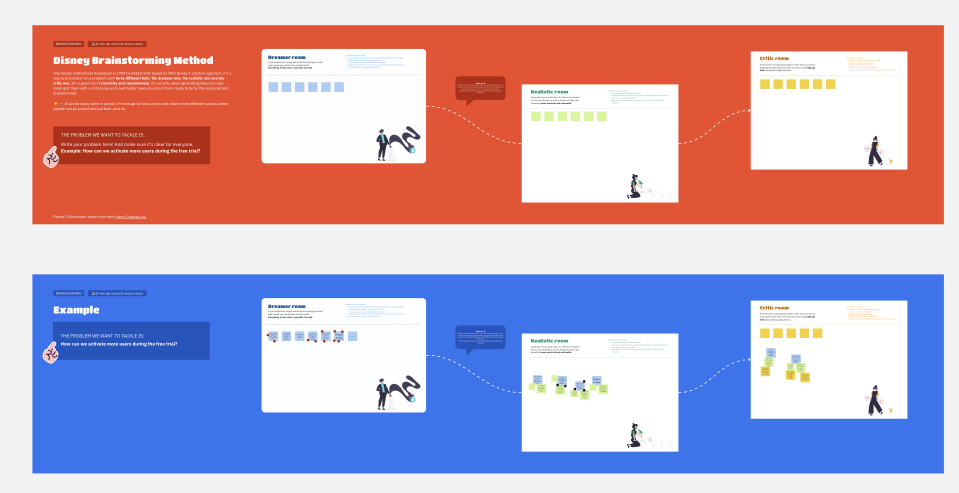
  • Role-play: This group activity allows participants to act out different scenarios or perspectives related to the workshop theme, encouraging dynamic discussion and cooperative problem-solving.
A screenshot of Disney’s brainstorming method template on Miro
Disney’s Brainstorming Method is a good example of what a fun role-play activity looks like. (Download the template: Disney Brainstorming Method) (Large preview)

Step 4. Estimate The Right Time And Allocate An Extra “Buffer” #

Once you have completed planning the workshop activities, if possible, try to conduct a pilot run so that you can decide the appropriate duration for each activity.

Time management is critical for inclusivity since participants may have other engagements, and if time management is out of control, both the facilitator and the participants may feel uncomfortable as they may need to shift focus to other commitments. Therefore, it is crucial to estimate the appropriate time and allocate extra “buffer” time to avoid rushing participants during engaging discussions.

I usually like to add a 20% buffer to each activity to ensure there is always some time to spare in case some people are slower. For instance, if you have set a 10-minute brainstorming session, schedule it to be 12 minutes so that you can have some extra buffer.

Step 5. Send A Pre-note Out #

Inclusion often starts before the workshop even begins. A pre-workshop note can make a significant difference in setting the stage for inclusivity. It allows all participants, regardless of their background or understanding of the key topic, to start from a common ground.

For example, if you’re conducting a workshop on project management, your pre-note could include an outline of the topics to be covered, such as agile methodology, risk management, or team leadership. You could also include a brief case study for participants to review before the workshop.

The pre-note can also include logistical details such as the workshop date, time, location (or virtual meeting link), any software they need to install (like Zoom or Microsoft Teams), and what they should bring with them (like a laptop or a notebook). By sending a pre-note, you ensure that all participants come prepared and are aligned with the workshop’s objectives right from the start.

A screenshot of a prenote template that the facilitator can use to send out pre-notes
A template that you can use to create your own workshop pre-note. (Get the template from Figma Community) (Large preview)

Step 6. Bonus Tip: Personalize The Experience #

Once you’ve established the framework of your workshop, it’s time to season it with some personal flair. This “secret sauce” could be a unique icebreaker or an element of surprise that sparks laughter and lightens up the atmosphere.

For instance, I’ve often incorporated the pets of my colleagues into the Miro board during my workshops. The sight of familiar furry friends not only brings a smile but also fosters a sense of community and connection within the team.

A screenshot showing how cat photo avatars can be used to replace normal dots
Instead of having a standard dot-voting session, replace the “dots” with cats or dogs (of your colleagues, if possible) to create some fun during the workshop session! (Image credits: Official Remote 5-day Design Sprint, a Miro template by Steph Cruchon) (Large preview)

Conclusion #

This was the first half of our journey exploring inclusive remote workshops where we’ve “peeled back” the layers of their essence and highlighted some critical techniques and approaches to lay out the groundwork. Remember, the key to running a successful inclusive workshop is to know your participants well and to create a space where they feel at ease. Take the time to understand them and shape the workshop activities in such a way that they match participant’s personal preferences. The most important bit, perhaps, is that every attendee should feel valued and heard.

In the second part of this two-part series, I will dive deeper into what you can do during and after the workshop in order to better tailor the experience to the workshop attendees, and I will also introduce you to the P.A.R.T.S. principle, which stands for Promote, Acknowledge, Respect, Transparency, and Share.