The Death Of The Button: Why The Best Interface Is No Interface
The web is evolving beyond menus, forms, and endless clicks toward experiences shaped around human intent. For UX designers, understanding this shift means re-evaluating their role, moving from designing visible interfaces to guiding transparent, intent-driven AI experiences.
Ever since the commercialisation of the Graphical User Interface pioneered by systems like the Xerox Star and popularised by the original Apple Macintosh, software has relied heavily on point-and-click interactions. If you wanted to book a trip, buy a pair of shoes, or research a health symptom, you were expected to navigate a labyrinth of user interfaces. You click menus, adjust range sliders, fill out multi-step forms, deal with cookie pop-ups, and open dozens of browser tabs just to cross-reference basic information. We have become accustomed to spending more time managing the software rather than actually achieving our goals.
That contract is officially changing. Driven by advances in artificial intelligence and large language models, a new generation of web tools is pioneering a radical philosophy: Intent-Driven Design. Rather than expecting our users to learn complex menus and click through elaborate sales funnels, these platforms operate by capturing high-level human goals and silently executing the grunt work in the background.
Well, at least what we understand based on our current experience.
It is essential for UX designers to understand the changes we’re witnessing and even re-evaluate our role, shifting our focus from designing visible interfaces to guiding transparent, intent-driven AI experiences.
The Death Of The “10-click” Process
To understand where web design is going, we first have to look at the friction we have accepted as “normal” for decades.
Consider the traditional workflow of buying a flight online. The user experience is intentionally hyper-interactive:
Navigate to a travel aggregator or airline website.
Select “Round Trip” from a dropdown menu.
Type the origin city and wait for auto-complete.
Type the destination city and wait for auto-complete.
Click a calendar modal, toggle through months, and select departure and return dates.
Choose the number of passengers and cabin class.
Click “Search” and wait for the results page to load.
Filter by price, layover duration, departure time, and airline.
Sort the results and scan through dozens of individual options.
Click through a three-page checkout funnel dodging upsells for rental cars and travel insurance.
This is a classic point-and-click UI paradigm. The computer acts as a passive container of data, and the human acts as the orchestrator, manually inputting parameters, interpreting raw outputs, and executing each micro-step along the way.
Intent-driven design flips this dynamic entirely. Instead of forcing you to navigate the mechanical steps of how to find a flight, the interface asks a simple question: What are you trying to accomplish?
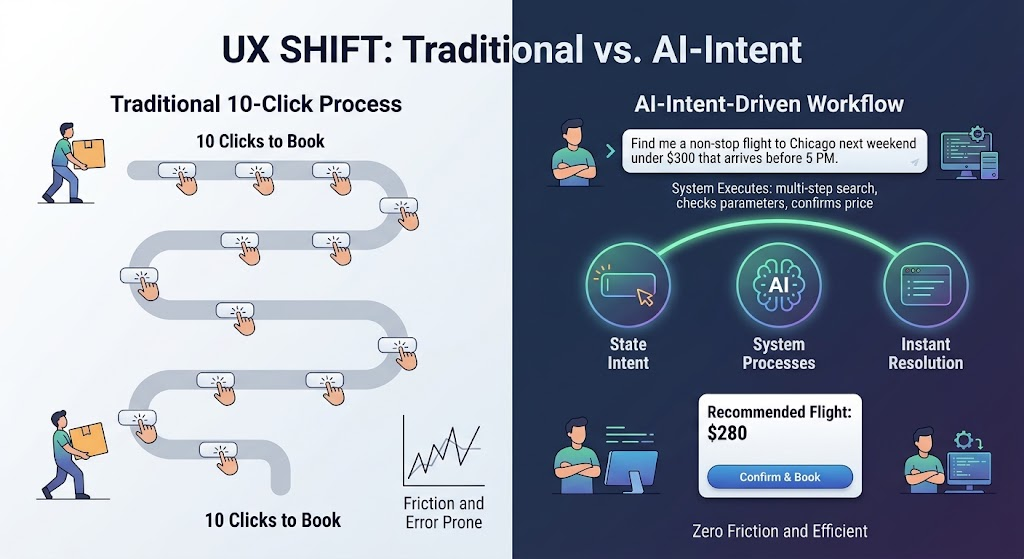
When you express a goal, such as “Find me a non-stop flight to Chicago next weekend under $300 that arrives before 5 PM”, the software reads your intent, executes the multi-step search query behind the scenes, compares the options, and presents a single actionable resolution. The ten clicks dissolve into one clear intent outcome.
10-click process vs AI-driven intent flow. Image generated by Gemini.


No comments:
Post a Comment