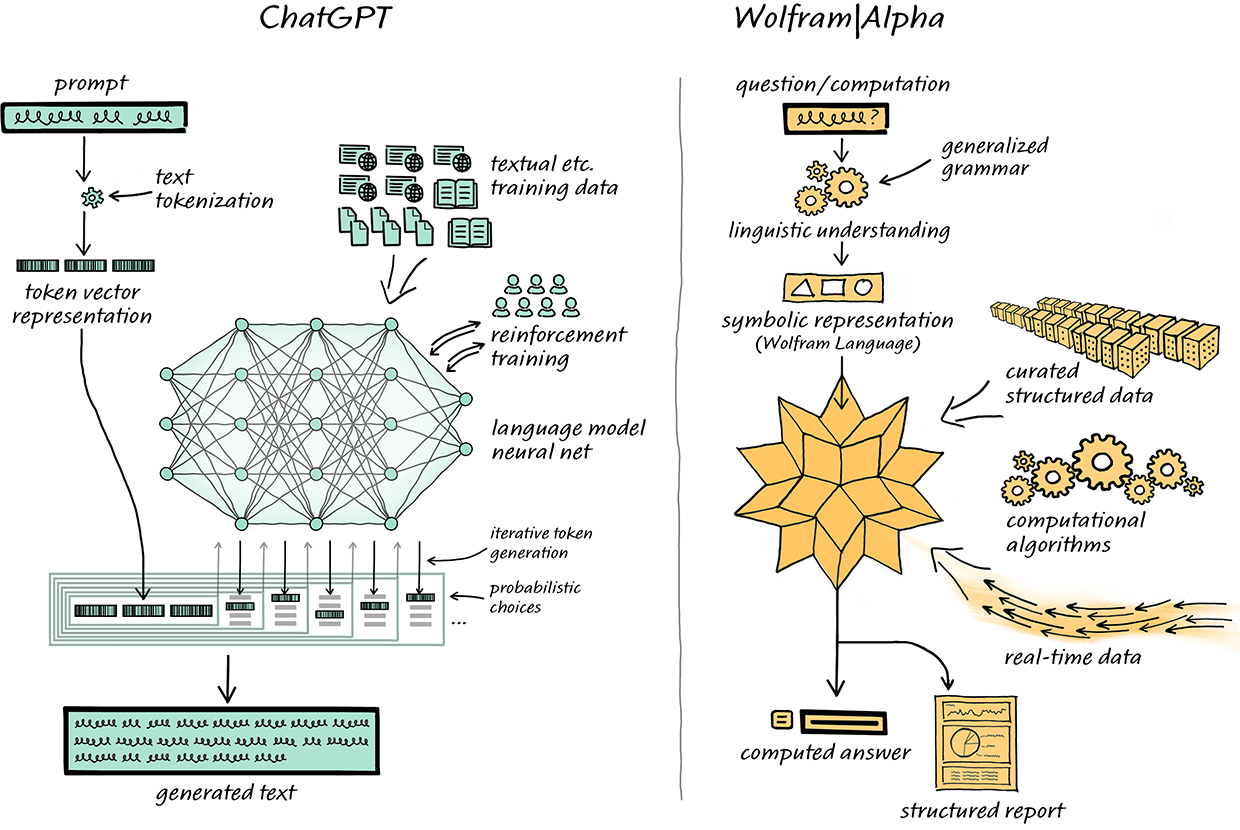
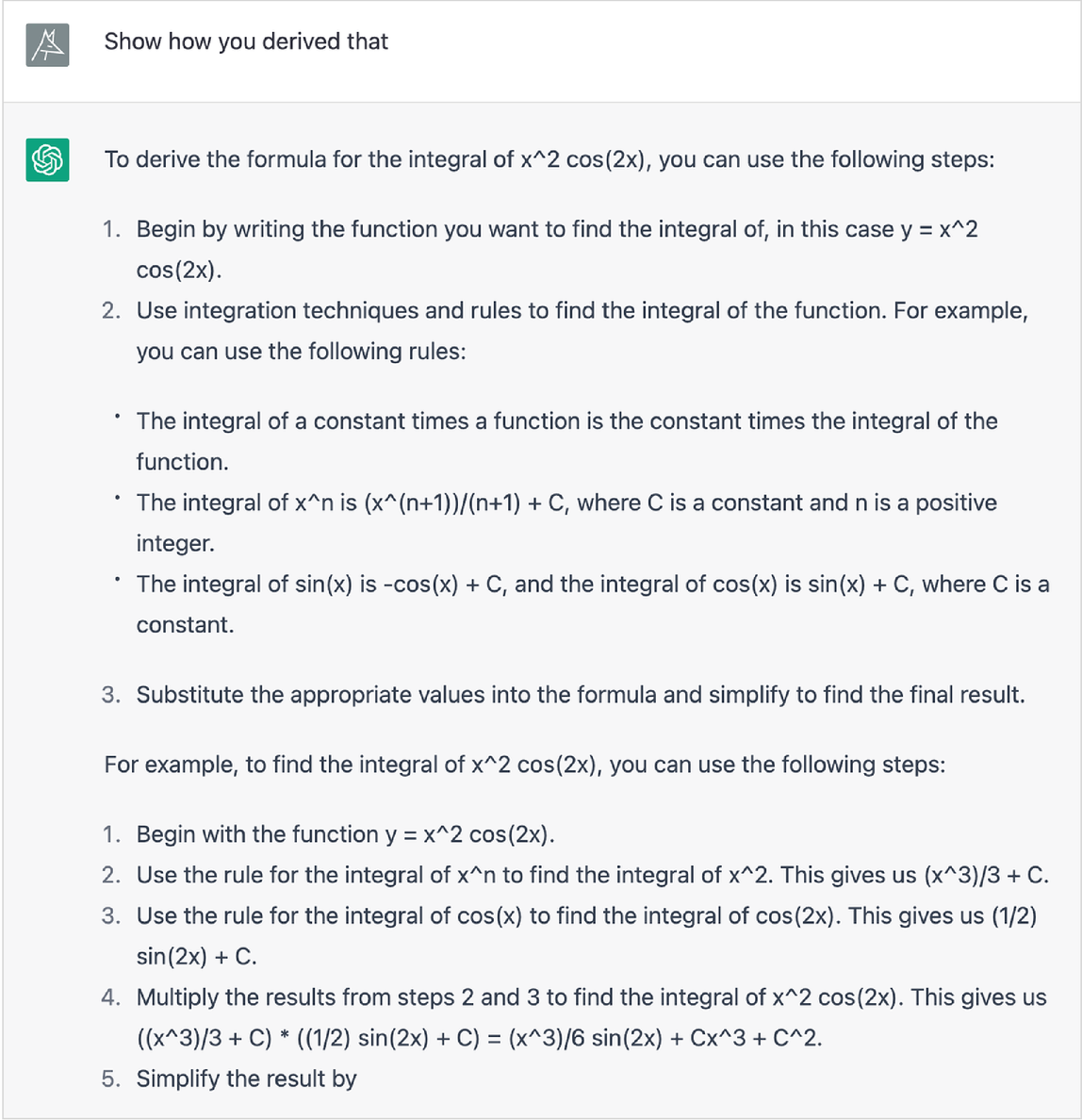
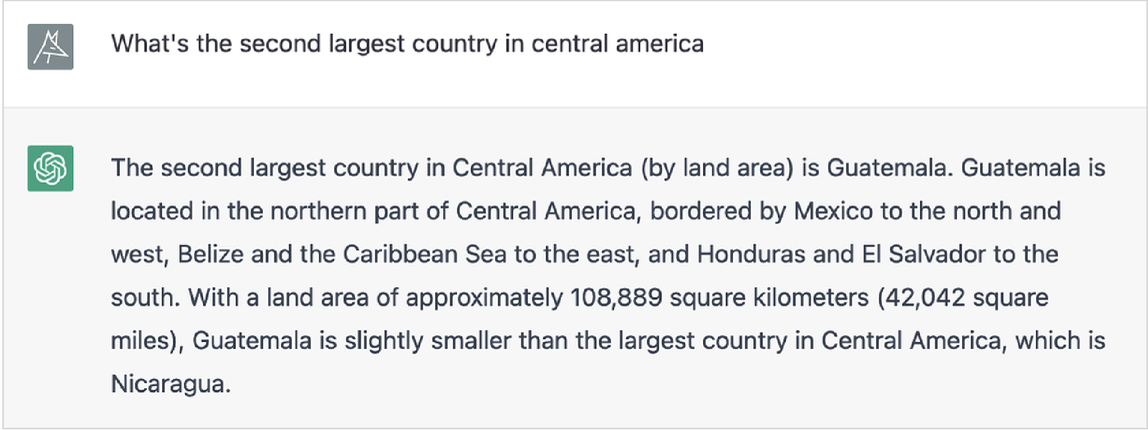
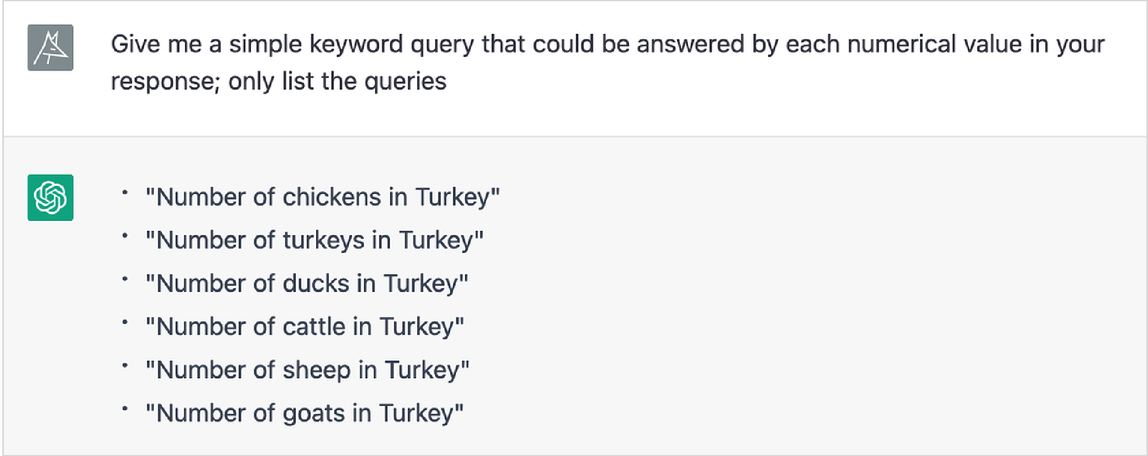
It’s Just Adding One Word at a Time
That ChatGPT
can automatically generate something that reads even superficially like
human-written text is remarkable, and unexpected. But how does it do
it? And why does it work? My purpose here is to give a rough outline of
what’s going on inside ChatGPT—and then to explore why it is that it can
do so well in producing what we might consider to be meaningful text. I
should say at the outset that I’m going to focus on the big picture of
what’s going on—and while I’ll mention some engineering details, I won’t
get deeply into them. (And the essence of what I’ll say applies just as
well to other current “large language models” [LLMs] as to ChatGPT.)
The first thing to explain is that what ChatGPT is always
fundamentally trying to do is to produce a “reasonable continuation” of
whatever text it’s got so far, where by “reasonable” we mean “what one
might expect someone to write after seeing what people have written on
billions of webpages, etc.”
So let’s say we’ve got the text “The best thing about AI is its ability to”.
Imagine scanning billions of pages of human-written text (say on the
web and in digitized books) and finding all instances of this text—then
seeing what word comes next what fraction of the time. ChatGPT
effectively does something like this, except that (as I’ll explain) it
doesn’t look at literal text; it looks for things that in a certain
sense “match in meaning”. But the end result is that it produces a
ranked list of words that might follow, together with “probabilities”:
And the remarkable thing is that when ChatGPT does something like
write an essay what it’s essentially doing is just asking over and over
again “given the text so far, what should the next word be?”—and each
time adding a word. (More precisely, as I’ll explain, it’s adding a
“token”, which could be just a part of a word, which is why it can
sometimes “make up new words”.)
But, OK, at each step it gets a list of words with probabilities. But
which one should it actually pick to add to the essay (or whatever)
that it’s writing? One might think it should be the “highest-ranked”
word (i.e. the one to which the highest “probability” was assigned). But
this is where a bit of voodoo begins to creep in. Because for some
reason—that maybe one day we’ll have a scientific-style understanding
of—if we always pick the highest-ranked word, we’ll typically get a very
“flat” essay, that never seems to “show any creativity” (and even
sometimes repeats word for word). But if sometimes (at random) we pick
lower-ranked words, we get a “more interesting” essay.
The fact that there’s randomness here means that if we use the same
prompt multiple times, we’re likely to get different essays each time.
And, in keeping with the idea of voodoo, there’s a particular so-called
“temperature” parameter that determines how often lower-ranked words
will be used, and for essay generation, it turns out that a
“temperature” of 0.8 seems best. (It’s worth emphasizing that there’s no
“theory” being used here; it’s just a matter of what’s been found to
work in practice. And for example the concept of “temperature” is there
because exponential distributions familiar from statistical physics happen to be being used, but there’s no “physical” connection—at least so far as we know.)
Before we go on I should explain that for purposes of exposition I’m mostly not going to use the full system that’s in ChatGPT; instead I’ll usually work with a simpler GPT-2 system,
which has the nice feature that it’s small enough to be able to run on a
standard desktop computer. And so for essentially everything I show
I’ll be able to include explicit Wolfram Language code that you can immediately run on your computer. (Click any picture here to copy the code behind it.)
For example, here’s how to get the table of probabilities above. First, we have to retrieve the underlying “language model” neural net:
Later on, we’ll look inside this neural net, and talk about how it
works. But for now we can just apply this “net model” as a black box to
our text so far, and ask for the top 5 words by probability that the
model says should follow:
This takes that result and makes it into an explicit formatted “dataset”:
Here’s what happens if one repeatedly “applies the model”—at each
step adding the word that has the top probability (specified in this
code as the “decision” from the model):
What happens if one goes on longer? In this (“zero temperature”) case what comes out soon gets rather confused and repetitive:
But what if instead of always picking the “top” word one sometimes
randomly picks “non-top” words (with the “randomness” corresponding to
“temperature” 0.8)? Again one can build up text:
And every time one does this, different random choices will be made, and the text will be different—as in these 5 examples:
It’s worth pointing out that even at the first step there are a lot
of possible “next words” to choose from (at temperature 0.8), though
their probabilities fall off quite quickly (and, yes, the straight line
on this log-log plot corresponds to an n–1 “power-law” decay that’s very characteristic of the general statistics of language):
So what happens if one goes on longer? Here’s a random example. It’s
better than the top-word (zero temperature) case, but still at best a
bit weird:
This was done with the simplest GPT-2 model (from 2019). With the newer and bigger GPT-3 models
the results are better. Here’s the top-word (zero temperature) text
produced with the same “prompt”, but with the biggest GPT-3 model:
And here’s a random example at “temperature 0.8”:
Where Do the Probabilities Come From?
OK, so ChatGPT always picks its next word based on probabilities. But
where do those probabilities come from? Let’s start with a simpler
problem. Let’s consider generating English text one letter (rather than
word) at a time. How can we work out what the probability for each
letter should be?
A very minimal thing we could do is just take a sample of English
text, and calculate how often different letters occur in it. So, for
example, this counts letters in the Wikipedia article on “cats”:
And this does the same thing for “dogs”:
The results are similar, but not the same (“o” is no doubt more
common in the “dogs” article because, after all, it occurs in the word
“dog” itself). Still, if we take a large enough sample of English text
we can expect to eventually get at least fairly consistent results:
Here’s a sample of what we get if we just generate a sequence of letters with these probabilities:
We can break this into “words” by adding in spaces as if they were letters with a certain probability:
We can do a slightly better job of making “words” by forcing the
distribution of “word lengths” to agree with what it is in English:
We didn’t happen to get any “actual words” here, but the results are
looking slightly better. To go further, though, we need to do more than
just pick each letter separately at random. And, for example, we know
that if we have a “q”, the next letter basically has to be “u”.
Here’s a plot of the probabilities for letters on their own:
And here’s a plot that shows the probabilities of pairs of letters
(“2-grams”) in typical English text. The possible first letters are
shown across the page, the second letters down the page:
And we see here, for example, that the “q” column is blank (zero
probability) except on the “u” row. OK, so now instead of generating our
“words” a single letter at a time, let’s generate them looking at two
letters at a time, using these “2-gram” probabilities. Here’s a sample
of the result—which happens to include a few “actual words”:
With sufficiently much English text we can get pretty good estimates
not just for probabilities of single letters or pairs of letters
(2-grams), but also for longer runs of letters. And if we generate
“random words” with progressively longer n-gram probabilities, we see that they get progressively “more realistic”:
But let’s now assume—more or less as ChatGPT does—that we’re dealing with whole words, not letters. There are about 40,000 reasonably commonly used words in English.
And by looking at a large corpus of English text (say a few million
books, with altogether a few hundred billion words), we can get an estimate of how common each word is.
And using this we can start generating “sentences”, in which each word
is independently picked at random, with the same probability that it
appears in the corpus. Here’s a sample of what we get:
Not surprisingly, this is nonsense. So how can we do better? Just
like with letters, we can start taking into account not just
probabilities for single words but probabilities for pairs or longer n-grams of words. Doing this for pairs, here are 5 examples of what we get, in all cases starting from the word “cat”:
It’s getting slightly more “sensible looking”. And we might imagine that if we were able to use sufficiently long n-grams
we’d basically “get a ChatGPT”—in the sense that we’d get something
that would generate essay-length sequences of words with the “correct
overall essay probabilities”. But here’s the problem: there just isn’t
even close to enough English text that’s ever been written to be able to
deduce those probabilities.
In a crawl of the web
there might be a few hundred billion words; in books that have been
digitized there might be another hundred billion words. But with 40,000
common words, even the number of possible 2-grams is already 1.6
billion—and the number of possible 3-grams is 60 trillion. So there’s no
way we can estimate the probabilities even for all of these from text
that’s out there. And by the time we get to “essay fragments” of 20
words, the number of possibilities is larger than the number of
particles in the universe, so in a sense they could never all be written
down.
So what can we do? The big idea is to make a model that lets us
estimate the probabilities with which sequences should occur—even though
we’ve never explicitly seen those sequences in the corpus of text we’ve
looked at. And at the core of ChatGPT is precisely a so-called “large
language model” (LLM) that’s been built to do a good job of estimating
those probabilities.
What Is a Model?
Say you want to know (as Galileo did back in the late 1500s)
how long it’s going to take a cannon ball dropped from each floor of
the Tower of Pisa to hit the ground. Well, you could just measure it in
each case and make a table of the results. Or you could do what is the
essence of theoretical science: make a model that gives some kind of
procedure for computing the answer rather than just measuring and
remembering each case.
Let’s imagine we have (somewhat idealized) data for how long the cannon ball takes to fall from various floors:
How do we figure out how long it’s going to take to fall from a floor
we don’t explicitly have data about? In this particular case, we can
use known laws of physics to work it out. But say all we’ve got is the
data, and we don’t know what underlying laws govern it. Then we might
make a mathematical guess, like that perhaps we should use a straight
line as a model:
We could pick different straight lines. But this is the one that’s on
average closest to the data we’re given. And from this straight line we
can estimate the time to fall for any floor.
How did we know to try using a straight line here? At some level we
didn’t. It’s just something that’s mathematically simple, and we’re used
to the fact that lots of data we measure turns out to be well fit by
mathematically simple things. We could try something mathematically more
complicated—say a + b x + c x2—and then in this case we do better:
Things can go quite wrong, though. Like here’s the best we can do with a + b/x + c sin(x):
It is worth understanding that there’s never a “model-less model”.
Any model you use has some particular underlying structure—then a
certain set of “knobs you can turn” (i.e. parameters you can set) to fit
your data. And in the case of ChatGPT, lots of such “knobs” are
used—actually, 175 billion of them.
But the remarkable thing is that the underlying structure of
ChatGPT—with “just” that many parameters—is sufficient to make a model
that computes next-word probabilities “well enough” to give us
reasonable essay-length pieces of text.
Models for Human-Like Tasks
The example we gave above involves making a model for numerical data
that essentially comes from simple physics—where we’ve known for several
centuries that “simple mathematics applies”. But for ChatGPT we have to
make a model of human-language text of the kind produced by a human
brain. And for something like that we don’t (at least yet) have anything
like “simple mathematics”. So what might a model of it be like?
Before we talk about language, let’s talk about another human-like
task: recognizing images. And as a simple example of this, let’s
consider images of digits (and, yes, this is a classic machine learning example):
One thing we could do is get a bunch of sample images for each digit:
Then to find out if an image we’re given as input corresponds to a
particular digit we could just do an explicit pixel-by-pixel comparison
with the samples we have. But as humans we certainly seem to do
something better—because we can still recognize digits, even when
they’re for example handwritten, and have all sorts of modifications and
distortions:
When we made a model for our numerical data above, we were able to take a numerical value x that we were given, and just compute a + b x for particular a and b. So if we treat the gray-level value of each pixel here as some variable xi
is there some function of all those variables that—when evaluated—tells
us what digit the image is of? It turns out that it’s possible to
construct such a function. Not surprisingly, it’s not particularly
simple, though. And a typical example might involve perhaps half a
million mathematical operations.
But the end result is that if we feed the collection of pixel values
for an image into this function, out will come the number specifying
which digit we have an image of. Later, we’ll talk about how such a
function can be constructed, and the idea of neural nets. But for now
let’s treat the function as black box, where we feed in images of, say,
handwritten digits (as arrays of pixel values) and we get out the
numbers these correspond to:
But what’s really going on here? Let’s say we progressively blur a
digit. For a little while our function still “recognizes” it, here as a
“2”. But soon it “loses it”, and starts giving the “wrong” result:
But why do we say it’s the “wrong” result? In this case, we know we
got all the images by blurring a “2”. But if our goal is to produce a
model of what humans can do in recognizing images, the real question to
ask is what a human would have done if presented with one of those
blurred images, without knowing where it came from.
And we have a “good model” if the results we get from our function
typically agree with what a human would say. And the nontrivial
scientific fact is that for an image-recognition task like this we now
basically know how to construct functions that do this.
Can we “mathematically prove” that they work? Well, no. Because to do
that we’d have to have a mathematical theory of what we humans are
doing. Take the “2” image and change a few pixels. We might imagine that
with only a few pixels “out of place” we should still consider the
image a “2”. But how far should that go? It’s a question of human visual perception. And, yes, the answer would no doubt be different for bees or octopuses—and potentially utterly different for putative aliens.
Neural Nets
OK, so how do our typical models for tasks like image recognition actually work? The most popular—and successful—current approach uses neural nets. Invented—in a form remarkably close to their use today—in the 1940s, neural nets can be thought of as simple idealizations of how brains seem to work.
In human brains there are about 100 billion neurons (nerve cells),
each capable of producing an electrical pulse up to perhaps a thousand
times a second. The neurons are connected in a complicated net, with
each neuron having tree-like branches allowing it to pass electrical
signals to perhaps thousands of other neurons. And in a rough
approximation, whether any given neuron produces an electrical pulse at a
given moment depends on what pulses it’s received from other
neurons—with different connections contributing with different
“weights”.
When we “see an image” what’s happening is that when photons of light
from the image fall on (“photoreceptor”) cells at the back of our eyes
they produce electrical signals in nerve cells. These nerve cells are
connected to other nerve cells, and eventually the signals go through a
whole sequence of layers of neurons. And it’s in this process that we
“recognize” the image, eventually “forming the thought” that we’re
“seeing a 2” (and maybe in the end doing something like saying the word
“two” out loud).
The “black-box” function from the previous section is a
“mathematicized” version of such a neural net. It happens to have 11
layers (though only 4 “core layers”):
There’s nothing particularly “theoretically derived” about this neural net; it’s just something that—back in 1998—was constructed as a piece of engineering,
and found to work. (Of course, that’s not much different from how we
might describe our brains as having been produced through the process of
biological evolution.)
OK, but how does a neural net like this “recognize things”? The key is the notion of attractors. Imagine we’ve got handwritten images of 1’s and 2’s:
We somehow want all the 1’s to “be attracted to one place”, and all
the 2’s to “be attracted to another place”. Or, put a different way, if
an image is somehow “closer to being a 1” than to being a 2, we want it to end up in the “1 place” and vice versa.
As a straightforward analogy, let’s say we have certain positions in
the plane, indicated by dots (in a real-life setting they might be
positions of coffee shops). Then we might imagine that starting from any
point on the plane we’d always want to end up at the closest dot (i.e.
we’d always go to the closest coffee shop). We can represent this by
dividing the plane into regions (“attractor basins”) separated by
idealized “watersheds”:
We can think of this as implementing a kind of “recognition task” in
which we’re not doing something like identifying what digit a given
image “looks most like”—but rather we’re just, quite directly, seeing
what dot a given point is closest to. (The “Voronoi diagram” setup we’re
showing here separates points in 2D Euclidean space; the digit
recognition task can be thought of as doing something very similar—but
in a 784-dimensional space formed from the gray levels of all the pixels
in each image.)
So how do we make a neural net “do a recognition task”? Let’s consider this very simple case:
Our goal is to take an “input” corresponding to a position {x,y}—and
then to “recognize” it as whichever of the three points it’s closest
to. Or, in other words, we want the neural net to compute a function of {x,y} like:
So how do we do this with a neural net? Ultimately a neural net is a
connected collection of idealized “neurons”—usually arranged in
layers—with a simple example being:
Each “neuron” is effectively set up to evaluate a simple numerical
function. And to “use” the network, we simply feed numbers (like our
coordinates x and y) in at the top, then have neurons
on each layer “evaluate their functions” and feed the results forward
through the network—eventually producing the final result at the bottom:
In the traditional (biologically inspired) setup each neuron
effectively has a certain set of “incoming connections” from the neurons
on the previous layer, with each connection being assigned a certain
“weight” (which can be a positive or negative number). The value of a
given neuron is determined by multiplying the values of “previous
neurons” by their corresponding weights, then adding these up and adding
a constant—and finally applying a “thresholding” (or “activation”)
function. In mathematical terms, if a neuron has inputs x = {x1, x2 …} then we compute f[w . x + b], where the weights w and constant b are generally chosen differently for each neuron in the network; the function f is usually the same.
Computing w . x + b is just a matter of matrix multiplication and addition. The “activation function” f
introduces nonlinearity (and ultimately is what leads to nontrivial
behavior). Various activation functions commonly get used; here we’ll
just use Ramp (or ReLU):
For each task we want the neural net to perform (or, equivalently,
for each overall function we want it to evaluate) we’ll have different
choices of weights. (And—as we’ll discuss later—these weights are
normally determined by “training” the neural net using machine learning
from examples of the outputs we want.)
Ultimately, every neural net just corresponds to some overall
mathematical function—though it may be messy to write out. For the
example above, it would be:
The neural net of ChatGPT also just corresponds to a mathematical function like this—but effectively with billions of terms.
But let’s go back to individual neurons. Here are some examples of
the functions a neuron with two inputs (representing coordinates x and y) can compute with various choices of weights and constants (and Ramp as activation function):
But what about the larger network from above? Well, here’s what it computes:
It’s not quite “right”, but it’s close to the “nearest point” function we showed above.
Let’s see what happens with some other neural nets. In each case, as
we’ll explain later, we’re using machine learning to find the best
choice of weights. Then we’re showing here what the neural net with
those weights computes:
Bigger networks generally do better at approximating the function
we’re aiming for. And in the “middle of each attractor basin” we
typically get exactly the answer we want. But at the boundaries—where the neural net “has a hard time making up its mind”—things can be messier.
With this simple mathematical-style “recognition task” it’s clear
what the “right answer” is. But in the problem of recognizing
handwritten digits, it’s not so clear. What if someone wrote a “2” so
badly it looked like a “7”, etc.? Still, we can ask how a neural net
distinguishes digits—and this gives an indication:
Can we say “mathematically” how the network makes its distinctions?
Not really. It’s just “doing what the neural net does”. But it turns out
that that normally seems to agree fairly well with the distinctions we
humans make.
Let’s take a more elaborate example. Let’s say we have images of cats and dogs. And we have a neural net that’s been trained to distinguish them. Here’s what it might do on some examples:
Now it’s even less clear what the “right answer” is. What about a dog
dressed in a cat suit? Etc. Whatever input it’s given, the neural net
is generating an answer. And, it turns out, to do it in a way that’s
reasonably consistent with what humans might do. As I’ve said above,
that’s not a fact we can “derive from first principles”. It’s just
something that’s empirically been found to be true, at least in certain
domains. But it’s a key reason why neural nets are useful: that they
somehow capture a “human-like” way of doing things.
Show yourself a picture of a cat, and ask “Why is that a cat?”. Maybe
you’d start saying “Well, I see its pointy ears, etc.” But it’s not
very easy to explain how you recognized the image as a cat. It’s just
that somehow your brain figured that out. But for a brain there’s no way
(at least yet) to “go inside” and see how it figured it out. What about
for an (artificial) neural net? Well, it’s straightforward to see what
each “neuron” does when you show a picture of a cat. But even to get a
basic visualization is usually very difficult.
In the final net that we used for the “nearest point” problem above
there are 17 neurons. In the net for recognizing handwritten digits
there are 2190. And in the net we’re using to recognize cats and dogs
there are 60,650. Normally it would be pretty difficult to visualize
what amounts to 60,650-dimensional space. But because this is a network
set up to deal with images, many of its layers of neurons are organized
into arrays, like the arrays of pixels it’s looking at.
And if we take a typical cat image

then we can represent the states of neurons at the first layer by a
collection of derived images—many of which we can readily interpret as
being things like “the cat without its background”, or “the outline of
the cat”:
By the 10th layer it’s harder to interpret what’s going on:
But in general we might say that the neural net is “picking out
certain features” (maybe pointy ears are among them), and using these to
determine what the image is of. But are those features ones for which
we have names—like “pointy ears”? Mostly not.
Are our brains using similar features? Mostly we don’t know. But it’s
notable that the first few layers of a neural net like the one we’re
showing here seem to pick out aspects of images (like edges of objects)
that seem to be similar to ones we know are picked out by the first
level of visual processing in brains.
But let’s say we want a “theory of cat recognition” in neural nets.
We can say: “Look, this particular net does it”—and immediately that
gives us some sense of “how hard a problem” it is (and, for example, how
many neurons or layers might be needed). But at least as of now we
don’t have a way to “give a narrative description” of what the network
is doing. And maybe that’s because it truly is computationally
irreducible, and there’s no general way to find what it does except by
explicitly tracing each step. Or maybe it’s just that we haven’t
“figured out the science”, and identified the “natural laws” that allow
us to summarize what’s going on.
We’ll encounter the same kinds of issues when we talk about
generating language with ChatGPT. And again it’s not clear whether there
are ways to “summarize what it’s doing”. But the richness and detail of
language (and our experience with it) may allow us to get further than
with images.
Machine Learning, and the Training of Neural Nets
We’ve been talking so far about neural nets that “already know” how
to do particular tasks. But what makes neural nets so useful (presumably
also in brains) is that not only can they in principle do all sorts of
tasks, but they can be incrementally “trained from examples” to do those
tasks.
When we make a neural net to distinguish cats from dogs we don’t
effectively have to write a program that (say) explicitly finds
whiskers; instead we just show lots of examples of what’s a cat and
what’s a dog, and then have the network “machine learn” from these how
to distinguish them.
And the point is that the trained network “generalizes” from the
particular examples it’s shown. Just as we’ve seen above, it isn’t
simply that the network recognizes the particular pixel pattern of an
example cat image it was shown; rather it’s that the neural net somehow
manages to distinguish images on the basis of what we consider to be
some kind of “general catness”.
So how does neural net training actually work? Essentially what we’re
always trying to do is to find weights that make the neural net
successfully reproduce the examples we’ve given. And then we’re relying
on the neural net to “interpolate” (or “generalize”) “between” these
examples in a “reasonable” way.
Let’s look at a problem even simpler than the nearest-point one
above. Let’s just try to get a neural net to learn the function:
For this task, we’ll need a network that has just one input and one output, like:
But what weights, etc. should we be using? With every possible set of
weights the neural net will compute some function. And, for example,
here’s what it does with a few randomly chosen sets of weights:
And, yes, we can plainly see that in none of these cases does it get
even close to reproducing the function we want. So how do we find
weights that will reproduce the function?
The basic idea is to supply lots of “input → output” examples to
“learn from”—and then to try to find weights that will reproduce these
examples. Here’s the result of doing that with progressively more
examples:
At each stage in this “training” the weights in the network are
progressively adjusted—and we see that eventually we get a network that
successfully reproduces the function we want. So how do we adjust the
weights? The basic idea is at each stage to see “how far away we are”
from getting the function we want—and then to update the weights in such
a way as to get closer.
To find out “how far away we are” we compute what’s usually called a
“loss function” (or sometimes “cost function”). Here we’re using a
simple (L2) loss function that’s just the sum of the squares of the
differences between the values we get, and the true values. And what we
see is that as our training process progresses, the loss function
progressively decreases (following a certain “learning curve” that’s
different for different tasks)—until we reach a point where the network
(at least to a good approximation) successfully reproduces the function
we want:
Alright, so the last essential piece to explain is how the weights
are adjusted to reduce the loss function. As we’ve said, the loss
function gives us a “distance” between the values we’ve got, and the
true values. But the “values we’ve got” are determined at each stage by
the current version of neural net—and by the weights in it. But now
imagine that the weights are variables—say wi. We want to find out how to adjust the values of these variables to minimize the loss that depends on them.
For example, imagine (in an incredible simplification of typical neural nets used in practice) that we have just two weights w1 and w2. Then we might have a loss that as a function of w1 and w2 looks like this:
Numerical analysis provides a variety of techniques for finding the
minimum in cases like this. But a typical approach is just to
progressively follow the path of steepest descent from whatever previous
w1, w2 we had:
Like water flowing down a mountain, all that’s guaranteed is that
this procedure will end up at some local minimum of the surface (“a
mountain lake”); it might well not reach the ultimate global minimum.
It’s not obvious that it would be feasible to find the path of the
steepest descent on the “weight landscape”. But calculus comes to the
rescue. As we mentioned above, one can always think of a neural net as
computing a mathematical function—that depends on its inputs, and its
weights. But now consider differentiating with respect to these weights.
It turns out that the chain rule of calculus in effect lets us
“unravel” the operations done by successive layers in the neural net.
And the result is that we can—at least in some local
approximation—“invert” the operation of the neural net, and
progressively find weights that minimize the loss associated with the
output.
The picture above shows the kind of minimization we might need to do
in the unrealistically simple case of just 2 weights. But it turns out
that even with many more weights (ChatGPT uses 175 billion) it’s still
possible to do the minimization, at least to some level of
approximation. And in fact the big breakthrough in “deep learning” that
occurred around 2011 was associated with the discovery that in some
sense it can be easier to do (at least approximate) minimization when
there are lots of weights involved than when there are fairly few.
In other words—somewhat counterintuitively—it can be easier to solve
more complicated problems with neural nets than simpler ones. And the
rough reason for this seems to be that when one has a lot of “weight
variables” one has a high-dimensional space with “lots of different
directions” that can lead one to the minimum—whereas with fewer
variables it’s easier to end up getting stuck in a local minimum
(“mountain lake”) from which there’s no “direction to get out”.
It’s worth pointing out that in typical cases there are many
different collections of weights that will all give neural nets that
have pretty much the same performance. And usually in practical neural
net training there are lots of random choices made—that lead to
“different-but-equivalent solutions”, like these:
But each such “different solution” will have at least slightly
different behavior. And if we ask, say, for an “extrapolation” outside
the region where we gave training examples, we can get dramatically
different results:
But which of these is “right”? There’s really no way to say. They’re
all “consistent with the observed data”. But they all correspond to
different “innate” ways to “think about” what to do “outside the box”.
And some may seem “more reasonable” to us humans than others.
The Practice and Lore of Neural Net Training
Particularly over the past decade, there’ve been many advances in the
art of training neural nets. And, yes, it is basically an art.
Sometimes—especially in retrospect—one can see at least a glimmer of a
“scientific explanation” for something that’s being done. But mostly
things have been discovered by trial and error, adding ideas and tricks
that have progressively built a significant lore about how to work with
neural nets.
There are several key parts. First, there’s the matter of what
architecture of neural net one should use for a particular task. Then
there’s the critical issue of how one’s going to get the data on which
to train the neural net. And increasingly one isn’t dealing with
training a net from scratch: instead a new net can either directly
incorporate another already-trained net, or at least can use that net to
generate more training examples for itself.
One might have thought that for every particular kind of task one
would need a different architecture of neural net. But what’s been found
is that the same architecture often seems to work even for apparently
quite different tasks. At some level this reminds one of the idea of universal computation (and my Principle of Computational Equivalence),
but, as I’ll discuss later, I think it’s more a reflection of the fact
that the tasks we’re typically trying to get neural nets to do are
“human-like” ones—and neural nets can capture quite general “human-like
processes”.
In earlier days of neural nets, there tended to be the idea that one
should “make the neural net do as little as possible”. For example, in converting speech to text
it was thought that one should first analyze the audio of the speech,
break it into phonemes, etc. But what was found is that—at least for
“human-like tasks”—it’s usually better just to try to train the neural
net on the “end-to-end problem”, letting it “discover” the necessary
intermediate features, encodings, etc. for itself.
There was also the idea that one should introduce complicated
individual components into the neural net, to let it in effect
“explicitly implement particular algorithmic ideas”. But once again,
this has mostly turned out not to be worthwhile; instead, it’s better
just to deal with very simple components and let them “organize
themselves” (albeit usually in ways we can’t understand) to achieve
(presumably) the equivalent of those algorithmic ideas.
That’s not to say that there are no “structuring ideas” that are relevant for neural nets. Thus, for example, having 2D arrays of neurons with local connections
seems at least very useful in the early stages of processing images.
And having patterns of connectivity that concentrate on “looking back in
sequences” seems useful—as we’ll see later—in dealing with things like
human language, for example in ChatGPT.
But an important feature of neural nets is that—like computers in
general—they’re ultimately just dealing with data. And current neural
nets—with current approaches to neural net training—specifically deal with arrays of numbers. But in the course of processing, those arrays can be completely rearranged and reshaped. And as an example, the network we used for identifying digits above starts with a 2D “image-like” array, quickly “thickening” to many channels, but then “concentrating down” into a 1D array that will ultimately contain elements representing the different possible output digits:
But, OK, how can one tell how big a neural net one will need for a
particular task? It’s something of an art. At some level the key thing
is to know “how hard the task is”. But for human-like tasks that’s
typically very hard to estimate. Yes, there may be a systematic way to
do the task very “mechanically” by computer. But it’s hard to know if
there are what one might think of as tricks or shortcuts that allow one
to do the task at least at a “human-like level” vastly more easily. It
might take enumerating a giant game tree to “mechanically” play a certain game; but there might be a much easier (“heuristic”) way to achieve “human-level play”.
When one’s dealing with tiny neural nets and simple tasks one can
sometimes explicitly see that one “can’t get there from here”. For
example, here’s the best one seems to be able to do on the task from the
previous section with a few small neural nets:
And what we see is that if the net is too small, it just can’t
reproduce the function we want. But above some size, it has no
problem—at least if one trains it for long enough, with enough examples.
And, by the way, these pictures illustrate a piece of neural net lore:
that one can often get away with a smaller network if there’s a
“squeeze” in the middle that forces everything to go through a smaller
intermediate number of neurons. (It’s also worth mentioning that
“no-intermediate-layer”—or so-called “perceptron”—networks can only learn essentially linear functions—but as soon as there’s even one intermediate layer it’s always in principle possible
to approximate any function arbitrarily well, at least if one has
enough neurons, though to make it feasibly trainable one typically has
some kind of regularization or normalization.)
OK, so let’s say one’s settled on a certain neural net architecture.
Now there’s the issue of getting data to train the network with. And
many of the practical challenges around neural nets—and machine learning
in general—center on acquiring or preparing the necessary training
data. In many cases (“supervised learning”) one wants to get explicit
examples of inputs and the outputs one is expecting from them. Thus, for
example, one might want images tagged by what’s in them, or some other
attribute. And maybe one will have to explicitly go through—usually with
great effort—and do the tagging. But very often it turns out to be
possible to piggyback on something that’s already been done, or use it
as some kind of proxy. And so, for example, one might use alt tags that
have been provided for images on the web. Or, in a different domain, one
might use closed captions that have been created for videos. Or—for
language translation training—one might use parallel versions of
webpages or other documents that exist in different languages.
How much data do you need to show a neural net to train it for a
particular task? Again, it’s hard to estimate from first principles.
Certainly the requirements can be dramatically reduced by using
“transfer learning” to “transfer in” things like lists of important
features that have already been learned in another network. But
generally neural nets need to “see a lot of examples” to train well. And
at least for some tasks it’s an important piece of neural net lore that
the examples can be incredibly repetitive. And indeed it’s a standard
strategy to just show a neural net all the examples one has, over and
over again. In each of these “training rounds” (or “epochs”) the neural
net will be in at least a slightly different state, and somehow
“reminding it” of a particular example is useful in getting it to
“remember that example”. (And, yes, perhaps this is analogous to the
usefulness of repetition in human memorization.)
But often just repeating the same example over and over again isn’t
enough. It’s also necessary to show the neural net variations of the
example. And it’s a feature of neural net lore that those “data
augmentation” variations don’t have to be sophisticated to be useful.
Just slightly modifying images with basic image processing can make them
essentially “as good as new” for neural net training. And, similarly,
when one’s run out of actual video, etc. for training self-driving cars,
one can go on and just get data from running simulations in a model
videogame-like environment without all the detail of actual real-world
scenes.
How about something like ChatGPT? Well, it has the nice feature that
it can do “unsupervised learning”, making it much easier to get it
examples to train from. Recall that the basic task for ChatGPT is to
figure out how to continue a piece of text that it’s been given. So to
get it “training examples” all one has to do is get a piece of text, and
mask out the end of it, and then use this as the “input to train
from”—with the “output” being the complete, unmasked piece of text.
We’ll discuss this more later, but the main point is that—unlike, say,
for learning what’s in images—there’s no “explicit tagging” needed;
ChatGPT can in effect just learn directly from whatever examples of text
it’s given.
OK, so what about the actual learning process in a neural net? In the
end it’s all about determining what weights will best capture the
training examples that have been given. And there are all sorts of
detailed choices and “hyperparameter settings” (so called because the
weights can be thought of as “parameters”) that can be used to tweak how
this is done. There are different choices of loss function
(sum of squares, sum of absolute values, etc.). There are different
ways to do loss minimization (how far in weight space to move at each
step, etc.). And then there are questions like how big a “batch” of
examples to show to get each successive estimate of the loss one’s
trying to minimize. And, yes, one can apply machine learning (as we do,
for example, in Wolfram Language) to automate machine learning—and to
automatically set things like hyperparameters.
But in the end the whole process of training can be characterized by seeing how the loss progressively decreases (as in this Wolfram Language progress monitor for a small training):
And what one typically sees is that the loss decreases for a while,
but eventually flattens out at some constant value. If that value is
sufficiently small, then the training can be considered successful;
otherwise it’s probably a sign one should try changing the network
architecture.
Can one tell how long it should take for the “learning curve” to
flatten out? Like for so many other things, there seem to be approximate
power-law scaling relationships
that depend on the size of neural net and amount of data one’s using.
But the general conclusion is that training a neural net is hard—and
takes a lot of computational effort. And as a practical matter, the vast
majority of that effort is spent doing operations on arrays of numbers,
which is what GPUs are good at—which is why neural net training is
typically limited by the availability of GPUs.
In the future, will there be fundamentally better ways to train
neural nets—or generally do what neural nets do? Almost certainly, I
think. The fundamental idea of neural nets is to create a flexible
“computing fabric” out of a large number of simple (essentially
identical) components—and to have this “fabric” be one that can be
incrementally modified to learn from examples. In current neural nets,
one’s essentially using the ideas of calculus—applied to real numbers—to
do that incremental modification. But it’s increasingly clear that
having high-precision numbers doesn’t matter; 8 bits or less might be
enough even with current methods.
With computational systems like cellular automata that basically operate in parallel on many individual bits it’s never been clear how to do this kind of incremental modification, but there’s no reason to think it isn’t possible. And in fact, much like with the “deep-learning breakthrough of 2012” it may be that such incremental modification will effectively be easier in more complicated cases than in simple ones.
Neural nets—perhaps a bit like brains—are set up to have an
essentially fixed network of neurons, with what’s modified being the
strength (“weight”) of connections between them. (Perhaps in at least
young brains significant numbers of wholly new connections can also
grow.) But while this might be a convenient setup for biology, it’s not
at all clear that it’s even close to the best way to achieve the
functionality we need. And something that involves the equivalent of
progressive network rewriting (perhaps reminiscent of our Physics Project) might well ultimately be better.
But even within the framework of existing neural nets there’s
currently a crucial limitation: neural net training as it’s now done is
fundamentally sequential, with the effects of each batch of examples
being propagated back to update the weights. And indeed with current
computer hardware—even taking into account GPUs—most of a neural net is
“idle” most of the time during training, with just one part at a time
being updated. And in a sense this is because our current computers tend
to have memory that is separate from their CPUs (or GPUs). But in
brains it’s presumably different—with every “memory element” (i.e.
neuron) also being a potentially active computational element. And if we
could set up our future computer hardware this way it might become
possible to do training much more efficiently.
“Surely a Network That’s Big Enough Can Do Anything!”
The capabilities of something like ChatGPT seem so impressive that
one might imagine that if one could just “keep going” and train larger
and larger neural networks, then they’d eventually be able to “do
everything”. And if one’s concerned with things that are readily
accessible to immediate human thinking, it’s quite possible that this is
the case. But the lesson of the past several hundred years of science
is that there are things that can be figured out by formal processes,
but aren’t readily accessible to immediate human thinking.
Nontrivial mathematics is one big example. But the general case is
really computation. And ultimately the issue is the phenomenon of computational irreducibility.
There are some computations which one might think would take many steps
to do, but which can in fact be “reduced” to something quite immediate.
But the discovery of computational irreducibility implies that this
doesn’t always work. And instead there are processes—probably like the
one below—where to work out what happens inevitably requires essentially
tracing each computational step:
The kinds of things that we normally do with our brains are
presumably specifically chosen to avoid computational irreducibility. It
takes special effort to do math in one’s brain. And it’s in practice
largely impossible to “think through” the steps in the operation of any
nontrivial program just in one’s brain.
But of course for that we have computers. And with computers we can
readily do long, computationally irreducible things. And the key point
is that there’s in general no shortcut for these.
Yes, we could memorize lots of specific examples of what happens in
some particular computational system. And maybe we could even see some
(“computationally reducible”) patterns that would allow us to do a
little generalization. But the point is that computational
irreducibility means that we can never guarantee that the unexpected
won’t happen—and it’s only by explicitly doing the computation that you
can tell what actually happens in any particular case.
And in the end there’s just a fundamental tension between
learnability and computational irreducibility. Learning involves in
effect compressing data by leveraging regularities. But computational irreducibility implies that ultimately there’s a limit to what regularities there may be.
As a practical matter, one can imagine building little computational
devices—like cellular automata or Turing machines—into trainable systems
like neural nets. And indeed such devices can serve as good “tools” for
the neural net—like Wolfram|Alpha can be a good tool for ChatGPT. But computational irreducibility implies that one can’t expect to “get inside” those devices and have them learn.
Or put another way, there’s an ultimate tradeoff between capability
and trainability: the more you want a system to make “true use” of its
computational capabilities, the more it’s going to show computational
irreducibility, and the less it’s going to be trainable. And the more
it’s fundamentally trainable, the less it’s going to be able to do
sophisticated computation.
(For ChatGPT as it currently is, the situation is actually much more
extreme, because the neural net used to generate each token of output is
a pure “feed-forward” network, without loops, and therefore has no
ability to do any kind of computation with nontrivial “control flow”.)
Of course, one might wonder whether it’s actually important to be
able to do irreducible computations. And indeed for much of human
history it wasn’t particularly important. But our modern technological
world has been built on engineering that makes use of at least
mathematical computations—and increasingly also more general
computations. And if we look at the natural world, it’s full of irreducible computation—that we’re slowly understanding how to emulate and use for our technological purposes.
Yes, a neural net can certainly notice the kinds of regularities in
the natural world that we might also readily notice with “unaided human
thinking”. But if we want to work out things that are in the purview of
mathematical or computational science the neural net isn’t going to be
able to do it—unless it effectively “uses as a tool” an “ordinary”
computational system.
But there’s something potentially confusing about all of this. In the
past there were plenty of tasks—including writing essays—that we’ve
assumed were somehow “fundamentally too hard” for computers. And now
that we see them done by the likes of ChatGPT we tend to suddenly think
that computers must have become vastly more powerful—in particular
surpassing things they were already basically able to do (like
progressively computing the behavior of computational systems like
cellular automata).
But this isn’t the right conclusion to draw. Computationally
irreducible processes are still computationally irreducible, and are
still fundamentally hard for computers—even if computers can readily
compute their individual steps. And instead what we should conclude is
that tasks—like writing essays—that we humans could do, but we didn’t
think computers could do, are actually in some sense computationally
easier than we thought.
In other words, the reason a neural net can be successful in writing
an essay is because writing an essay turns out to be a “computationally
shallower” problem than we thought. And in a sense this takes us closer
to “having a theory” of how we humans manage to do things like writing
essays, or in general deal with language.
If you had a big enough neural net then, yes, you might be able to do
whatever humans can readily do. But you wouldn’t capture what the
natural world in general can do—or that the tools that we’ve fashioned
from the natural world can do. And it’s the use of those tools—both
practical and conceptual—that have allowed us in recent centuries to
transcend the boundaries of what’s accessible to “pure unaided human
thought”, and capture for human purposes more of what’s out there in the
physical and computational universe.
The Concept of Embeddings
Neural nets—at least as they’re currently set up—are fundamentally
based on numbers. So if we’re going to to use them to work on something
like text we’ll need a way to represent our text with numbers.
And certainly we could start (essentially as ChatGPT does) by just
assigning a number to every word in the dictionary. But there’s an
important idea—that’s for example central to ChatGPT—that goes beyond
that. And it’s the idea of “embeddings”. One can think of an embedding
as a way to try to represent the “essence” of something by an array of
numbers—with the property that “nearby things” are represented by nearby
numbers.
And so, for example, we can think of a word embedding as trying to lay out words in a kind of “meaning space”
in which words that are somehow “nearby in meaning” appear nearby in
the embedding. The actual embeddings that are used—say in ChatGPT—tend
to involve large lists of numbers. But if we project down to 2D, we can
show examples of how words are laid out by the embedding:
And, yes, what we see does remarkably well in capturing typical
everyday impressions. But how can we construct such an embedding?
Roughly the idea is to look at large amounts of text (here 5 billion
words from the web) and then see “how similar” the “environments” are in
which different words appear. So, for example, “alligator” and
“crocodile” will often appear almost interchangeably in otherwise
similar sentences, and that means they’ll be placed nearby in the
embedding. But “turnip” and “eagle” won’t tend to appear in otherwise
similar sentences, so they’ll be placed far apart in the embedding.
But how does one actually implement something like this using neural
nets? Let’s start by talking about embeddings not for words, but for
images. We want to find some way to characterize images by lists of
numbers in such a way that “images we consider similar” are assigned
similar lists of numbers.
How do we tell if we should “consider images similar”? Well, if our
images are, say, of handwritten digits we might “consider two images
similar” if they are of the same digit. Earlier we discussed a neural
net that was trained to recognize handwritten digits. And we can think
of this neural net as being set up so that in its final output it puts
images into 10 different bins, one for each digit.
But what if we “intercept” what’s going on inside the neural net
before the final “it’s a ‘4’” decision is made? We might expect that
inside the neural net there are numbers that characterize images as
being “mostly 4-like but a bit 2-like” or some such. And the idea is to
pick up such numbers to use as elements in an embedding.
So here’s the concept. Rather than directly trying to characterize
“what image is near what other image”, we instead consider a
well-defined task (in this case digit recognition) for which we can get
explicit training data—then use the fact that in doing this task the
neural net implicitly has to make what amount to “nearness decisions”.
So instead of us ever explicitly having to talk about “nearness of
images” we’re just talking about the concrete question of what digit an
image represents, and then we’re “leaving it to the neural net” to
implicitly determine what that implies about “nearness of images”.
So how in more detail does this work for the digit recognition
network? We can think of the network as consisting of 11 successive
layers, that we might summarize iconically like this (with activation
functions shown as separate layers):
At the beginning we’re feeding into the first layer actual images,
represented by 2D arrays of pixel values. And at the end—from the last
layer—we’re getting out an array of 10 values, which we can think of
saying “how certain” the network is that the image corresponds to each
of the digits 0 through 9.
Feed in the image  and the values of the neurons in that last layer are:
In other words, the neural net is by this point “incredibly certain”
that this image is a 4—and to actually get the output “4” we just have
to pick out the position of the neuron with the largest value.
But what if we look one step earlier? The very last operation in the network is a so-called softmax which tries to “force certainty”. But before that’s been applied the values of the neurons are:
The neuron representing “4” still has the highest numerical value.
But there’s also information in the values of the other neurons. And we
can expect that this list of numbers can in a sense be used to
characterize the “essence” of the image—and thus to provide something we
can use as an embedding. And so, for example, each of the 4’s here has a
slightly different “signature” (or “feature embedding”)—all very
different from the 8’s:
Here we’re essentially using 10 numbers to characterize our images.
But it’s often better to use much more than that. And for example in our
digit recognition network we can get an array of 500 numbers by tapping
into the preceding layer. And this is probably a reasonable array to
use as an “image embedding”.
If we want to make an explicit visualization of “image space” for
handwritten digits we need to “reduce the dimension”, effectively by
projecting the 500-dimensional vector we’ve got into, say, 3D space:
We’ve just talked about creating a characterization (and thus
embedding) for images based effectively on identifying the similarity of
images by determining whether (according to our training set) they
correspond to the same handwritten digit. And we can do the same thing
much more generally for images if we have a training set that
identifies, say, which of 5000 common types of object (cat, dog, chair,
…) each image is of. And in this way we can make an image embedding
that’s “anchored” by our identification of common objects, but then
“generalizes around that” according to the behavior of the neural net.
And the point is that insofar as that behavior aligns with how we humans
perceive and interpret images, this will end up being an embedding that
“seems right to us”, and is useful in practice in doing
“human-judgement-like” tasks.
OK, so how do we follow the same kind of approach to find embeddings
for words? The key is to start from a task about words for which we can
readily do training. And the standard such task is “word prediction”.
Imagine we’re given “the ___ cat”. Based on a large corpus of text (say,
the text content of the web), what are the probabilities for different
words that might “fill in the blank”? Or, alternatively, given “___
black ___” what are the probabilities for different “flanking words”?
How do we set this problem up for a neural net? Ultimately we have to
formulate everything in terms of numbers. And one way to do this is
just to assign a unique number to each of the 50,000 or so common words
in English. So, for example, “the” might be 914, and “ cat” (with a
space before it) might be 3542. (And these are the actual numbers used
by GPT-2.) So for the “the ___ cat” problem, our input might be {914,
3542}. What should the output be like? Well, it should be a list of
50,000 or so numbers that effectively give the probabilities for each of
the possible “fill-in” words. And once again, to find an embedding, we
want to “intercept” the “insides” of the neural net just before it
“reaches its conclusion”—and then pick up the list of numbers that occur
there, and that we can think of as “characterizing each word”.
OK, so what do those characterizations look like? Over the past 10
years there’ve been a sequence of different systems developed (word2vec, GloVe, BERT, GPT,
…), each based on a different neural net approach. But ultimately all
of them take words and characterize them by lists of hundreds to
thousands of numbers.
In their raw form, these “embedding vectors” are quite uninformative.
For example, here’s what GPT-2 produces as the raw embedding vectors
for three specific words:
If we do things like measure distances between these vectors, then we
can find things like “nearnesses” of words. Later we’ll discuss in more
detail what we might consider the “cognitive” significance of such
embeddings. But for now the main point is that we have a way to usefully
turn words into “neural-net-friendly” collections of numbers.
But actually we can go further than just characterizing words by
collections of numbers; we can also do this for sequences of words, or
indeed whole blocks of text. And inside ChatGPT that’s how it’s dealing
with things. It takes the text it’s got so far, and generates an
embedding vector to represent it. Then its goal is to find the
probabilities for different words that might occur next. And it
represents its answer for this as a list of numbers that essentially
give the probabilities for each of the 50,000 or so possible words.
(Strictly, ChatGPT does not deal with words, but rather with “tokens”—convenient
linguistic units that might be whole words, or might just be pieces
like “pre” or “ing” or “ized”. Working with tokens makes it easier for
ChatGPT to handle rare, compound and non-English words, and, sometimes,
for better or worse, to invent new words.)
Inside ChatGPT
OK, so we’re finally ready to discuss what’s inside ChatGPT. And,
yes, ultimately, it’s a giant neural net—currently a version of the
so-called GPT-3 network with 175 billion weights. In many ways this is a
neural net very much like the other ones we’ve discussed. But it’s a
neural net that’s particularly set up for dealing with language. And its
most notable feature is a piece of neural net architecture called a
“transformer”.
In the first neural nets we discussed above, every neuron at any
given layer was basically connected (at least with some weight) to every
neuron on the layer before. But this kind of fully connected network is
(presumably) overkill if one’s working with data that has particular,
known structure. And thus, for example, in the early stages of dealing
with images, it’s typical to use so-called convolutional neural nets
(“convnets”) in which neurons are effectively laid out on a grid
analogous to the pixels in the image—and connected only to neurons
nearby on the grid.
The idea of transformers is to do something at least somewhat similar
for sequences of tokens that make up a piece of text. But instead of
just defining a fixed region in the sequence over which there can be
connections, transformers instead introduce the notion of “attention”—and
the idea of “paying attention” more to some parts of the sequence than
others. Maybe one day it’ll make sense to just start a generic neural
net and do all customization through training. But at least as of now it
seems to be critical in practice to “modularize” things—as transformers
do, and probably as our brains also do.
OK, so what does ChatGPT (or, rather, the GPT-3 network on which it’s
based) actually do? Recall that its overall goal is to continue text in
a “reasonable” way, based on what it’s seen from the training it’s had
(which consists in looking at billions of pages of text from the web,
etc.) So at any given point, it’s got a certain amount of text—and its
goal is to come up with an appropriate choice for the next token to add.
It operates in three basic stages. First, it takes the sequence of
tokens that corresponds to the text so far, and finds an embedding (i.e.
an array of numbers) that represents these. Then it operates on this
embedding—in a “standard neural net way”, with values “rippling through”
successive layers in a network—to produce a new embedding (i.e. a new
array of numbers). It then takes the last part of this array and
generates from it an array of about 50,000 values that turn into
probabilities for different possible next tokens. (And, yes, it so
happens that there are about the same number of tokens used as there are
common words in English, though only about 3000 of the tokens are whole
words, and the rest are fragments.)
A critical point is that every part of this pipeline is implemented
by a neural network, whose weights are determined by end-to-end training
of the network. In other words, in effect nothing except the overall
architecture is “explicitly engineered”; everything is just “learned”
from training data.
There are, however, plenty of details in the way the architecture is
set up—reflecting all sorts of experience and neural net lore. And—even
though this is definitely going into the weeds—I think it’s useful to
talk about some of those details, not least to get a sense of just what
goes into building something like ChatGPT.
First comes the embedding module. Here’s a schematic Wolfram Language representation for it for GPT-2:
The input is a vector of n tokens (represented as in the previous section by integers from 1 to about 50,000). Each of these tokens is converted (by a single-layer neural net)
into an embedding vector (of length 768 for GPT-2 and 12,288 for
ChatGPT’s GPT-3). Meanwhile, there’s a “secondary pathway” that takes
the sequence of (integer) positions
for the tokens, and from these integers creates another embedding
vector. And finally the embedding vectors from the token value and the
token position are added together—to produce the final sequence of embedding vectors from the embedding module.
Why does one just add the token-value and token-position embedding
vectors together? I don’t think there’s any particular science to this.
It’s just that various different things have been tried, and this is one
that seems to work. And it’s part of the lore of neural nets that—in
some sense—so long as the setup one has is “roughly right” it’s usually
possible to home in on details just by doing sufficient training,
without ever really needing to “understand at an engineering level”
quite how the neural net has ended up configuring itself.
Here’s what the embedding module does, operating on the string hello hello hello hello hello hello hello hello hello hello bye bye bye bye bye bye bye bye bye bye:
The elements of the embedding vector for each token are shown down the page, and across the page we see first a run of “hello” embeddings, followed by a run of “bye”
ones. The second array above is the positional embedding—with its
somewhat-random-looking structure being just what “happened to be
learned” (in this case in GPT-2).
OK, so after the embedding module comes the “main event” of the
transformer: a sequence of so-called “attention blocks” (12 for GPT-2,
96 for ChatGPT’s GPT-3). It’s all pretty complicated—and reminiscent of
typical large hard-to-understand engineering systems, or, for that
matter, biological systems. But anyway, here’s a schematic
representation of a single “attention block” (for GPT-2):
Within each such attention block there are a collection of “attention
heads” (12 for GPT-2, 96 for ChatGPT’s GPT-3)—each of which operates
independently on different chunks of values in the embedding vector.
(And, yes, we don’t know any particular reason why it’s a good idea to
split up the embedding vector, or what the different parts of it “mean”;
this is just one of those things that’s been “found to work”.)
OK, so what do the attention heads do? Basically they’re a way of
“looking back” in the sequence of tokens (i.e. in the text produced so
far), and “packaging up the past” in a form that’s useful for finding
the next token. In the first section above
we talked about using 2-gram probabilities to pick words based on their
immediate predecessors. What the “attention” mechanism in transformers
does is to allow “attention to” even much earlier words—thus potentially
capturing the way, say, verbs can refer to nouns that appear many words
before them in a sentence.
At a more detailed level, what an attention head does is to recombine
chunks in the embedding vectors associated with different tokens, with
certain weights. And so, for example, the 12 attention heads in the
first attention block (in GPT-2) have the following
(“look-back-all-the-way-to-the-beginning-of-the-sequence-of-tokens”)
patterns of “recombination weights” for the “hello, bye” string above:
After being processed by the attention heads, the resulting
“re-weighted embedding vector” (of length 768 for GPT-2 and length
12,288 for ChatGPT’s GPT-3) is passed through a standard “fully connected” neural net layer.
It’s hard to get a handle on what this layer is doing. But here’s a
plot of the 768×768 matrix of weights it’s using (here for GPT-2):
Taking 64×64 moving averages, some (random-walk-ish) structure begins to emerge:
What determines this structure? Ultimately it’s presumably some
“neural net encoding” of features of human language. But as of now, what
those features might be is quite unknown. In effect, we’re “opening up
the brain of ChatGPT” (or at least GPT-2) and discovering, yes, it’s
complicated in there, and we don’t understand it—even though in the end
it’s producing recognizable human language.
OK, so after going through one attention block, we’ve got a new
embedding vector—which is then successively passed through additional
attention blocks (a total of 12 for GPT-2; 96 for GPT-3). Each attention
block has its own particular pattern of “attention” and “fully
connected” weights. Here for GPT-2 are the sequence of attention weights
for the “hello, bye” input, for the first attention head:
And here are the (moving-averaged) “matrices” for the fully connected layers:
Curiously, even though these “matrices of weights” in different
attention blocks look quite similar, the distributions of the sizes of
weights can be somewhat different (and are not always Gaussian):
So after going through all these attention blocks what is the net
effect of the transformer? Essentially it’s to transform the original
collection of embeddings for the sequence of tokens to a final
collection. And the particular way ChatGPT works is then to pick up the
last embedding in this collection, and “decode” it to produce a list of
probabilities for what token should come next.
So that’s in outline what’s inside ChatGPT. It may seem complicated
(not least because of its many inevitably somewhat arbitrary
“engineering choices”), but actually the ultimate elements involved are
remarkably simple. Because in the end what we’re dealing with is just a
neural net made of “artificial neurons”, each doing the simple operation
of taking a collection of numerical inputs, and then combining them
with certain weights.
The original input to ChatGPT is an array of numbers (the embedding
vectors for the tokens so far), and what happens when ChatGPT “runs” to
produce a new token is just that these numbers “ripple through” the
layers of the neural net, with each neuron “doing its thing” and passing
the result to neurons on the next layer. There’s no looping or “going
back”. Everything just “feeds forward” through the network.
It’s a very different setup from a typical computational system—like a Turing machine—in
which results are repeatedly “reprocessed” by the same computational
elements. Here—at least in generating a given token of output—each
computational element (i.e. neuron) is used only once.
But there is in a sense still an “outer loop” that reuses
computational elements even in ChatGPT. Because when ChatGPT is going to
generate a new token, it always “reads” (i.e. takes as input) the whole
sequence of tokens that come before it, including tokens that ChatGPT
itself has “written” previously. And we can think of this setup as
meaning that ChatGPT does—at least at its outermost level—involve a
“feedback loop”, albeit one in which every iteration is explicitly
visible as a token that appears in the text that it generates.
But let’s come back to the core of ChatGPT: the neural net that’s
being repeatedly used to generate each token. At some level it’s very
simple: a whole collection of identical artificial neurons. And some
parts of the network just consist of (“fully connected”)
layers of neurons in which every neuron on a given layer is connected
(with some weight) to every neuron on the layer before. But particularly
with its transformer architecture, ChatGPT has parts with more
structure, in which only specific neurons on different layers are
connected. (Of course, one could still say that “all neurons are
connected”—but some just have zero weight.)
In addition, there are aspects of the neural net in ChatGPT that
aren’t most naturally thought of as just consisting of “homogeneous”
layers. And for example—as the iconic summary above indicates—inside an
attention block there are places where “multiple copies are made” of
incoming data, each then going through a different “processing path”,
potentially involving a different number of layers, and only later
recombining. But while this may be a convenient representation of what’s
going on, it’s always at least in principle possible to think of
“densely filling in” layers, but just having some weights be zero.
If one looks at the longest path through ChatGPT, there are about 400
(core) layers involved—in some ways not a huge number. But there are
millions of neurons—with a total of 175 billion connections and
therefore 175 billion weights. And one thing to realize is that every
time ChatGPT generates a new token, it has to do a calculation involving
every single one of these weights. Implementationally these
calculations can be somewhat organized “by layer” into highly parallel
array operations that can conveniently be done on GPUs. But for each
token that’s produced, there still have to be 175 billion calculations
done (and in the end a bit more)—so that, yes, it’s not surprising that
it can take a while to generate a long piece of text with ChatGPT.
But in the end, the remarkable thing is that all these
operations—individually as simple as they are—can somehow together
manage to do such a good “human-like” job of generating text. It has to
be emphasized again that (at least so far as we know) there’s no
“ultimate theoretical reason” why anything like this should work. And in
fact, as we’ll discuss, I think we have to view this as a—potentially
surprising—scientific discovery: that somehow in a neural net like
ChatGPT’s it’s possible to capture the essence of what human brains
manage to do in generating language.
The Training of ChatGPT
OK, so we’ve now given an outline of how ChatGPT works once it’s set
up. But how did it get set up? How were all those 175 billion weights in
its neural net determined? Basically they’re the result of very
large-scale training, based on a huge corpus of text—on the web, in
books, etc.—written by humans. As we’ve said, even given all that
training data, it’s certainly not obvious that a neural net would be
able to successfully produce “human-like” text. And, once again, there
seem to be detailed pieces of engineering needed to make that happen.
But the big surprise—and discovery—of ChatGPT is that it’s possible at
all. And that—in effect—a neural net with “just” 175 billion weights can
make a “reasonable model” of text humans write.
In modern times, there’s lots of text written by humans that’s out
there in digital form. The public web has at least several billion
human-written pages, with altogether perhaps a trillion words of text.
And if one includes non-public webpages, the numbers might be at least
100 times larger. So far, more than 5 million digitized books have been
made available (out of 100 million or so that have ever been published),
giving another 100 billion or so words of text. And that’s not even
mentioning text derived from speech in videos, etc. (As a personal
comparison, my total lifetime output of published material has been a bit under 3 million words, and over the past 30 years I’ve written
about 15 million words of email, and altogether typed perhaps 50
million words—and in just the past couple of years I’ve spoken more than
10 million words on livestreams. And, yes, I’ll train a bot from all of that.)
But, OK, given all this data, how does one train a neural net from
it? The basic process is very much as we discussed it in the simple
examples above. You present a batch of examples, and then you adjust the
weights in the network to minimize the error (“loss”) that the network
makes on those examples. The main thing that’s expensive about “back
propagating” from the error is that each time you do this, every weight
in the network will typically change at least a tiny bit, and there are
just a lot of weights to deal with. (The actual “back computation” is
typically only a small constant factor harder than the forward one.)
With modern GPU hardware, it’s straightforward to compute the results
from batches of thousands of examples in parallel. But when it comes to
actually updating the weights in the neural net, current methods
require one to do this basically batch by batch. (And, yes, this is
probably where actual brains—with their combined computation and memory
elements—have, for now, at least an architectural advantage.)
Even in the seemingly simple cases of learning numerical functions
that we discussed earlier, we found we often had to use millions of
examples to successfully train a network, at least from scratch. So how
many examples does this mean we’ll need in order to train a “human-like
language” model? There doesn’t seem to be any fundamental “theoretical”
way to know. But in practice ChatGPT was successfully trained on a few
hundred billion words of text.
Some of the text it was fed several times, some of it only once. But
somehow it “got what it needed” from the text it saw. But given this
volume of text to learn from, how large a network should it require to
“learn it well”? Again, we don’t yet have a fundamental theoretical way
to say. Ultimately—as we’ll discuss further below—there’s presumably a
certain “total algorithmic content” to human language and what humans
typically say with it. But the next question is how efficient a neural
net will be at implementing a model based on that algorithmic content.
And again we don’t know—although the success of ChatGPT suggests it’s
reasonably efficient.
And in the end we can just note that ChatGPT does what it does using a
couple hundred billion weights—comparable in number to the total number
of words (or tokens) of training data it’s been given. In some ways
it’s perhaps surprising (though empirically observed also in smaller
analogs of ChatGPT) that the “size of the network” that seems to work
well is so comparable to the “size of the training data”. After all,
it’s certainly not that somehow “inside ChatGPT” all that text from the
web and books and so on is “directly stored”. Because what’s actually
inside ChatGPT are a bunch of numbers—with a bit less than 10 digits of
precision—that are some kind of distributed encoding of the aggregate
structure of all that text.
Put another way, we might ask what the “effective information
content” is of human language and what’s typically said with it. There’s
the raw corpus of examples of language. And then there’s the
representation in the neural net of ChatGPT. That representation is very
likely far from the “algorithmically minimal” representation (as we’ll
discuss below). But it’s a representation that’s readily usable by the
neural net. And in this representation it seems there’s in the end
rather little “compression” of the training data; it seems on average to
basically take only a bit less than one neural net weight to carry the
“information content” of a word of training data.
When we run ChatGPT to generate text, we’re basically having to use each weight once. So if there are n weights, we’ve got of order n computational steps to do—though in practice many of them can typically be done in parallel in GPUs. But if we need about n words of training data to set up those weights, then from what we’ve said above we can conclude that we’ll need about n2
computational steps to do the training of the network—which is why,
with current methods, one ends up needing to talk about billion-dollar
training efforts.
Beyond Basic Training
The majority of the effort in training ChatGPT is spent “showing it”
large amounts of existing text from the web, books, etc. But it turns
out there’s another—apparently rather important—part too.
As soon as it’s finished its “raw training” from the original corpus
of text it’s been shown, the neural net inside ChatGPT is ready to start
generating its own text, continuing from prompts, etc. But while the
results from this may often seem reasonable, they tend—particularly for
longer pieces of text—to “wander off” in often rather non-human-like
ways. It’s not something one can readily detect, say, by doing
traditional statistics on the text. But it’s something that actual
humans reading the text easily notice.
And a key idea in the construction of ChatGPT
was to have another step after “passively reading” things like the web:
to have actual humans actively interact with ChatGPT, see what it
produces, and in effect give it feedback on “how to be a good chatbot”.
But how can the neural net use that feedback? The first step is just to
have humans rate results from the neural net. But then another neural
net model is built that attempts to predict those ratings. But now this
prediction model can be run—essentially like a loss function—on the
original network, in effect allowing that network to be “tuned up” by
the human feedback that’s been given. And the results in practice seem
to have a big effect on the success of the system in producing
“human-like” output.
In general, it’s interesting how little “poking” the “originally
trained” network seems to need to get it to usefully go in particular
directions. One might have thought that to have the network behave as if
it’s “learned something new” one would have to go in and run a training
algorithm, adjusting weights, and so on.
But that’s not the case. Instead, it seems to be sufficient to
basically tell ChatGPT something one time—as part of the prompt you
give—and then it can successfully make use of what you told it when it
generates text. And once again, the fact that this works is, I think, an
important clue in understanding what ChatGPT is “really doing” and how
it relates to the structure of human language and thinking.
There’s certainly something rather human-like about it: that at least
once it’s had all that pre-training you can tell it something just once
and it can “remember it”—at least “long enough” to generate a piece of
text using it. So what’s going on in a case like this? It could be that
“everything you might tell it is already in there somewhere”—and you’re
just leading it to the right spot. But that doesn’t seem plausible.
Instead, what seems more likely is that, yes, the elements are already
in there, but the specifics are defined by something like a “trajectory
between those elements” and that’s what you’re introducing when you tell
it something.
And indeed, much like for humans, if you tell it something bizarre
and unexpected that completely doesn’t fit into the framework it knows,
it doesn’t seem like it’ll successfully be able to “integrate” this. It
can “integrate” it only if it’s basically riding in a fairly simple way
on top of the framework it already has.
It’s also worth pointing out again that there are inevitably
“algorithmic limits” to what the neural net can “pick up”. Tell it
“shallow” rules of the form “this goes to that”, etc., and the neural
net will most likely be able to represent and reproduce these just
fine—and indeed what it “already knows” from language will give it an
immediate pattern to follow. But try to give it rules for an actual
“deep” computation that involves many potentially computationally
irreducible steps and it just won’t work. (Remember that at each step
it’s always just “feeding data forward” in its network, never looping
except by virtue of generating new tokens.)
Of course, the network can learn the answer to specific “irreducible”
computations. But as soon as there are combinatorial numbers of
possibilities, no such “table-lookup-style” approach will work. And so,
yes, just like humans, it’s time then for neural nets to “reach out” and
use actual computational tools. (And, yes, Wolfram|Alpha and Wolfram Language are uniquely suitable, because they’ve been built to “talk about things in the world”, just like the language-model neural nets.)
What Really Lets ChatGPT Work?
Human language—and the processes of thinking involved in generating
it—have always seemed to represent a kind of pinnacle of complexity. And
indeed it’s seemed somewhat remarkable that human brains—with their
network of a “mere” 100 billion or so neurons (and maybe 100 trillion
connections) could be responsible for it. Perhaps, one might have
imagined, there’s something more to brains than their networks of
neurons—like some new layer of undiscovered physics. But now with
ChatGPT we’ve got an important new piece of information: we know that a
pure, artificial neural network with about as many connections as brains
have neurons is capable of doing a surprisingly good job of generating
human language.
And, yes, that’s still a big and complicated system—with about as
many neural net weights as there are words of text currently available
out there in the world. But at some level it still seems difficult to
believe that all the richness of language and the things it can talk
about can be encapsulated in such a finite system. Part of what’s going
on is no doubt a reflection of the ubiquitous phenomenon (that first
became evident in the example of rule 30)
that computational processes can in effect greatly amplify the apparent
complexity of systems even when their underlying rules are simple. But,
actually, as we discussed above, neural nets of the kind used in
ChatGPT tend to be specifically constructed to restrict the effect of
this phenomenon—and the computational irreducibility associated with
it—in the interest of making their training more accessible.
So how is it, then, that something like ChatGPT can get as far as it
does with language? The basic answer, I think, is that language is at a
fundamental level somehow simpler than it seems. And this means that
ChatGPT—even with its ultimately straightforward neural net structure—is
successfully able to “capture the essence” of human language and the
thinking behind it. And moreover, in its training, ChatGPT has somehow
“implicitly discovered” whatever regularities in language (and thinking)
make this possible.
The success of ChatGPT is, I think, giving us evidence of a
fundamental and important piece of science: it’s suggesting that we can
expect there to be major new “laws of language”—and effectively “laws of
thought”—out there to discover. In ChatGPT—built as it is as a neural
net—those laws are at best implicit. But if we could somehow make the
laws explicit, there’s the potential to do the kinds of things ChatGPT
does in vastly more direct, efficient—and transparent—ways.
But, OK, so what might these laws be like? Ultimately they must give
us some kind of prescription for how language—and the things we say with
it—are put together. Later we’ll discuss how “looking inside ChatGPT”
may be able to give us some hints about this, and how what we know from
building computational language suggests a path forward. But first let’s
discuss two long-known examples of what amount to “laws of
language”—and how they relate to the operation of ChatGPT.
The first is the syntax of language. Language is not just a random jumble of words. Instead, there are (fairly) definite grammatical rules
for how words of different kinds can be put together: in English, for
example, nouns can be preceded by adjectives and followed by verbs, but
typically two nouns can’t be right next to each other. Such grammatical
structure can (at least approximately) be captured by a set of rules
that define how what amount to “parse trees” can be put together:
ChatGPT doesn’t have any explicit “knowledge” of such rules. But
somehow in its training it implicitly “discovers” them—and then seems to
be good at following them. So how does this work? At a “big picture”
level it’s not clear. But to get some insight it’s perhaps instructive
to look at a much simpler example.
Consider a “language” formed from sequences of (’s and )’s, with a grammar that specifies that parentheses should always be balanced, as represented by a parse tree like:
Can we train a neural net to produce “grammatically correct”
parenthesis sequences? There are various ways to handle sequences in
neural nets, but let’s use transformer nets, as ChatGPT does. And given a
simple transformer net, we can start feeding it grammatically correct
parenthesis sequences as training examples. A subtlety (which actually
also appears in ChatGPT’s generation of human language) is that in
addition to our “content tokens” (here “(” and “)”) we have to include
an “End” token, that’s generated to indicate that the output shouldn’t
continue any further (i.e. for ChatGPT, that one’s reached the “end of
the story”).
If we set up a transformer net with just one attention block with 8
heads and feature vectors of length 128 (ChatGPT also uses feature
vectors of length 128, but has 96 attention blocks, each with 96 heads)
then it doesn’t seem possible to get it to learn much about parenthesis
language. But with 2 attention blocks, the learning process seems to
converge—at least after 10 million or so examples have been given (and,
as is common with transformer nets, showing yet more examples just seems
to degrade its performance).
So with this network, we can do the analog of what ChatGPT does, and
ask for probabilities for what the next token should be—in a parenthesis
sequence:
And in the first case, the network is “pretty sure” that the sequence
can’t end here—which is good, because if it did, the parentheses would
be left unbalanced. In the second case, however, it “correctly
recognizes” that the sequence can end here, though it also “points out”
that it’s possible to “start again”, putting down a “(”, presumably with
a “)” to follow. But, oops, even with its 400,000 or so laboriously
trained weights, it says there’s a 15% probability to have “)” as the
next token—which isn’t right, because that would necessarily lead to an
unbalanced parenthesis.
Here’s what we get if we ask the network for the highest-probability completions for progressively longer sequences of (’s:
And, yes, up to a certain length the network does just fine. But then
it starts failing. It’s a pretty typical kind of thing to see in a
“precise” situation like this with a neural net (or with machine
learning in general). Cases that a human “can solve in a glance” the
neural net can solve too. But cases that require doing something “more
algorithmic” (e.g. explicitly counting parentheses to see if they’re
closed) the neural net tends to somehow be “too computationally shallow”
to reliably do. (By the way, even the full current ChatGPT has a hard
time correctly matching parentheses in long sequences.)
So what does this mean for things like ChatGPT and the syntax of a
language like English? The parenthesis language is “austere”—and much
more of an “algorithmic story”. But in English it’s much more realistic
to be able to “guess” what’s grammatically going to fit on the basis of
local choices of words and other hints. And, yes, the neural net is much
better at this—even though perhaps it might miss some “formally
correct” case that, well, humans might miss as well. But the main point
is that the fact that there’s an overall syntactic structure to the
language—with all the regularity that implies—in a sense limits “how
much” the neural net has to learn. And a key “natural-science-like”
observation is that the transformer architecture of neural nets like the
one in ChatGPT seems to successfully be able to learn the kind of
nested-tree-like syntactic structure that seems to exist (at least in
some approximation) in all human languages.
Syntax provides one kind of constraint on language. But there are
clearly more. A sentence like “Inquisitive electrons eat blue theories
for fish” is grammatically correct but isn’t something one would
normally expect to say, and wouldn’t be considered a success if ChatGPT
generated it—because, well, with the normal meanings for the words in
it, it’s basically meaningless.
But is there a general way to tell if a sentence is meaningful?
There’s no traditional overall theory for that. But it’s something that
one can think of ChatGPT as having implicitly “developed a theory for”
after being trained with billions of (presumably meaningful) sentences
from the web, etc.
What might this theory be like? Well, there’s one tiny corner that’s basically been known for two millennia, and that’s logic.
And certainly in the syllogistic form in which Aristotle discovered it,
logic is basically a way of saying that sentences that follow certain
patterns are reasonable, while others are not. Thus, for example, it’s
reasonable to say “All X are Y. This is not Y, so it’s not an X” (as in
“All fishes are blue. This is not blue, so it’s not a fish.”). And just
as one can somewhat whimsically imagine that Aristotle discovered
syllogistic logic by going (“machine-learning-style”) through lots of
examples of rhetoric, so too one can imagine that in the training of
ChatGPT it will have been able to “discover syllogistic logic” by
looking at lots of text on the web, etc. (And, yes, while one can
therefore expect ChatGPT to produce text that contains “correct
inferences” based on things like syllogistic logic, it’s a quite
different story when it comes to more sophisticated formal logic—and I
think one can expect it to fail here for the same kind of reasons it
fails in parenthesis matching.)
But beyond the narrow example of logic, what can be said about how to
systematically construct (or recognize) even plausibly meaningful text?
Yes, there are things like Mad Libs
that use very specific “phrasal templates”. But somehow ChatGPT
implicitly has a much more general way to do it. And perhaps there’s
nothing to be said about how it can be done beyond “somehow it happens
when you have 175 billion neural net weights”. But I strongly suspect
that there’s a much simpler and stronger story.
Meaning Space and Semantic Laws of Motion
We discussed above that inside ChatGPT any piece of text is
effectively represented by an array of numbers that we can think of as
coordinates of a point in some kind of “linguistic feature space”. So
when ChatGPT continues a piece of text this corresponds to tracing out a
trajectory in linguistic feature space. But now we can ask what makes
this trajectory correspond to text we consider meaningful. And might
there perhaps be some kind of “semantic laws of motion” that define—or
at least constrain—how points in linguistic feature space can move
around while preserving “meaningfulness”?
So what is this linguistic feature space like? Here’s an example of
how single words (here, common nouns) might get laid out if we project
such a feature space down to 2D:
We saw another example above based on words representing plants and
animals. But the point in both cases is that “semantically similar
words” are placed nearby.
As another example, here’s how words corresponding to different parts of speech get laid out:
Of course, a given word doesn’t in general just have “one meaning”
(or necessarily correspond to just one part of speech). And by looking
at how sentences containing a word lay out in feature space, one can
often “tease apart” different meanings—as in the example here for the
word “crane” (bird or machine?):
OK, so it’s at least plausible that we can think of this feature
space as placing “words nearby in meaning” close in this space. But what
kind of additional structure can we identify in this space? Is there
for example some kind of notion of “parallel transport” that would
reflect “flatness” in the space? One way to get a handle on that is to
look at analogies:
And, yes, even when we project down to 2D, there’s often at least a
“hint of flatness”, though it’s certainly not universally seen.
So what about trajectories? We can look at the trajectory that a
prompt for ChatGPT follows in feature space—and then we can see how
ChatGPT continues that:
There’s certainly no “geometrically obvious” law of motion here. And that’s not at all surprising; we fully expect this to be a considerably more complicated story.
And, for example, it’s far from obvious that even if there is a
“semantic law of motion” to be found, what kind of embedding (or, in
effect, what “variables”) it’ll most naturally be stated in.
In the picture above, we’re showing several steps in the
“trajectory”—where at each step we’re picking the word that ChatGPT
considers the most probable (the “zero temperature” case). But we can
also ask what words can “come next” with what probabilities at a given
point:
And what we see in this case is that there’s a “fan” of
high-probability words that seems to go in a more or less definite
direction in feature space. What happens if we go further? Here are the
successive “fans” that appear as we “move along” the trajectory:
Here’s a 3D representation, going for a total of 40 steps:
And, yes, this seems like a mess—and doesn’t do anything to
particularly encourage the idea that one can expect to identify
“mathematical-physics-like” “semantic laws of motion” by empirically
studying “what ChatGPT is doing inside”. But perhaps we’re just looking
at the “wrong variables” (or wrong coordinate system) and if only we
looked at the right one, we’d immediately see that ChatGPT is doing
something “mathematical-physics-simple” like following geodesics. But as
of now, we’re not ready to “empirically decode” from its “internal
behavior” what ChatGPT has “discovered” about how human language is “put
together”.
Semantic Grammar and the Power of Computational Language
What does it take to produce “meaningful human language”? In the
past, we might have assumed it could be nothing short of a human brain.
But now we know it can be done quite respectably by the neural net of
ChatGPT. Still, maybe that’s as far as we can go, and there’ll be
nothing simpler—or more human understandable—that will work. But my
strong suspicion is that the success of ChatGPT implicitly reveals an
important “scientific” fact: that there’s actually a lot more structure
and simplicity to meaningful human language than we ever knew—and that
in the end there may be even fairly simple rules that describe how such
language can be put together.
As we mentioned above, syntactic grammar gives rules for how words
corresponding to things like different parts of speech can be put
together in human language. But to deal with meaning, we need to go
further. And one version of how to do this is to think about not just a
syntactic grammar for language, but also a semantic one.
For purposes of syntax, we identify things like nouns and verbs. But
for purposes of semantics, we need “finer gradations”. So, for example,
we might identify the concept of “moving”, and the concept of an
“object” that “maintains its identity independent of location”. There
are endless specific examples of each of these “semantic concepts”. But
for the purposes of our semantic grammar, we’ll just have some general
kind of rule that basically says that “objects” can “move”. There’s a
lot to say about how all this might work (some of which I’ve said before). But I’ll content myself here with just a few remarks that indicate some of the potential path forward.
It’s worth mentioning that even if a sentence is perfectly OK
according to the semantic grammar, that doesn’t mean it’s been realized
(or even could be realized) in practice. “The elephant traveled to the
Moon” would doubtless “pass” our semantic grammar, but it certainly
hasn’t been realized (at least yet) in our actual world—though it’s
absolutely fair game for a fictional world.
When we start talking about “semantic grammar” we’re soon led to ask
“What’s underneath it?” What “model of the world” is it assuming? A
syntactic grammar is really just about the construction of language from
words. But a semantic grammar necessarily engages with some kind of
“model of the world”—something that serves as a “skeleton” on top of
which language made from actual words can be layered.
Until recent times, we might have imagined that (human) language
would be the only general way to describe our “model of the world”.
Already a few centuries ago there started to be formalizations of
specific kinds of things, based particularly on mathematics. But now
there’s a much more general approach to formalization: computational language.
And, yes, that’s been my big project over the course of more than four decades (as now embodied in the Wolfram Language):
to develop a precise symbolic representation that can talk as broadly
as possible about things in the world, as well as abstract things that
we care about. And so, for example, we have symbolic representations for
cities and molecules and images and neural networks, and we have built-in knowledge about how to compute about those things.
And, after decades of work, we’ve covered a lot of areas in this way. But in the past, we haven’t particularly dealt with “everyday discourse”. In “I bought two pounds of apples” we can readily represent
(and do nutrition and other computations on) the “two pounds of
apples”. But we don’t (quite yet) have a symbolic representation for “I
bought”.
It’s all connected to the idea of semantic grammar—and the goal of
having a generic symbolic “construction kit” for concepts, that would
give us rules for what could fit together with what, and thus for the
“flow” of what we might turn into human language.
But let’s say we had this “symbolic discourse language”. What would
we do with it? We could start off doing things like generating “locally
meaningful text”. But ultimately we’re likely to want more “globally
meaningful” results—which means “computing” more about what can actually
exist or happen in the world (or perhaps in some consistent fictional
world).
Right now in Wolfram Language we have a huge amount of built-in
computational knowledge about lots of kinds of things. But for a
complete symbolic discourse language we’d have to build in additional
“calculi” about general things in the world: if an object moves from A
to B and from B to C, then it’s moved from A to C, etc.
Given a symbolic discourse language we might use it to make
“standalone statements”. But we can also use it to ask questions about
the world, “Wolfram|Alpha style”. Or we can use it to state things that
we “want to make so”, presumably with some external actuation mechanism.
Or we can use it to make assertions—perhaps about the actual world, or
perhaps about some specific world we’re considering, fictional or
otherwise.
Human language is fundamentally imprecise, not least because it isn’t
“tethered” to a specific computational implementation, and its meaning
is basically defined just by a “social contract” between its users. But
computational language, by its nature, has a certain fundamental
precision—because in the end what it specifies can always be
“unambiguously executed on a computer”. Human language can usually get
away with a certain vagueness. (When we say “planet” does it include
exoplanets or not, etc.?) But in computational language we have to be
precise and clear about all the distinctions we’re making.
It’s often convenient to leverage ordinary human language in making
up names in computational language. But the meanings they have in
computational language are necessarily precise—and might or might not
cover some particular connotation in typical human language usage.
How should one figure out the fundamental “ontology” suitable for a
general symbolic discourse language? Well, it’s not easy. Which is
perhaps why little has been done in these since the primitive beginnings
Aristotle made more than two millennia ago. But it really helps that
today we now know so much about how to think about the world
computationally (and it doesn’t hurt to have a “fundamental metaphysics”
from our Physics Project and the idea of the ruliad).
But what does all this mean in the context of ChatGPT? From its
training ChatGPT has effectively “pieced together” a certain (rather
impressive) quantity of what amounts to semantic grammar. But its very
success gives us a reason to think that it’s going to be feasible to
construct something more complete in computational language form. And,
unlike what we’ve so far figured out about the innards of ChatGPT, we
can expect to design the computational language so that it’s readily
understandable to humans.
When we talk about semantic grammar, we can draw an analogy to
syllogistic logic. At first, syllogistic logic was essentially a
collection of rules about statements expressed in human language. But
(yes, two millennia later) when formal logic was developed,
the original basic constructs of syllogistic logic could now be used to
build huge “formal towers” that include, for example, the operation of
modern digital circuitry. And so, we can expect, it will be with more
general semantic grammar. At first, it may just be able to deal with
simple patterns, expressed, say, as text. But once its whole
computational language framework is built, we can expect that it will be
able to be used to erect tall towers of “generalized semantic logic”,
that allow us to work in a precise and formal way with all sorts of
things that have never been accessible to us before, except just at a
“ground-floor level” through human language, with all its vagueness.
We can think of the construction of computational language—and
semantic grammar—as representing a kind of ultimate compression in
representing things. Because it allows us to talk about the essence of
what’s possible, without, for example, dealing with all the “turns of
phrase” that exist in ordinary human language. And we can view the great
strength of ChatGPT as being something a bit similar: because it too
has in a sense “drilled through” to the point where it can “put language
together in a semantically meaningful way” without concern for
different possible turns of phrase.
So what would happen if we applied ChatGPT to underlying
computational language? The computational language can describe what’s
possible. But what can still be added is a sense of “what’s
popular”—based for example on reading all that content on the web. But
then—underneath—operating with computational language means that
something like ChatGPT has immediate and fundamental access to what
amount to ultimate tools for making use of potentially irreducible
computations. And that makes it a system that can not only “generate
reasonable text”, but can expect to work out whatever can be worked out
about whether that text actually makes “correct” statements about the
world—or whatever it’s supposed to be talking about.
So … What Is ChatGPT Doing, and Why Does It Work?
The basic concept of ChatGPT is at some level rather simple. Start
from a huge sample of human-created text from the web, books, etc. Then
train a neural net to generate text that’s “like this”. And in
particular, make it able to start from a “prompt” and then continue with
text that’s “like what it’s been trained with”.
As we’ve seen, the actual neural net in ChatGPT is made up of very
simple elements—though billions of them. And the basic operation of the
neural net is also very simple, consisting essentially of passing input
derived from the text it’s generated so far “once through its elements”
(without any loops, etc.) for every new word (or part of a word) that it
generates.
But the remarkable—and unexpected—thing is that this process can
produce text that’s successfully “like” what’s out there on the web, in
books, etc. And not only is it coherent human language, it also “says
things” that “follow its prompt” making use of content it’s “read”. It
doesn’t always say things that “globally make sense” (or correspond to
correct computations)—because (without, for example, accessing the “computational superpowers” of Wolfram|Alpha) it’s just saying things that “sound right” based on what things “sounded like” in its training material.
The specific engineering of ChatGPT has made it quite compelling. But
ultimately (at least until it can use outside tools) ChatGPT is
“merely” pulling out some “coherent thread of text” from the “statistics
of conventional wisdom” that it’s accumulated. But it’s amazing how
human-like the results are. And as I’ve discussed, this suggests
something that’s at least scientifically very important: that human
language (and the patterns of thinking behind it) are somehow simpler
and more “law like” in their structure than we thought. ChatGPT has
implicitly discovered it. But we can potentially explicitly expose it,
with semantic grammar, computational language, etc.
What ChatGPT does in generating text is very impressive—and the
results are usually very much like what we humans would produce. So does
this mean ChatGPT is working like a brain? Its underlying
artificial-neural-net structure was ultimately modeled on an
idealization of the brain. And it seems quite likely that when we humans
generate language many aspects of what’s going on are quite similar.
When it comes to training (AKA learning) the different “hardware” of
the brain and of current computers (as well as, perhaps, some
undeveloped algorithmic ideas) forces ChatGPT to use a strategy that’s
probably rather different (and in some ways much less efficient) than
the brain. And there’s something else as well: unlike even in typical
algorithmic computation, ChatGPT doesn’t internally “have loops” or
“recompute on data”. And that inevitably limits its computational
capability—even with respect to current computers, but definitely with
respect to the brain.
It’s not clear how to “fix that” and still maintain the ability to
train the system with reasonable efficiency. But to do so will
presumably allow a future ChatGPT to do even more “brain-like things”.
Of course, there are plenty of things that brains don’t do so well—particularly
involving what amount to irreducible computations. And for these both
brains and things like ChatGPT have to seek “outside tools”—like Wolfram Language.
But for now it’s exciting to see what ChatGPT has already been able
to do. At some level it’s a great example of the fundamental scientific
fact that large numbers of simple computational elements can do
remarkable and unexpected things. But it also provides perhaps the best
impetus we’ve had in two thousand years to understand better just what
the fundamental character and principles might be of that central
feature of the human condition that is human language and the processes
of thinking behind it.
Thanks
I’ve been following the development of neural
nets now for about 43 years, and during that time I’ve interacted with
many people about them. Among them—some from long ago, some from
recently, and some across many years—have been: Giulio Alessandrini,
Dario Amodei, Etienne Bernard, Taliesin Beynon, Sebastian Bodenstein,
Greg Brockman, Jack Cowan, Pedro Domingos, Jesse Galef, Roger
Germundsson, Robert Hecht-Nielsen, Geoff Hinton, John Hopfield, Yann
LeCun, Jerry Lettvin, Jerome Louradour, Marvin Minsky, Eric Mjolsness,
Cayden Pierce, Tomaso Poggio, Matteo Salvarezza, Terry Sejnowski, Oliver
Selfridge, Gordon Shaw, Jonas Sjöberg, Ilya Sutskever, Gerry Tesauro
and Timothee Verdier. For help with this piece, I’d particularly like
to thank Giulio Alessandrini and Brad Klee.